Anti-ATP5A antibody [EPR13030(B)] - BSA and Azide free
- RabMAb
- Recombinant
- 각 태그의 뜻
5
(2 리뷰들)
|
(3 제품이 사용된 논문 )
- BSA, sodium azide, and glycerol-free for easy conjugation
- Biophysical QC for unrivalled batch-batch consistency

- IHC-P
Supplier Data
Immunohistochemistry (Formalin/PFA-fixed paraffin-embedded sections) - Anti-ATP5A antibody [EPR13030(B)] - BSA and Azide free (AB231692)
Immunohistochemical analysis of paraffin-embedded Human liver tissue labeling ATP5A using ab176569 (unpurified) at a 1/50 dilution.
This data was developed using the same antibody clone in a different buffer formulation containing PBS, BSA, glycerol, and sodium azide (ab176569).

- ICC/IF
Lab
Immunocytochemistry/ Immunofluorescence - Anti-ATP5A antibody [EPR13030(B)] - BSA and Azide free (AB231692)
ab176569 (purified) staining ATP5A in HeLa (human cervix adenocarcinoma epithelial cell) by Immunocytochemistry/Immunofluorescence (ICC/IF). Cells were fixed with 4% paraformaldehyde and permeabilized n 0.1% TritonX-100. Samples were incubated with primary antibody at 1/500 dilution (4.2µg/ml). An AlexaFluor®488 Goat anti-Rabbit (ab150077) was used as a secondary antibody at 1/1000 dilution (2µg/ml). DAPI was used as a nuclear counterstain. Confocal image showing cytoplasmic staining in HeLa cells.
This data was developed using the same antibody clone in a different buffer formulation containing PBS, BSA, glycerol, and sodium azide (ab176569).

- IHC-P
Supplier Data
Immunohistochemistry (Formalin/PFA-fixed paraffin-embedded sections) - Anti-ATP5A antibody [EPR13030(B)] - BSA and Azide free (AB231692)
Immunohistochemical analysis of paraffin-embedded Human fetal heart tissue labeling ATP5A using ab176569 (unpurified) at a 1/50 dilution.
This data was developed using the same antibody clone in a different buffer formulation containing PBS, BSA, glycerol, and sodium azide (ab176569).

- IHC-P
Unknown
Immunohistochemistry (Formalin/PFA-fixed paraffin-embedded sections) - Anti-ATP5A antibody [EPR13030(B)] - BSA and Azide free (AB231692)
Immunohistochemistry (Formalin/PFA-fixed paraffin-embedded sections) analysis of Human liver tissue sections labeling ATP5A with Purified ab176569 at 1 : 500 dilution (0.21 μg/ml). Heat mediated antigen retrieval was performed using ab93684 (Tris/EDTA buffer, pH 9.0). ImmunoHistoProbe one step HRP Polymer (ready to use)was used as the secondary antibody.Negative control : PBS instead of the primary antibody.Hematoxylin was used as a counterstain.This data was developed using the same antibody clone in a different buffer formulation containing PBS, BSA, glycerol, and sodium azide (ab176569).

- Flow Cyt (Intra)
Unknown
Flow Cytometry (Intracellular) - Anti-ATP5A antibody [EPR13030(B)] - BSA and Azide free (AB231692)
Intracellular Flow Cytometry analysis of HeLa (Human cervix adenocarcinoma epithelial cell) cells labeling ATP5A with purified ab176569 at 1/60 dilution (10 μg/ml) (red). Cells were fixed with 4% Paraformaldehyde. A Goat anti rabbit IgG (Alexa Fluor® 488) secondary antibody was used at 1/2000 dilution. Isotype control - Rabbit monoclonal IgG (Black). Unlabeled control - Cell without incubation with primary antibody and secondary antibody (Blue). This data was developed using the same antibody clone in a different buffer formulation containing PBS, BSA, glycerol, and sodium azide (ab176569).

- ICC/IF
Supplier Data
Immunocytochemistry/ Immunofluorescence - Anti-ATP5A antibody [EPR13030(B)] - BSA and Azide free (AB231692)
Immunofluorescence analysis of MCF7 cells labeling ATP5A using ab176569 (unpurified) at a 1/100 dilution (green). DAPI nuclear staining (blue).
This data was developed using the same antibody clone in a different buffer formulation containing PBS, BSA, glycerol, and sodium azide (ab176569).

- Flow Cyt (Intra)
Supplier Data
Flow Cytometry (Intracellular) - Anti-ATP5A antibody [EPR13030(B)] - BSA and Azide free (AB231692)
Intracellular flow cytometric analysis of permeabilized HeLa cells labeling ATP5A using ab176569 (unpurified) at a 1/10 dilution (red) or a rabbit IgG negative control (green).
This data was developed using the same antibody clone in a different buffer formulation containing PBS, BSA, glycerol, and sodium azide (ab176569).

- IHC-P
Unknown
Immunohistochemistry (Formalin/PFA-fixed paraffin-embedded sections) - Anti-ATP5A antibody [EPR13030(B)] - BSA and Azide free (AB231692)
Immunohistochemistry (Formalin/PFA-fixed paraffin-embedded sections) analysis of Rat kidney tissue sections labeling ATP5A with Purified ab176569 at 1 : 500 dilution (0.21 μg/ml). Heat mediated antigen retrieval was performed using ab93684 (Tris/EDTA buffer, pH 9.0). ImmunoHistoProbe one step HRP Polymer (ready to use)was used as the secondary antibody.Negative control : PBS instead of the primary antibody.Hematoxylin was used as a counterstain.This data was developed using the same antibody clone in a different buffer formulation containing PBS, BSA, glycerol, and sodium azide (ab176569).

- IHC-P
Unknown
Immunohistochemistry (Formalin/PFA-fixed paraffin-embedded sections) - Anti-ATP5A antibody [EPR13030(B)] - BSA and Azide free (AB231692)
Immunohistochemistry (Formalin/PFA-fixed paraffin-embedded sections) analysis of Mouse kidney tissue sections labeling ATP5A with Purified ab176569 at 1 : 500 dilution (0.21 μg/ml). Heat mediated antigen retrieval was performed using ab93684 (Tris/EDTA buffer, pH 9.0). ImmunoHistoProbe one step HRP Polymer (ready to use)was used as the secondary antibody.Negative control : PBS instead of the primary antibody.Hematoxylin was used as a counterstain.This data was developed using the same antibody clone in a different buffer formulation containing PBS, BSA, glycerol, and sodium azide (ab176569).
관련 conjugated 항체와 다양한 조성의 항체 (7)
-
Anti-ATP5A antibody [EPR13030(B)] - Mitochondrial Marker
-
519 Alexa Fluor® 488
Alexa Fluor® 488 Anti-ATP5A antibody [EPR13030(B)] - Mitochondrial Marker
-
617 Alexa Fluor® 594
Alexa Fluor® 594 Anti-ATP5A antibody [EPR13030(B)] - Mitochondrial Marker
-
665 Alexa Fluor® 647
Alexa Fluor® 647 Anti-ATP5A antibody [EPR13030(B)] - Mitochondrial Marker
-
HRP Anti-ATP5A antibody [EPR13030(B)] - Mitochondrial Marker
-
578 PE
PE Anti-ATP5A antibody [EPR13030(B)]
-
428 SNv428
SNv428 Anti-ATP5A antibody [EPR13030(B)]
대체품


Primary Antibodies
AB119688
FITC Anti-ATP5A antibody [15H4C4] - Mitochondrial Marker
Lab Essentials

- 5
- 1
Primary Antibodies
AB178421
Anti-ATP5A antibody [EPR13031] - Mitochondrial Marker
Recombinant|Lab Essentials|RabMAb

- 0
- 0
Primary Antibodies
AB14748
Anti-ATP5A antibody [15H4C4] - Mitochondrial Marker
BOND RX™ Validated|Lab Essentials

- 5
- 27
Primary Antibodies
AB110273
Anti-ATP5A antibody [7H10BD4F9] - Mitochondrial Marker
Lab Essentials

- 5
- 7


보완 제품


Primary Antibodies
AB240098
Anti-SDHA antibody [EPR9043(B)] - BSA and Azide free
RabMAb|Recombinant|KO Validated

- 5
- 2
Primary Antibodies
AB186735
Anti-TOMM20 antibody [EPR15581-54] - Mitochondrial Marker
RabMAb|Recombinant|Lab Essentials|20ul selling size

- 5
- 16
Primary Antibodies
AB203832
Anti-UQCRC2 antibody [EPR13051]
RabMAb|Recombinant|20ul selling size

- 5
- 1

Reactivity 정보
제품 세부 정보
What is this antibody validated in?
Anti-ATP5A antibody [EPR13030(B)] - BSA and Azide free (ab231692) is a rabbit recombinant monoclonal antibody and is validated for use in Western Blot (WB), Flow Cytometry (Intra), Immunohistochemistry (IHC-P), Immunocytochemistry/immunofluorescence (ICC/IF) in Human, Mouse, Rat samples.
What is the molecular weight of ATP5A?
Anti-ATP5A [EPR13030(B)] - BSA and Azide free (ab231692) specifically detects a band for ATP5A (UniProt: P25705) at a molecular weight of 60kDa.
Other related products
We have a range of other formats of antibody clone [EPR13030(B)] also available for your convenience: ab176569, HRP - ab195891, Alexa Fluor® 647 - ab196198, Alexa Fluor® 488 - ab196467, Alexa Fluor® 594 - ab216385, Carrier free - ab231692
Patented technology
Our RabMAb® technology is a patented hybridoma-based technology for making rabbit monoclonal antibodies. For details on our patents, please refer to RabMAb® patents.
What are the advantages of a recombinant monoclonal antibody?
This product is a recombinant monoclonal antibody, which offers several advantages including:
- - High batch-to-batch consistency and reproducibility
- - Improved sensitivity and specificity
- - Long-term security of supply
- - Animal-free batch production
For more information, read more on recombinant antibodies.
Conjugation ready
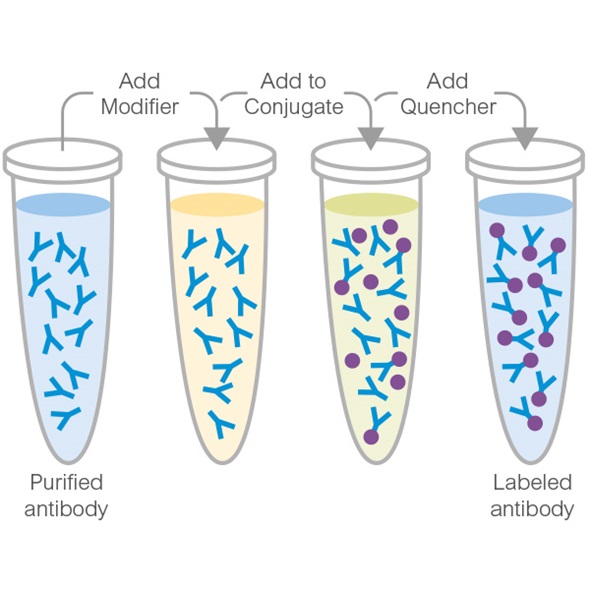
Our carrier-free antibodies are typically supplied in a PBS-only formulation, purified and free of BSA, sodium azide and glycerol. This conjugation-ready format is designed for use with fluorochromes, metal isotopes, oligonucleotides, and enzymes, which makes them ideal for antibody labelling, functional and cell-based assays, flow-based assays (e.g. mass cytometry) and Multiplex Imaging applications.
Use our conjugation kits for antibody conjugates that are ready-to-use in as little as 20 minutes with 1 minute hands-on-time and 100% antibody recovery: available for fluorescent dyes, HRP, biotin and gold.
Compatibility
This product is compatible with the Maxpar® Antibody Labeling Kit from Fluidigm, without the need for antibody preparation. Maxpar® is a trademark of Fluidigm Canada Inc.
특성 및 보관 정보
제형
Purification 테크닉
보관 버퍼
배송 시 보관 조건
적절한 단기 보관 조건
적절한 장기 보관 조건
보관 정보
추가 정보
This supplementary information is collated from multiple sources and compiled automatically.
Biological function summary
ATP5A is essential in cellular respiration serving as a catalytic core of the F1 component of ATP synthase. As part of the multi-subunit enzyme complex ATP synthase is responsible for ATP production the primary energy currency in cells. The ATP5A subunit works in conjunction with other subunits of the enzyme oligomer to facilitate the conversion of energy released during oxidative phosphorylation into a usable form. The protein's efficiency in this biological role underpins its importance in sustaining cellular energy homeostasis.
Pathways
ATP5A plays a pivotal role in oxidative phosphorylation and the electron transport chain integral components of cellular respiration. The oxidative phosphorylation pathway depends on this protein to manage the synthesis of ATP molecules while the electron transport chain creates the proton gradient necessary for ATP production. ATP5A is functionally connected to other proteins in these pathways such as ATP5B and cytochrome c oxidase working in a coordinated manner to ensure efficient energy transfer and maintenance.
제품 프로토콜
- Visit the General protocols
- Visit the Troubleshooting
타겟 정보
대체 명칭 보기
제품이 사용된 논문 (3)
Recent publications for all applications. Explore the 전체 목록and refine your search
Nature 644:790-798 PubMed40533564
2025
Applications
Flow Cyt
Species
Mouse
The Journal of clinical investigation 134: PubMed38954588
2024
Applications
Unspecified application
Species
Unspecified reactive species
Nature communications 14:5627 PubMed37699869
2023
Applications
Flow Cyt (Intra)
Species
Mouse
Product promise
Please note: All products are 'FOR RESEARCH USE ONLY. NOT FOR USE IN DIAGNOSTIC OR THERAPEUTIC PROCEDURES'.
For licensing inquiries, please contact partnerships@abcam.com