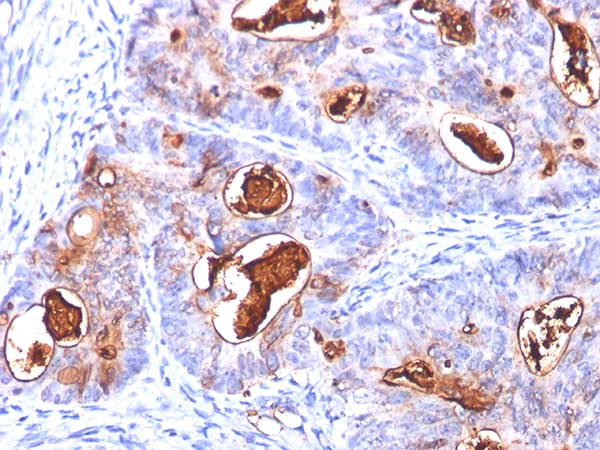
- IHC-P
Supplier Data
Immunohistochemistry (Formalin/PFA-fixed paraffin-embedded sections) - Anti-CEACAM5 antibody [COL-1 + CEA31 + C66/26] (AB201328)
Immunohistochemical analysis of formalin-fixed, paraffin-embedded Human colon carcinoma tissue labeling Carcino Embryonic Antigen CEA with ab201328 at 2 μg/ml.
대체품
Primary Antibodies
AB207718
Anti-CEACAM5 + CD66b + CEACAM1 + CEACAM6 antibody [EPR20721]
BOND RX™ Validated|RabMAb|Recombinant|20ul selling size

- 0
- 0
Primary Antibodies
AB133633
Anti-CEACAM5 antibody [EPCEAR7]
BOND RX™ Validated|KO Validated|RabMAb|Recombinant|20ul selling size

- 0
- 0

Primary Antibodies
AB229074
Anti-CEACAM5 + CD66b + CEACAM1 + CEACAM6 antibody [EPR20721] - BSA and Azide free
BOND RX™ Validated|RabMAb|Recombinant

- 0
- 0
Primary Antibodies
AB4451
Anti-CEACAM5 antibody [26/3/13] - BSA and Azide free
BOND RX™ Validated|Recombinant

- 1
- 2
보완 제품

Primary Antibodies
AB255607
Anti-ErbB3 / HER3 antibody [EPR22669-25]
20ul selling size|RabMAb|Recombinant|KO Validated

- 0
- 0
Primary Antibodies
AB227637
Anti-Met (c-Met) antibody [SP44] - C-terminal
RabMAb|Recombinant|KO Validated|20ul selling size

- 5
- 1
Primary Antibodies
AB229902
Anti-DLL3 antibody [EPR22592-18]
20ul selling size|BOND RX™ Validated|RabMAb|Recombinant

- 0
- 0
Primary Antibodies
AB214488
Anti-TROP2 antibody [EPR20043]
20ul selling size|BOND RX™ Validated|KO Validated|RabMAb|Recombinant

- 5
- 9
Reactivity 정보
제품 세부 정보
Isotype - IgG2a (COL-1) + IgG1 (CEA31 &; C66/261).
What is an oligoclonal antibody?
This oligoclonal antibody is a cocktail of monoclonal antibodies that have been carefully selected. Oligoclonal antibodies have not only the specificity and batch-to-batch consistency of a monoclonal antibody, but also have the advantage of the sensitivity of a polyclonal antibody due to their ability to recognize multiple epitopes on an antigen.
특성 및 보관 정보
제형
Purification 테크닉
Purification 관련 사항
보관 버퍼
배송 시 보관 조건
적절한 단기 보관 기간
적절한 단기 보관 조건
적절한 장기 보관 조건
분주 정보
보관 정보
추가 정보
This supplementary information is collated from multiple sources and compiled automatically.
Biological function summary
CEACAM5 contributes to cellular processes involving cell adhesion and immune response modulation. This protein operates as part of a larger group of cell adhesion molecules and does not function as part of a complex. CEACAM5 can affect the interactions between cells and the extracellular matrix which has implications for tissue structuring and integrity. It helps the immune system recognize and respond to infectious agents or cellular anomalies.
Pathways
CEACAM5 involvement extends to immune response regulation and cell adhesion pathways. It interacts functionally with proteins like E-cadherin in these pathways which contribute to maintaining epithelial integrity. These pathways are critical for normal tissue maintenance and immune system function especially in mucosal surfaces where pathogen entry occurs. Understanding CEACAM5 interactions provides insight into cellular communication and adhesion mechanisms.
제품 프로토콜
- Visit the General protocols
- Visit the Troubleshooting
타겟 정보
대체 명칭 보기
제품이 사용된 논문 (1)
Recent publications for all applications. Explore the 전체 목록and refine your search
PLoS biology 23:e3002881 PubMed40163536
2025
Applications
Unspecified application
Species
Unspecified reactive species
Product promise
Please note: All products are 'FOR RESEARCH USE ONLY. NOT FOR USE IN DIAGNOSTIC OR THERAPEUTIC PROCEDURES'.
For licensing inquiries, please contact partnerships@abcam.com