- Flow Cyt
Unknown
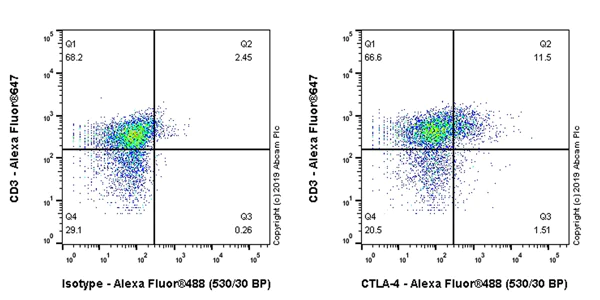
Flow Cytometry - Anti-CTLA4 antibody [EPR22860-65] (AB216338)
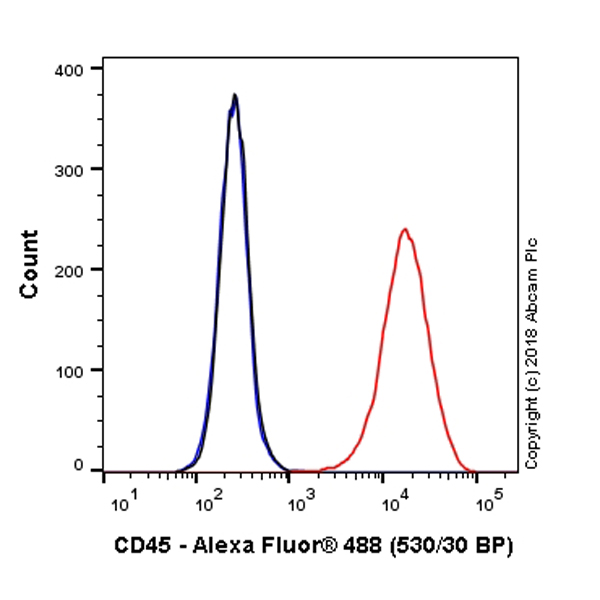
Flow cytometric analysis of human peripheral blood mononuclear cells (PBMC) treated with 10 μg/ml phytohemagglutinin (PHA) for 2 days labeling CTLA4 with ab216338 at 1/500 Right panel, compared with a Rabbit monoclonal IgG (ab172730) / Left panel isotype control. Goat anti rabbit IgG (Alexa Fluor® 488, ab150077) at 1/2000 was used as the secondary antibody.
Cells were stained with rabbit IgG (Left) or ab216338 (Right). Then stained with anti-CD3 conjugated to Alexa Fluor® 647.
Gated on viable cells.
관련 conjugated 항체와 다양한 조성의 항체 (2)
-
Anti-CTLA4 antibody [EPR22860-65] - BSA and Azide free
-
578 PE
PE Anti-CTLA-4 antibody [EPR22860-65]
대체품
Primary Antibodies
AB251599
Anti-CTLA4 antibody [CAL49] - BSA and Azide free
BOND RX™ Validated|RabMAb|Recombinant

- 4
- 4
Primary Antibodies
AB237712
20ul selling size|BOND RX™ Validated|RabMAb|Recombinant

- 4
- 5
Primary Antibodies
AB283489
Alexa Fluor® 555 Anti-CTLA4 antibody [CAL49]
BOND RX™ Validated|RabMAb|Recombinant
- 5
- 2
보완 제품
Primary Antibodies
AB237365
Alexa Fluor® 647 Anti-CD8 alpha antibody [EPR21769]
BOND RX™ Validated|RabMAb|Recombinant

- 0
- 0
Primary Antibodies
AB133616
BOND RX™ Validated|RabMAb|Recombinant|Lab Essentials|20ul selling size
- 5
- 20
Reactivity 정보
제품 세부 정보
Patented technology
Our RabMAb® technology is a patented hybridoma-based technology for making rabbit monoclonal antibodies. For details on our patents, please refer to RabMAb® patents.
What are the advantages of a recombinant monoclonal antibody?
This product is a recombinant monoclonal antibody, which offers several advantages including:
- - High batch-to-batch consistency and reproducibility
- - Improved sensitivity and specificity
- - Long-term security of supply
- - Animal-free batch production
For more information, read more on recombinant antibodies.
특성 및 보관 정보
제형
Purification 테크닉
보관 버퍼
배송 시 보관 조건
적절한 단기 보관 기간
적절한 단기 보관 조건
적절한 장기 보관 조건
분주 정보
보관 정보
추가 정보
This supplementary information is collated from multiple sources and compiled automatically.
Biological function summary
The CTLA-4 protein functions as a critical regulator of the immune system. It interacts with CD80/CD86 in a complex that effectively transmits inhibitory signals to T-cells. CTLA-4 controls the amplitude of the initial activation of T-cells ensuring that the body's immune responses are kept under control. In regulatory T-cells CTLA-4 engagement contributes to their immunosuppressive functions through which they maintain tolerance to self-antigens and prevent overactive immune reactions.
Pathways
CTLA-4 involves itself in the adaptive immune response pathways specifically the regulation of T-cell activity. CTLA-4's interaction with CD80/CD86 modulates pathways associated with TCR (T-cell receptor) signaling. When CTLA-4 binds its ligands it recruits phosphatases such as SHP-2 that dephosphorylate signaling proteins leading to the downregulation of T-cell interaction. This pathway interaction exemplifies how CTLA-4 acts in concert with proteins like CD28 to finely tune immune responses.
제품 프로토콜
- Visit the General protocols
- Visit the Troubleshooting
타겟 정보
대체 명칭 보기
Product promise
Please note: All products are 'FOR RESEARCH USE ONLY. NOT FOR USE IN DIAGNOSTIC OR THERAPEUTIC PROCEDURES'.
For licensing inquiries, please contact partnerships@abcam.com