- WB
Lab
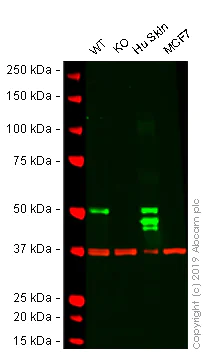
Western blot - Anti-Cytokeratin 14 antibody [EPR17336] - BSA and Azide free (AB251249)
This data was developed using the same antibody clone in a different buffer formulation (ab197893).
Lanes 1 - 4 : Merged signal (red and green). Green - ab197893 observed at 52 kDa. Red - loading control, ab8245 (Mouse anti-GAPDH antibody [6C5]) observed at 37kDa.
ab197893 was shown to react with KRT14 in A431 wild-type cells in Western blot. Loss of signal was observed when KRT14 knockout sample was used. A431 wild-type and KRT14 knockout cell lysates were subjected to SDS-PAGE. Membranes were blocked in 3% Milk in TBS-T (0.1% Tween®) before incubation with ab197893 and ab8245 (Mouse anti-GAPDH antibody [6C5]) overnight at 4°C at a 1 in 50000 dilution and a 1 in 20000 dilution respectively. Blots were developed with Goat anti-Rabbit IgG H&L (IRDye® 800CW) preabsorbed (ab216773) and Goat anti-Mouse IgG H&L (IRDye® 680RD) preabsorbed (ab216776) secondary antibodies at 1 in 20000 dilution for 1 hour at room temperature before imaging.
All lanes:
Western blot - Anti-Cytokeratin 14 antibody [EPR17336] (<a href='/ko/products/primary-antibodies/cytokeratin-14-antibody-epr17336-ab197893'>ab197893</a>) at 1/50000 dilution
Lane 1:
Wild-type A-431 (Human epidermoid carcinoma cell line) whole cell lysate at 20 µg
Lane 2:
KRT14 knockout A-431 (Human epidermoid carcinoma cell line) whole cell lysate at 20 µg
Lane 2:
Western blot - Human KRT14 (Cytokeratin 14) knockout A-431 cell line (<a href='/ko/products/cell-lines/human-krt14-cytokeratin-14-knockout-a-431-cell-line-ab261897'>ab261897</a>)
Lane 3:
Human skin whole tissue lysate at 20 µg
Lane 4:
MCF7 (Human breast adenocarcinoma cell line) whole cell lysate at 20 µg
Predicted band size: 52 kDa
Observed band size: 52 kDa
false
관련 conjugated 항체와 다양한 조성의 항체 (1)
-
Anti-Cytokeratin 14 antibody [EPR17336]
보완 제품
Primary Antibodies
AB76318
Anti-Cytokeratin 10 antibody [EP1607IHCY] - Cytoskeleton Marker
20ul selling size|RabMAb|Recombinant|Lab Essentials

- 5
- 14
Primary Antibodies
AB52635
Anti-Cytokeratin 5 antibody [EP1601Y] - Cytoskeleton Marker
BOND RX™ Validated|RabMAb|Recombinant|Lab Essentials

- 5
- 11


Reactivity 정보
제품 세부 정보
ab251249 is the carrier-free version of ab197893.
Patented technology
Our RabMAb® technology is a patented hybridoma-based technology for making rabbit monoclonal antibodies. For details on our patents, please refer to RabMAb® patents.
What are the advantages of a recombinant monoclonal antibody?
This product is a recombinant monoclonal antibody, which offers several advantages including:
- - High batch-to-batch consistency and reproducibility
- - Improved sensitivity and specificity
- - Long-term security of supply
- - Animal-free batch production
For more information, read more on recombinant antibodies.
Conjugation ready
Our carrier-free antibodies are typically supplied in a PBS-only formulation, purified and free of BSA, sodium azide and glycerol. This conjugation-ready format is designed for use with fluorochromes, metal isotopes, oligonucleotides, and enzymes, which makes them ideal for antibody labelling, functional and cell-based assays, flow-based assays (e.g. mass cytometry) and Multiplex Imaging applications.
Use our conjugation kits for antibody conjugates that are ready-to-use in as little as 20 minutes with 1 minute hands-on-time and 100% antibody recovery: available for fluorescent dyes, HRP, biotin and gold.
Compatibility
This product is compatible with the Maxpar® Antibody Labeling Kit from Fluidigm, without the need for antibody preparation. Maxpar® is a trademark of Fluidigm Canada Inc.
특성 및 보관 정보
제형
Purification 테크닉
보관 버퍼
배송 시 보관 조건
적절한 단기 보관 조건
적절한 장기 보관 조건
보관 정보
추가 정보
This supplementary information is collated from multiple sources and compiled automatically.
Biological function summary
This protein significantly contributes to the maintenance and regeneration of epithelial tissues by forming a network of filaments with keratin 5. KRT14 pairs with keratin 5 to create a keratin intermediate filament complex which plays a structural role in the resilience and elasticity of epithelial tissues. This partnership is essential for the assembly of the cytoskeleton and supports the protective barrier function of the skin and related tissues.
Pathways
Cytokeratin 14 engages in pivotal cellular processes like keratinization and wound healing. The protein is actively involved in signal transduction pathways such as the epithelial cell differentiation pathway. Within these pathways KRT14 collaborates with KRT5 and other structural proteins to regulate cell proliferation and differentiation reflecting its importance in skin health and function.
제품 프로토콜
- Visit the General protocols
- Visit the Troubleshooting
타겟 정보
대체 명칭 보기
Product promise
Please note: All products are 'FOR RESEARCH USE ONLY. NOT FOR USE IN DIAGNOSTIC OR THERAPEUTIC PROCEDURES'.
For licensing inquiries, please contact partnerships@abcam.com