JavaScript is disabled in your browser. Please enable JavaScript to view this website.
AB327088

Anti-DLL1 antibody [EPR29655-26]

Be the first to review this product! 리뷰 제출

|

(0 출판물)
Rabbit Recombinant Monoclonal DLL1 antibody. Suitable for WB, ICC/IF and reacts with Transfected cell lysate - Human, Human, Mouse, Transfected cell line - Human samples.
5 이미지
Immunocytochemistry/ Immunofluorescence - Anti-DLL1 antibody [EPR29655-26] (AB327088)
  • ICC/IF

Lab

Immunocytochemistry/ Immunofluorescence - Anti-DLL1 antibody [EPR29655-26] (AB327088)

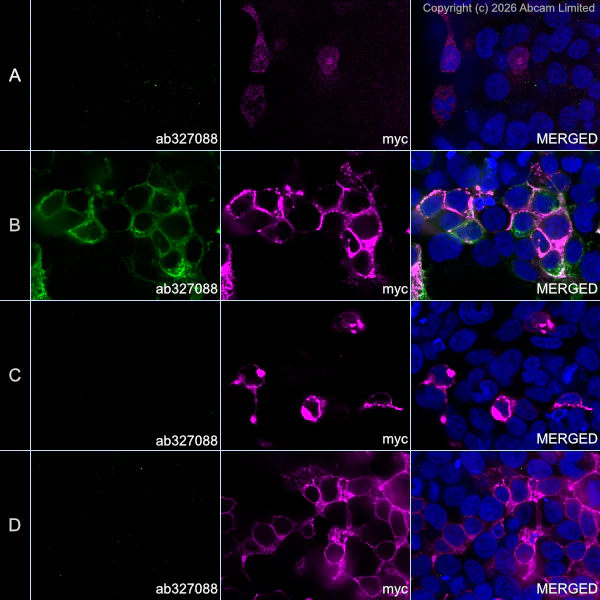
Immunofluorescent analysis of 4% Paraformaldehyde-fixed, 0.1% TritonX-100 permeabilized HEK-293T cells transfected with an empty expression vector containing a myc-His-tag® HEK-293T cells transfected with a human Dll1 expression vector containing a myc-His-tag® HEK-293T cells transfected with a human Dll3 expression vector containing a myc-His-tag® HEK-293T cells transfected with a human Dll4 expression vector containing a myc-His-tag® cells labelling DLL1 with ab327088 at 1/1000 (0.509 μg/ml) dilution , followed by ab150081 Goat Anti-Rabbit IgG H&L (Alexa Fluor® 488) preadsorbed antibody at 1/1000 dilution (Green).

Confocal image showing positive staining in HEK-293T cells transfected with a human Dll1 expression vector containing a myc-His-tag®(shown in green). The counterstain was observed in magenta. Nuclear DNA was labelled with DAPI (shown in blue). A : HEK-293T cells transfected with an empty expression vector containing a myc-His-tag®. B : HEK-293T cells transfected with a human Dll1 expression vector containing a myc-His-tag®. C : HEK-293T cells transfected with a human Dll3 expression vector containing a myc-His-tag®. D : HEK-293T cells transfected with a human Dll4 expression vector containing a myc-His-tag®. Image was taken with a confocal microscope (Leica-Microsystems, TCS SP8).

ab223894 Anti-Myc tag mouse monoclonal antibody (Alexa Fluor® 594) was used to counterstain tubulin at 1/100 dilution (Magenta). The Nuclear counterstain was DAPI (Blue).

Secondary antibody only control : Secondary antibody is ab150081 Goat Anti-Rabbit IgG H&L (Alexa Fluor® 488) preadsorbed at 1/1000 dilution.
Immunocytochemistry/ Immunofluorescence - Anti-DLL1 antibody [EPR29655-26] (AB327088)
  • ICC/IF

Lab

Immunocytochemistry/ Immunofluorescence - Anti-DLL1 antibody [EPR29655-26] (AB327088)

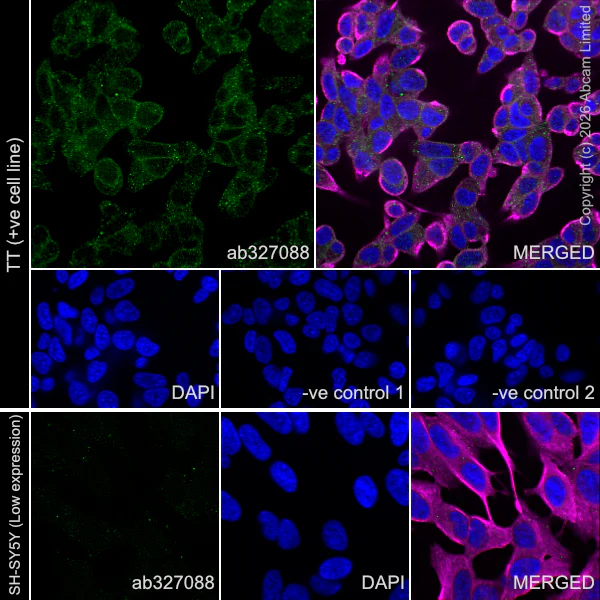
Immunofluorescent analysis of 4% Paraformaldehyde-fixed, 0.1% TritonX-100 permeabilized TT (human thyroid carcinoma epithelial cell) SH-SY5Y (human neuroblastoma epithelial cell) cells labelling DLL1 with ab327088 at 1/50 (10.18 μg/ml) dilution , followed by ab150081 Goat Anti-Rabbit IgG H&L (Alexa Fluor® 488) preadsorbed antibody at 1/1000 dilution (Green).

Confocal image showing membranous and cytoplasmic staining in TT cells and no staining in SH-SY5Y cells (shown in green). The counterstain was observed in magenta. Nuclear DNA was labelled with DAPI (shown in blue). Low expression : SH-SY5Y (PMID : 28525978). Image was taken with a confocal microscope (Leica-Microsystems, TCS SP8).

ab7291 Anti-alpha Tubulin mouse monoclonal antibody was used to counterstain tubulin at 1/1000 dilution (Magenta). The Nuclear counterstain was DAPI (Blue).

-ve control 1 : ab327088 at 1/50 dilution, followed by ab150120 at 1/1000 dilution.-ve control 2 : ab7291 at 1/1000 dilution, followed by ab150081 at 1/1000 dilution.
Western blot - Anti-DLL1 antibody [EPR29655-26] (AB327088)
  • WB

Lab

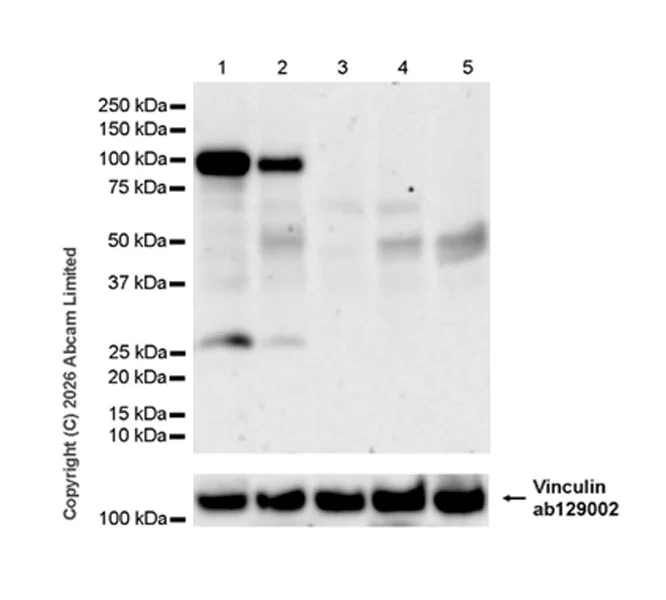
Western blot - Anti-DLL1 antibody [EPR29655-26] (AB327088)

Blocking and diluting buffer and concentration : 5% NFDM/TBST.

Low expression : SH-SY5Y (PMID : 28525978), SW620, AsPC-1.

The molecular weight observed is consistent with what has been described in the literature (PMID : 12794186).

In Western blot, Anti-Vinculin antibody [EPR8185] (ab129002) (1 : 10000) (124KDa).

All lanes:

Western blot - Anti-DLL1 antibody [EPR29655-26] (ab327088) at 1/1000 dilution

Lane 1:

TT (human thyroid carcinoma epithelial cell) whole cell lysate at 20 µg

Lane 2:

FaDu (human pharyngeal carcinoma epithelial cell) whole cell lysate at 20 µg

Lane 3:

SH-SY5Y (human neuroblastoma epithelial cell) whole cell lysate at 20 µg

Lane 4:

SW620 (human colorectal adenocarcinoma epithelial cell) whole cell lysate at 20 µg

Lane 5:

AsPC-1 (human Pancreas epithelial cell) whole cell lysate at 20 µg

Secondary

All lanes:

Western blot - Goat Anti-Rabbit IgG H&L (HRP) (<a href='/ko/products/secondary-antibodies/goat-rabbit-igg-h-l-hrp-ab97051'>ab97051</a>) at 1/20000 dilution

Observed band size: 85 kDa,30 kDa,124 kDa

false

Exposure time: 180s
Western blot - Anti-DLL1 antibody [EPR29655-26] (AB327088)
  • WB

Lab

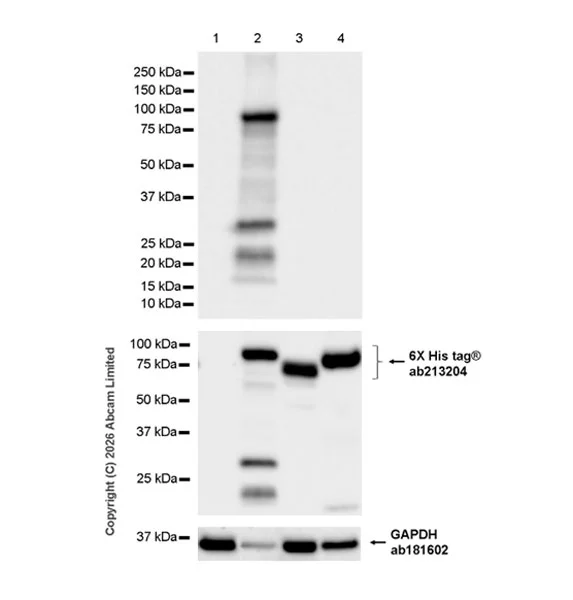
Western blot - Anti-DLL1 antibody [EPR29655-26] (AB327088)

Blocking and diluting buffer and concentration : 5% NFDM/TBST.

This antibody does not cross-react with overexpressed human DLL3 or DLL4 by western blot.

In Western blot, Anti-6X His tag® antibody [EPR20547] - ChIP Grade (ab213204) (1 : 5000)(85, 30KDa); Anti-GAPDH antibody [EPR16891] - Loading Control (ab181602) (1 : 200000) (36KDa).

All lanes:

Western blot - Anti-DLL1 antibody [EPR29655-26] (ab327088) at 1/1000 dilution

Lane 1:

293T (human embryonic kidney epithelial cell) cells transfected with an empty vector containing a myc-His-tag® whole cell lysate at 20 µg

Lane 2:

293T cells transfected with a human DLL1 expression vector containing a myc-His-tag® whole cell lysate at 20 µg

Lane 3:

293T cells transfected with a human DLL3 expression vector containing a myc-His-tag® whole cell lysate at 20 µg

Lane 4:

293T cells transfected with a human DLL4 expression vector containing a myc-His-tag® whole cell lysate at 20 µg

Secondary

All lanes:

Western blot - Goat Anti-Rabbit IgG H&L (HRP) (<a href='/ko/products/secondary-antibodies/goat-rabbit-igg-h-l-hrp-ab97051'>ab97051</a>) at 1/20000 dilution

Observed band size: 85 kDa,30 kDa,36 kDa

false

Exposure time: 8s
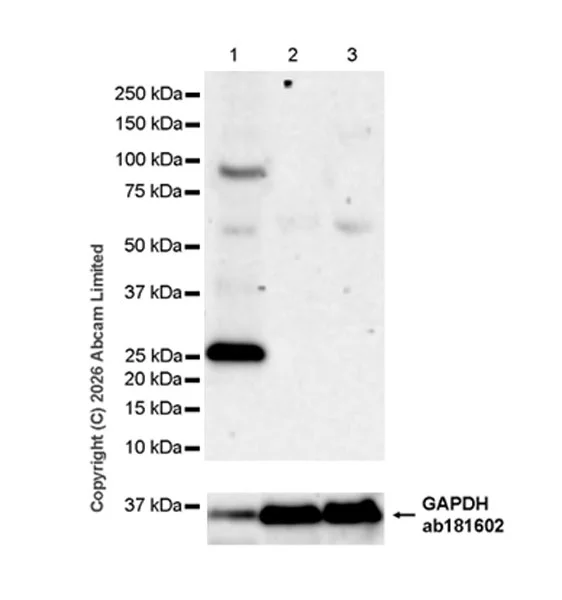
Western blot - Anti-DLL1 antibody [EPR29655-26] (AB327088)
  • WB

Lab

Western blot - Anti-DLL1 antibody [EPR29655-26] (AB327088)

Blocking and diluting buffer and concentration : 5% NFDM/TBST.

Low expression : NIH/3T3, EL4.

In Western blot, Anti-GAPDH antibody [EPR16891] - Loading Control (ab181602) (1 : 200000) (36KDa).

All lanes:

Western blot - Anti-DLL1 antibody [EPR29655-26] (ab327088) at 1/1000 dilution

Lane 1:

bEnd.3 (mouse brain endothelial cell) whole cell lysate at 20 µg

Lane 2:

NIH/3T3 (mouse embryonic fibroblast) whole cell lysate at 20 µg

Lane 3:

EL4 (mouse lymphoma t lymphocyte) whole cell lysate at 20 µg

Secondary

All lanes:

Western blot - Goat Anti-Rabbit IgG H&L (HRP) (<a href='/ko/products/secondary-antibodies/goat-rabbit-igg-h-l-hrp-ab97051'>ab97051</a>) at 1/20000 dilution

Observed band size: 85 kDa,30 kDa,36 kDa

false

Exposure time: 180s

주요 정보

Host species

Rabbit

Clonality

Monoclonal

Clone number

EPR29655-26

Isotype

IgG

Carrier free

No

Reacts with

Human, Mouse

Applications

WB, ICC/IF

applications

Immunogen

The exact immunogen used to generate this antibody is proprietary information.

Specificity

Unsuitable for mouse ICC

Reactivity 정보

{ "title": "Reactivity Data", "filters": { "stats": ["", "Species", "Dilution Info", "Notes"], "tabs": { "all-applications": {"fullname" : "All Applications", "shortname": "All Applications"}, "WB" : {"fullname" : "Western blot", "shortname":"WB"}, "ICCIF" : {"fullname" : "Immunocytochemistry/ Immunofluorescence", "shortname":"ICC/IF"}, "IHCP" : {"fullname" : "Immunohistochemistry (Formalin/PFA-fixed paraffin-embedded sections)", "shortname":"IHC-P"} }, "product-promise": { "all": "all", "testedAndGuaranteed": "tested", "guaranteed": "expected", "predicted": "predicted", "notRecommended": "not-recommended" } }, "values": { "Human": { "WB-species-checked": "testedAndGuaranteed", "WB-species-dilution-info": "1/1000", "WB-species-notes": "<p></p>", "ICCIF-species-checked": "testedAndGuaranteed", "ICCIF-species-dilution-info": "1/50", "ICCIF-species-notes": "<p></p>", "IHCP-species-checked": "notRecommended", "IHCP-species-dilution-info": "", "IHCP-species-notes": "<p></p>" }, "Mouse": { "WB-species-checked": "testedAndGuaranteed", "WB-species-dilution-info": "1/1000", "WB-species-notes": "<p></p>", "ICCIF-species-checked": "notRecommended", "ICCIF-species-dilution-info": "", "ICCIF-species-notes": "<p></p>", "IHCP-species-checked": "notRecommended", "IHCP-species-dilution-info": "", "IHCP-species-notes": "<p></p>" }, "Transfected cell line - Human": { "WB-species-checked": "notRecommended", "WB-species-dilution-info": "", "WB-species-notes": "", "ICCIF-species-checked": "testedAndGuaranteed", "ICCIF-species-dilution-info": "1/1000", "ICCIF-species-notes": "<p></p>", "IHCP-species-checked": "notRecommended", "IHCP-species-dilution-info": "", "IHCP-species-notes": "" }, "Transfected cell lysate - Human": { "WB-species-checked": "testedAndGuaranteed", "WB-species-dilution-info": "1/1000", "WB-species-notes": "<p></p>", "ICCIF-species-checked": "notRecommended", "ICCIF-species-dilution-info": "", "ICCIF-species-notes": "", "IHCP-species-checked": "notRecommended", "IHCP-species-dilution-info": "", "IHCP-species-notes": "" } } }

제품 세부 정보

Patented technology
Our RabMAb® technology is a patented hybridoma-based technology for making rabbit monoclonal antibodies. For details on our patents, please refer to RabMAb® patents.

What are the advantages of a recombinant monoclonal antibody?
This product is a recombinant monoclonal antibody, which offers several advantages including:

  • - High batch-to-batch consistency and reproducibility
  • - Improved sensitivity and specificity
  • - Long-term security of supply
  • - Animal-free batch production

For more information, read more on recombinant antibodies.

특성 및 보관 정보

제형
Liquid
Purification 테크닉
Affinity purification Protein A
보관 버퍼
pH: 7.2 - 7.4 Preservative: 0.01% Sodium azide Constituents: PBS, 40% Glycerol (glycerin, glycerine), 0.05% BSA
배송 시 보관 조건
Conditional Ambient
적절한 단기 보관 기간
1-2 weeks
적절한 단기 보관 조건
+4°C
적절한 장기 보관 조건
-20°C
분주 정보
Upon delivery aliquot
보관 정보
Avoid freeze / thaw cycle

제품 프로토콜

For this product, it's our understanding that no specific protocols are required. You can visit:

타겟 정보

Transmembrane ligand protein of NOTCH1, NOTCH2 and NOTCH3 receptors that binds the extracellular domain (ECD) of Notch receptor in a cis and trans fashion manner (PubMed : 11006133). Following transinteraction, ligand cells produce mechanical force that depends of a clathrin-mediated endocytosis, requiring ligand ubiquitination, EPN1 interaction, and actin polymerisation; these events promote Notch receptor extracellular domain (NECD) transendocytosis and triggers Notch signaling through induction of cleavage, hyperphosphorylation, and nuclear accumulation of the intracellular domain of Notch receptors (NICD) (By similarity). Is required for embryonic development and maintenance of adult stem cells in many different tissues and immune systeme; the DLL1-induced Notch signaling is mediated through an intercellular communication that regulates cell lineage, cell specification, cell patterning and morphogenesis through effects on differentiation and proliferation (PubMed : 11581320). Plays a role in brain development at different level, namely by regulating neuronal differentiation of neural precursor cells via cell-cell interaction, most likely through the lateral inhibitory system in an endogenous level dependent-manner. During neocortex development, Dll1-Notch signaling transmission is mediated by dynamic interactions between intermediate neurogenic progenitors and radial glia; the cell-cell interactions are mediated via dynamic and transient elongation processes, likely to reactivate/maintain Notch activity in neighboring progenitors, and coordinate progenitor cell division and differentiation across radial and zonal boundaries. During cerebellar development, regulates Bergmann glial monolayer formation and its morphological maturation through a Notch signaling pathway. At the retina and spinal cord level, regulates neurogenesis by preventing the premature differentiation of neural progenitors and also by maintaining progenitors in spinal cord through Notch signaling pathway. Also controls neurogenesis of the neural tube in a progenitor domain-specific fashion along the dorsoventral axis. Maintains quiescence of neural stem cells and plays a role as a fate determinant that segregates asymmetrically to one daughter cell during neural stem cells mitosis, resulting in neuronal differentiation in Dll1-inheriting cell. Plays a role in immune systeme development, namely the development of all T-cells and marginal zone (MZ) B-cells (By similarity). Blocks the differentiation of progenitor cells into the B-cell lineage while promoting the emergence of a population of cells with the characteristics of a T-cell/NK-cell precursor (PubMed : 11581320). Also plays a role during muscle development. During early development, inhibits myoblasts differentiation from the medial dermomyotomal lip and later regulates progenitor cell differentiation. Directly modulates cell adhesion and basal lamina formation in satellite cells through Notch signaling. Maintains myogenic progenitors pool by suppressing differentiation through down-regulation of MYOD1 and is required for satellite cell homing and PAX7 expression. During craniofacial and trunk myogenesis suppresses differentiation of cranial mesoderm-derived and somite-derived muscle via MYOD1 regulation but in cranial mesoderm-derived progenitors, is neither required for satellite cell homing nor for PAX7 expression. Also plays a role during pancreatic cell development. During type B pancreatic cell development, may be involved in the initiation of proximodistal patterning in the early pancreatic epithelium. Stimulates multipotent pancreatic progenitor cells proliferation and pancreatic growth by maintaining HES1 expression and PTF1A protein levels. During fetal stages of development, is required to maintain arterial identity and the responsiveness of arterial endothelial cells for VEGFA through regulation of KDR activation and NRP1 expression. Controls sprouting angiogenesis and subsequent vertical branch formation through regulation on tip cell differentiation. Negatively regulates goblet cell differentiation in intestine and controls secretory fat commitment through lateral inhibition in small intestine. Plays a role during inner ear development; negatively regulates auditory hair cell differentiation. Plays a role during nephron development through Notch signaling pathway. Regulates growth, blood pressure and energy homeostasis (By similarity).
See full target information DLL1

대체 명칭 보기

UNQ146/PRO172, DLL1, Delta-like protein 1, Drosophila Delta homolog 1, Delta1, H-Delta-1

Product promise

저희는 고품질 시약으로 고객님의 연구를 서포트하고자 최선을 다하고 있으며, 모든 단계에서 함께 하겠습니다. 만약 제품이 기대한 성능을 보이지 않을 경우에도 Product Promise로 보호받으실 수 있습니다.
자세한 내용은 이용 약관을 확인해 주세요.

Please note: All products are 'FOR RESEARCH USE ONLY. NOT FOR USE IN DIAGNOSTIC OR THERAPEUTIC PROCEDURES'.

For licensing inquiries, please contact partnerships@abcam.com