Anti-EGFR (phospho Y992) antibody
- Lab Essentials
- 각 태그의 뜻
Be the first to review this product! 리뷰 제출
|
(3 제품이 사용된 논문 )
- IHC-P
Supplier Data
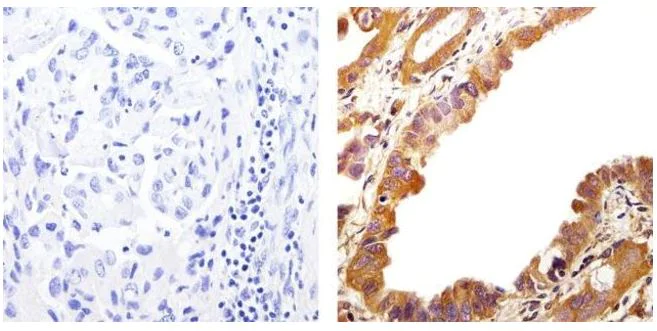
Immunohistochemistry (Formalin/PFA-fixed paraffin-embedded sections) - Anti-EGFR (phospho Y992) antibody (AB5638)
Immunohistochemistry analysis of EGFR (pY992) with ab5638 at 1/20 dilution showing staining in the cytoplasm and membrane of paraffin-embedded human lung adenocarcinoma (right) compared to a negative control without primary antibody (left).
Antigen retrieval was performed using 10mM sodium citrate (pH 6.0), microwaved for 8-15 min.
- IHC-P
Supplier Data
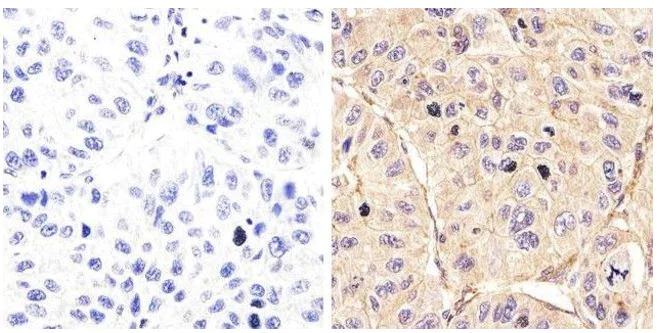
Immunohistochemistry (Formalin/PFA-fixed paraffin-embedded sections) - Anti-EGFR (phospho Y992) antibody (AB5638)
Immunohistochemistry analysis of EGFR (pY992) with ab5638 at 1/20 dilution showing staining in the cytoplasm and membrane of paraffin-embedded human hepatocellular carcinoma (right) compared to a negative control without primary antibody (left).
Antigen retrieval was performed using 10mM sodium citrate (pH 6.0), microwaved for 8-15 min.
- ICC
Supplier Data
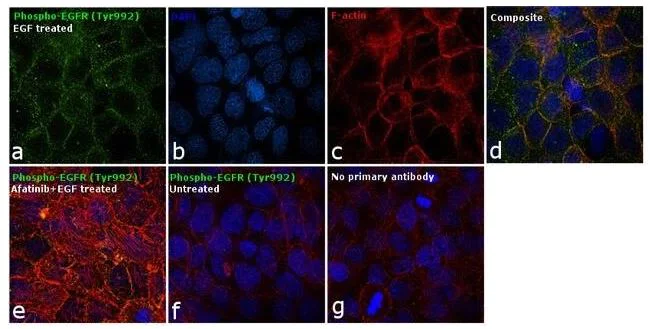
Immunocytochemistry - Anti-EGFR (phospho Y992) antibody (AB5638)
Immunocytochemical analysis of EGFR [pY992] was performed using A-431 cells treated with 200 ng/mL of EGF for 10 minutes. The cells were fixed with 4% paraformaldehyde, permeabilized with 0.1% Triton™ X-100, and blocked with 1% BSA. The cells were labeled with ab5638 at 1/250 dilution and incubated overnight at 4°C followed by a Goat anti-Mouse IgG (H+L) Secondary Antibody, Alexa Fluor® 488 conjugate at a dilution of 1/2000 for 45 minutes at room temperature (Panel a : green). Nuclei (Panel b : blue) DAPI (Panel c : red) F-actin was stained with Rhodamine Phalloidin at 1/300. Panel d represents the merged image showing membranous localization. Panel e represents cells treated with antagonist, Afatinib (1μM for 6hrs) followed by EGF (200 ng/mL for 10 minutes), showing reduced Phospho-EGFR staining. Panel f shows untreated cells with no signal. Panel g represents control cells with no primary antibody to assess background.
- WB
Supplier Data
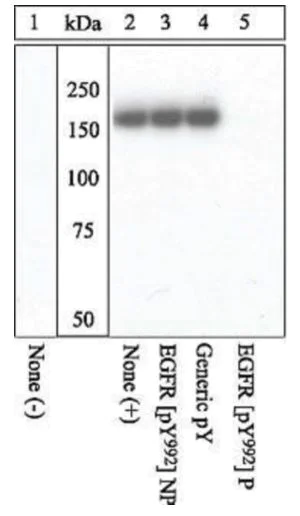
Western blot - Anti-EGFR (phospho Y992) antibody (AB5638)
All lanes:
Western blot - Anti-EGFR (phospho Y992) antibody (ab5638) at 1/1000 dilution
Lane 1:
A431 cells unstimulated
Lanes 2 - 5:
A431 cells stimulated with 200 ng/mL EGF for 15 minutes
Predicted band size: 134 kDa
false
대체품
Primary Antibodies
AB32578
Anti-EGFR (phospho Y1173) antibody [E124]
RabMAb|Recombinant|Lab Essentials|20ul selling size

- 0
- 0
Primary Antibodies
AB40815
Anti-EGFR (phospho Y1068) antibody [EP774Y]
RabMAb|Recombinant|Lab Essentials|20ul selling size

- 4
- 14
Primary Antibodies
AB76153
RabMAb|Recombinant|Lab Essentials|20ul selling size|KO Validated

- 0
- 0
Primary Antibodies
AB32430
Anti-EGFR (phospho Y1068) antibody [Y38]
RabMAb|Recombinant|Lab Essentials|20ul selling size

- 0
- 0
Primary Antibodies
AB32077
BOND RX™ Validated|KO Validated|RabMAb|Recombinant|Lab Essentials|20ul selling size

- 5
- 4
Primary Antibodies
AB32562
BOND RX™ Validated|RabMAb|Recombinant|Lab Essentials|20ul selling size

- 0
- 0
Primary Antibodies
AB227737
Anti-EGFR (deleted E746 + L747 + R748 + E749 + A750) antibody [SP111]
RabMAb|Recombinant|Lab Essentials|20ul selling size

- 0
- 0
보완 제품
Primary Antibodies
AB52894
BOND RX™ Validated|KO Validated|RabMAb|Lab Essentials|20ul selling size|Recombinant

- 5
- 24

Primary Antibodies
AB32086
Anti-EGFR (phospho Y1086) antibody [Y39]
RabMAb|Recombinant|Lab Essentials|20ul selling size

- 0
- 0
Primary Antibodies
AB40815
Anti-EGFR (phospho Y1068) antibody [EP774Y]
RabMAb|Recombinant|Lab Essentials|20ul selling size
- 4
- 14
Reactivity 정보
특성 및 보관 정보
제형
Purification 테크닉
Purification 관련 사항
보관 버퍼
배송 시 보관 조건
적절한 단기 보관 조건
적절한 장기 보관 조건
분주 정보
보관 정보
추가 정보
This supplementary information is collated from multiple sources and compiled automatically.
Biological function summary
The EGFR protein plays an important role in cellular communication and signaling processes. EGFR pairs with other receptor family members to form active dimers or even higher-order complexes which in turn initiate intracellular signaling cascades. Through these complexes EGFR influences many processes including cell differentiation and repair. This function of EGFR makes it an integral part of mammalian biology affecting how cells respond to their environment by mediating changes in gene expression.
Pathways
EGFR is a central player in the MAPK and PI3K/Akt signaling pathways. Alongside other protein partners like KRAS and PI3 kinase it contributes to transmitting signals from the cell surface to the nucleus affecting gene transcription and cell behavior. These pathways are important for normal cell growth and division and aberrations in these pathways can lead to excessive or insufficient cell proliferation.
제품 프로토콜
- Visit the General protocols
- Visit the Troubleshooting
타겟 정보
대체 명칭 보기
제품이 사용된 논문 (3)
Recent publications for all applications. Explore the 전체 목록 and refine your search
International archives of allergy and immunology 184:1010-1021 PubMed37336194
2023
Applications
Unspecified application
Species
Unspecified reactive species
Molecular medicine reports 22:3994-4002 PubMed33000220
2020
Applications
Unspecified application
Species
Unspecified reactive species
ACS central science 4:614-623 PubMed29806008
2018
Applications
Unspecified application
Species
Unspecified reactive species
Product promise
Please note: All products are 'FOR RESEARCH USE ONLY. NOT FOR USE IN DIAGNOSTIC OR THERAPEUTIC PROCEDURES'.
For licensing inquiries, please contact partnerships@abcam.com