Anti-Glutamate Receptor 1 (AMPA subtype) antibody [EPR19522] - BSA and Azide free
- RabMAb
- Recombinant
- 각 태그의 뜻
Be the first to review this product! 리뷰 제출
|
(0 출판물)

- IHC-P
Supplier Data
Immunohistochemistry (Formalin/PFA-fixed paraffin-embedded sections) - Anti-Glutamate Receptor 1 (AMPA subtype) antibody [EPR19522] - BSA and Azide free (AB250709)
This data was developed using ab183797, the same antibody clone in a different buffer formulation.
Immunohistochemical analysis of paraffin-embedded Mouse hippocampus tissue labeling Glutamate Receptor 1 (AMPA subtype) with ab183797 at 1/100 dilution, followed by Goat Anti-Rabbit IgG H&L (HRP) (ab97051) at 1/500 dilution. Cytoplasm staining on mouse hippocampus was observed [PMID : 15723058]. Counter stained with Hematoxylin.
Secondary antibody only control : Used PBS instead of primary antibody, secondary antibody is ab97051 at 1/500 dilution.
Perform heat mediated antigen retrieval with Tris/EDTA buffer pH 9.0 before commencing with IHC staining protocol.

- IHC-Fr
Supplier Data
Immunohistochemistry (Frozen sections) - Anti-Glutamate Receptor 1 (AMPA subtype) antibody [EPR19522] - BSA and Azide free (AB250709)
This data was developed using ab183797, the same antibody clone in a different buffer formulation.
Immunohistochemical analysis of 4% paraformaldehyde-fixed, 0.2% Triton X-100 permeabilized frozen Mouse hippocampus tissue labeling Glutamate Receptor 1 (AMPA subtype) with ab183797 at 1/100 dilution, followed by Goat anti-rabbit IgG (Alexa Fluor® 488) (ab150077) secondary antibody at 1/1000 dilution (green). Cytoplasm staining on mouse hippocampus was observed. The nuclear counterstain is DAPI (blue).
Secondary antibody only control : Used PBS instead of primary antibody, secondary antibody is ab150077 secondary antibody at 1/1000 dilution.

- IHC-P
Supplier Data
Immunohistochemistry (Formalin/PFA-fixed paraffin-embedded sections) - Anti-Glutamate Receptor 1 (AMPA subtype) antibody [EPR19522] - BSA and Azide free (AB250709)
This data was developed using ab183797, the same antibody clone in a different buffer formulation.
Immunohistochemical analysis of paraffin-embedded Rat hippocampus tissue labeling Glutamate Receptor 1 (AMPA subtype) with ab183797 at 1/100 dilution, followed by Goat Anti-Rabbit IgG H&L (HRP) (ab97051) at 1/500 dilution. Cytoplasm staining on rat hippocampus is observed [PMID : 15723058]. Counter stained with Hematoxylin.
Secondary antibody only control : Used PBS instead of primary antibody, secondary antibody is ab97051 at 1/500 dilution.
Perform heat mediated antigen retrieval with Tris/EDTA buffer pH 9.0 before commencing with IHC staining protocol.

- IHC-Fr
Supplier Data
Immunohistochemistry (Frozen sections) - Anti-Glutamate Receptor 1 (AMPA subtype) antibody [EPR19522] - BSA and Azide free (AB250709)
This data was developed using ab183797, the same antibody clone in a different buffer formulation.
Immunohistochemical analysis of 4% paraformaldehyde-fixed, 0.2% Triton X-100 permeabilized frozen Mouse hippocampus tissue labeling Glutamate Receptor 1 (AMPA subtype) with ab183797 at 1/100 dilution, followed by Goat Anti-Rabbit IgG (Alexa Fluor® 488) (ab150077) secondary antibody at 1/1000 dilution (green). Cytoplasm staining on mouse hippocampus was observed. The nuclear counterstain is DAPI (blue).
Secondary antibody only control : Used PBS instead of primary antibody, secondary antibody is ab150077 at 1/1000 dilution.

- IHC-P
Supplier Data
Immunohistochemistry (Formalin/PFA-fixed paraffin-embedded sections) - Anti-Glutamate Receptor 1 (AMPA subtype) antibody [EPR19522] - BSA and Azide free (AB250709)
This data was developed using ab183797, the same antibody clone in a different buffer formulation.
Immunohistochemical analysis of paraffin-embedded Rat stomach tissue labeling Glutamate Receptor 1 (AMPA subtype) with ab183797 at 1/100 dilution, followed by Goat Anti-Rabbit IgG H&L (HRP) (ab97051) at 1/500 dilution. No staining on rat stomach is observed. Counter stained with Hematoxylin.
Perform heat mediated antigen retrieval with Tris/EDTA buffer pH 9.0 before commencing with IHC staining protocol.

- IHC-P
Supplier Data
Immunohistochemistry (Formalin/PFA-fixed paraffin-embedded sections) - Anti-Glutamate Receptor 1 (AMPA subtype) antibody [EPR19522] - BSA and Azide free (AB250709)
This data was developed using ab183797, the same antibody clone in a different buffer formulation.
Immunohistochemical analysis of paraffin-embedded Mouse liver tissue labeling Glutamate Receptor 1 (AMPA subtype) with ab183797 at 1/100 dilution, followed by Goat Anti-Rabbit IgG H&L (HRP) (ab97051) at 1/500 dilution. No staining on mouse liver is observed. Counter stained with Hematoxylin.
Perform heat mediated antigen retrieval with Tris/EDTA buffer pH 9.0 before commencing with IHC staining protocol.

- IP
Supplier Data
Immunoprecipitation - Anti-Glutamate Receptor 1 (AMPA subtype) antibody [EPR19522] - BSA and Azide free (AB250709)
This data was developed using ab183797, the same antibody clone in a different buffer formulation.
Glutamate Receptor 1 (AMPA subtype) was immunoprecipitated from 0.35 mg of Mouse brain whole cell lysate with ab183797 at 1/30 dilution. Western blot was performed from the immunoprecipitate using ab183797 at 1/1000 dilution. VeriBlot for IP Detection Reaction (HRP) (ab131366), was used for detection at 1/10000 dilution.
Lane 1 : Mouse brain whole cell lysate, 10ug (Input).
Lane 2 : ab183797 IP in Mouse brain whole cell lysate.
Lane 3 : Rabbit IgG,monoclonal [EPR25A]-Isotype Control (ab172730) instead of ab183797 in Mouse brain whole cell lysate.
Blocking and dilution buffer and concentration : 5% NFDM/TBST.
Exposure time : 3 minutes.
All lanes:
Immunoprecipitation - Anti-Glutamate Receptor 1 (AMPA subtype) antibody [EPR19522] (<a href='/ko/products/primary-antibodies/glutamate-receptor-1-ampa-subtype-antibody-epr19522-ab183797'>ab183797</a>)
Predicted band size: 102 kDa
false
- WB
Lab
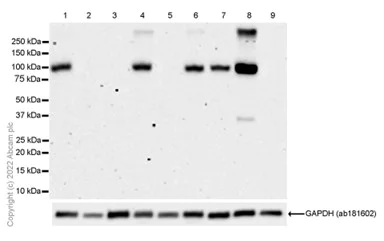
Western blot - Anti-Glutamate Receptor 1 (AMPA subtype) antibody [EPR19522] - BSA and Azide free (AB250709)
This data was developed using ab183797, the same antibody clone in a different buffer formulation.
Blocking and diluting buffer and concentration : 5% NFDM/TBST.
Negative control : liver (PMID : 2480522).human muscle (PMID : 1652753).
Bands around 300kDa in lane 4, lane 6 and lane 8 may due to protein aggregation.
All lanes:
Western blot - Anti-Glutamate Receptor 1 (AMPA subtype) antibody [EPR19522] (<a href='/ko/products/primary-antibodies/glutamate-receptor-1-ampa-subtype-antibody-epr19522-ab183797'>ab183797</a>) at 1/1000 dilution
Lane 1:
Human cerebellum tissue lysate at 20 µg
Lane 2:
Human liver tissue lysate at 20 µg
Lane 3:
human skeletal muscle tissue lysate at 20 µg
Lane 4:
Mouse brain tissue lysate at 20 µg
Lane 5:
Mouse liver tissue lysate at 20 µg
Lane 6:
Rat brain tissue lysate at 20 µg
Lane 7:
Rat cerebellum tissue at 20 µg
Lane 8:
Rat hippocampus tissue lysate at 20 µg
Lane 9:
Rat liver tissue lysate at 20 µg
Secondary
All lanes:
Western blot - Goat Anti-Rabbit IgG H&L (HRP) (<a href='/ko/products/secondary-antibodies/goat-rabbit-igg-h-l-hrp-ab97051'>ab97051</a>) at 1/100000 dilution
Observed band size: 101 kDa
false
Exposure time: 180s

- WB
Supplier Data
Western blot - Anti-Glutamate Receptor 1 (AMPA subtype) antibody [EPR19522] - BSA and Azide free (AB250709)
This data was developed using ab183797, the same antibody clone in a different buffer formulation.
Blocking and dilution buffer : 5% NFDM/TBST.
Human Glutamate Receptor 1 is widely expressed in brain and represents the predominant excitatory neurotransmitter system but not in muscle.
Negative control : human muscle (PMID : 1652753).
All lanes:
Western blot - Anti-Glutamate Receptor 1 (AMPA subtype) antibody [EPR19522] (<a href='/ko/products/primary-antibodies/glutamate-receptor-1-ampa-subtype-antibody-epr19522-ab183797'>ab183797</a>) at 1/1000 dilution
Lane 1:
Human cerebellum lysate at 20 µg
Lane 2:
Human muscle lysate at 20 µg
Lane 3:
Human fetal brain lysate at 20 µg
Secondary
All lanes:
Goat Anti-Rabbit IgG Peroxidase Conjugate, specific to the non-reduced form of IgG at 1/10000 dilution
Predicted band size: 102 kDa
Observed band size: 102 kDa
false
Exposure time: 3min

- WB
Supplier Data
Western blot - Anti-Glutamate Receptor 1 (AMPA subtype) antibody [EPR19522] - BSA and Azide free (AB250709)
This data was developed using ab183797, the same antibody clone in a different buffer formulation.
Blocking and dilution buffer : 5% NFDM/TBST.
Exposure times : Lane 1 : 2 seconds; Lane 2 : 3 minutes.
Mouse Glutamate Receptor 1 fragment recombinant protein contains aa19-184 with a GST/His-Tag®. Mouse Glutamate Receptor 2 fragment recombinant protein contains aa25-288 with a His-Tag®.
All lanes:
Western blot - Anti-Glutamate Receptor 1 (AMPA subtype) antibody [EPR19522] (<a href='/ko/products/primary-antibodies/glutamate-receptor-1-ampa-subtype-antibody-epr19522-ab183797'>ab183797</a>) at 1/5000 dilution
Lane 1:
Mouse Glutamate Receptor 1 fragment recombinant protein at 0.01 µg
Lane 2:
Mouse Glutamate Receptor 2 fragment recombinant protein at 0.01 µg
Secondary
All lanes:
Western blot - Goat Anti-Rabbit IgG H&L (HRP) (<a href='/ko/products/secondary-antibodies/goat-rabbit-igg-h-l-hrp-ab97051'>ab97051</a>) at 1/100000 dilution
Predicted band size: 102 kDa
false
- WB
Lab
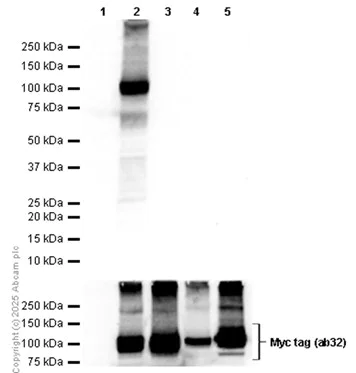
Western blot - Anti-Glutamate Receptor 1 (AMPA subtype) antibody [EPR19522] - BSA and Azide free (AB250709)
This data was developed using ab183797, the same antibody clone in a different buffer formulation.
Blocking and diluting buffer and concentration : 5% NFDM/TBST.
This antibody does not cross-react with Mouse GRIA2, GRIA3 and GRIA4.
All lanes:
Western blot - Anti-Glutamate Receptor 1 (AMPA subtype) antibody [EPR19522] (<a href='/ko/products/primary-antibodies/glutamate-receptor-1-ampa-subtype-antibody-epr19522-ab183797'>ab183797</a>) at 1/1000 dilution
Lane 1:
293T transfected with an empty vector (vector control), containing a myc-His-tag®, whole cell lysate at 20 µg
Lane 2:
293T transfected with Mouse full length GRIA1 expression vector containing a c-term myc-His-tag®, whole cell lysate at 20 µg
Lane 3:
293T transfected with Mouse full length GRIA2 expression vector containing a c-term myc-His-tag®, whole cell lysate at 20 µg
Lane 4:
293T transfected with Mouse full length GRIA3 expression vector containing a c-term myc-His-tag®, whole cell lysate at 20 µg
Lane 5:
293T transfected with Mouse full length GRIA4 expression vector containing a c-term myc-His-tag®, whole cell lysate at 20 µg
Secondary
Lanes 1 - 5:
Western blot - Goat Anti-Rabbit IgG H&L (HRP) (<a href='/ko/products/secondary-antibodies/goat-rabbit-igg-h-l-hrp-ab97051'>ab97051</a>) at 1/100000 dilution
Lanes 1 - 5:
Goat anti-mouse IgG (H+L), Peroxidase conjugated at 1/10000 dilution
Observed band size: 101 kDa
false
Exposure time: 20s

- WB
Supplier Data
Western blot - Anti-Glutamate Receptor 1 (AMPA subtype) antibody [EPR19522] - BSA and Azide free (AB250709)
This data was developed using ab183797, the same antibody clone in a different buffer formulation.
Blocking and dilution buffer : 5% NFDM/TBST.
Exposure times : Lanes 1-2 : 30 seconds; Lanes 3-7 : 15 seconds.
Rodent Glutamate Receptor 1 is widely expressed in brain and represents the predominant excitatory neurotransmitter system but not in liver.
Negative control : Rat liver (PMID : 2480522).
All lanes:
Western blot - Anti-Glutamate Receptor 1 (AMPA subtype) antibody [EPR19522] (<a href='/ko/products/primary-antibodies/glutamate-receptor-1-ampa-subtype-antibody-epr19522-ab183797'>ab183797</a>) at 1/1000 dilution
Lane 1:
Mouse brain lysate at 20 µg
Lane 2:
Rat liver lysate at 20 µg
Lane 3:
Mouse hippocampus lysate at 20 µg
Lane 4:
Mouse cerebellum lysate at 20 µg
Lane 5:
Rat brain lysate at 20 µg
Lane 6:
Rat cerebellum lysate at 20 µg
Lane 7:
Rat hippocampus lysate at 20 µg
Secondary
All lanes:
Western blot - Goat Anti-Rabbit IgG H&L (HRP) (<a href='/ko/products/secondary-antibodies/goat-rabbit-igg-h-l-hrp-ab97051'>ab97051</a>) at 1/100000 dilution
Predicted band size: 102 kDa
Observed band size: 102 kDa
false
관련 conjugated 항체와 다양한 조성의 항체 (1)
-
Anti-Glutamate Receptor 1 (AMPA subtype) antibody [EPR19522]
대체품

보완 제품
Sample Prep & Detection Kits
AB269901
Alkaline Phosphatase Conjugation Kit (Animal Free) - Lightning-Link®
- 0
- 0

Primary Antibodies
AB192757
Anti-PSD95 antibody [K28/43] - Synaptic Marker
BOND RX™ Validated|Lab Essentials

- 0
- 0
Primary Antibodies
AB124913
Anti-NMDAR2A antibody [EPR2465(2)]
20ul selling size|RabMAb|Recombinant

- 0
- 0

Primary Antibodies
AB133477
Anti-Ionotropic Glutamate receptor 2 antibody [EPR5032]
20ul selling size|RabMAb|Recombinant

- 5
- 3
Reactivity 정보
제품 세부 정보
ab250709 is the carrier-free version of ab183797.
Patented technology
Our RabMAb® technology is a patented hybridoma-based technology for making rabbit monoclonal antibodies. For details on our patents, please refer to RabMAb® patents.
What are the advantages of a recombinant monoclonal antibody?
This product is a recombinant monoclonal antibody, which offers several advantages including:
- - High batch-to-batch consistency and reproducibility
- - Improved sensitivity and specificity
- - Long-term security of supply
- - Animal-free batch production
For more information, read more on recombinant antibodies.
Conjugation ready
Our carrier-free antibodies are typically supplied in a PBS-only formulation, purified and free of BSA, sodium azide and glycerol. This conjugation-ready format is designed for use with fluorochromes, metal isotopes, oligonucleotides, and enzymes, which makes them ideal for antibody labelling, functional and cell-based assays, flow-based assays (e.g. mass cytometry) and Multiplex Imaging applications.
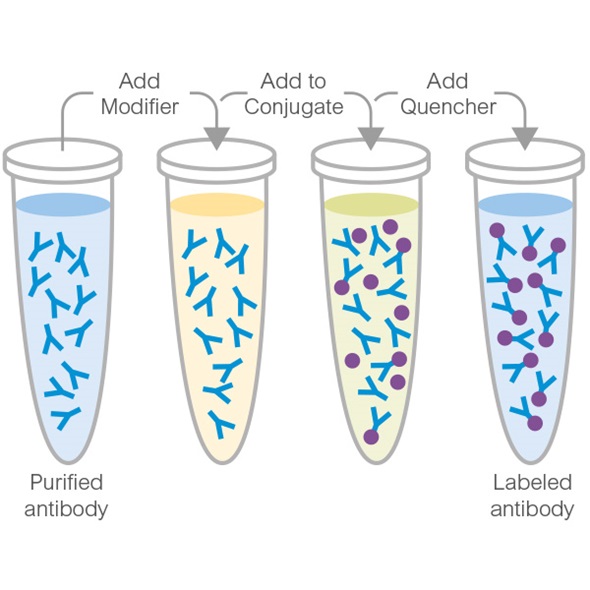
Use our conjugation kits for antibody conjugates that are ready-to-use in as little as 20 minutes with 1 minute hands-on-time and 100% antibody recovery: available for fluorescent dyes, HRP, biotin and gold.
Compatibility
This product is compatible with the Maxpar® Antibody Labeling Kit from Fluidigm, without the need for antibody preparation. Maxpar® is a trademark of Fluidigm Canada Inc.
특성 및 보관 정보
제형
Purification 테크닉
보관 버퍼
배송 시 보관 조건
적절한 단기 보관 조건
적절한 장기 보관 조건
보관 정보
추가 정보
This supplementary information is collated from multiple sources and compiled automatically.
Biological function summary
The GluR1 subunit is an essential component of the AMPA receptor complex which typically forms as a tetramer. This complex modulates synaptic strength and plasticity processes critical for learning and memory. The activity of AMPA receptors including those containing GluR1 is regulated by several auxiliary proteins and is essential for post-synaptic responses. The GluR1 subunit also interacts with other proteins such as TARPs which modulate its trafficking and channel properties.
Pathways
The GluR1-containing AMPA receptors participate significantly in the glutamatergic signaling pathway which is vital for fast excitatory synaptic transmission in the brain. This pathway also involves the NMDA receptors which work together with AMPA receptors to regulate synaptic plasticity and neuronal communication. Additionally the GluR1 interacts within the long-term potentiation (LTP) pathway contributing to the strengthening of synapses an essential mechanism underlying learning and memory.
제품 프로토콜
- Visit the General protocols
- Visit the Troubleshooting
타겟 정보
대체 명칭 보기
Product promise
Please note: All products are 'FOR RESEARCH USE ONLY. NOT FOR USE IN DIAGNOSTIC OR THERAPEUTIC PROCEDURES'.
For licensing inquiries, please contact partnerships@abcam.com