Anti-KCNQ3 antibody [EPR25237-57]
- BOND RX™ Validated
- 20ul selling size
- RabMAb
- Recombinant
- 각 태그의 뜻
Be the first to review this product! 리뷰 제출
|
(1 출판물)
- IHC
Supplier Data
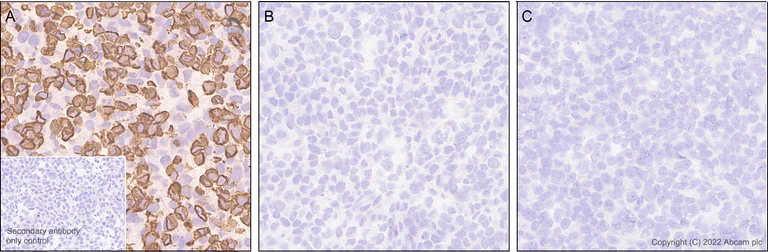
Immunohistochemistry - Anti-KCNQ3 antibody [EPR25237-57] (AB302782)
Immunohistochemical analysis of paraffin-embedded (A) HEK-293T cells t tissue labeling KCNQ3 with ab302782 at 1/8000 (0.066 ug/ml) followed by a LeicaDS9800 (Bond Polymer Refine Detection) was used at Ready to use dilution. Positive staining on (A) HEK-293T cells transfected with a mouse KCNQ3 expression vector containing a his tag. No staining on (B) HEK-293T cells transfected with a mouse KCNQ2 expression vector containing a his tag and (C) HEK-293T cells transfected with empty vector containing a his tag. The section was incubated with ab302782 for 30 mins at room temperature.The immunostaining was performed on a Leica Biosystems BOND® RX instrument Counterstained with Hematoxylin. Secondary antibody only control : Secondary antibody is LeicaDS9800 (Bond Polymer Refine Detection) was used at Ready to use dilution. Heat mediated antigen retrieval with Tris-EDTA buffer (pH 9.0, epitope retrieval solution2) for 20 mins
- IHC
Supplier Data
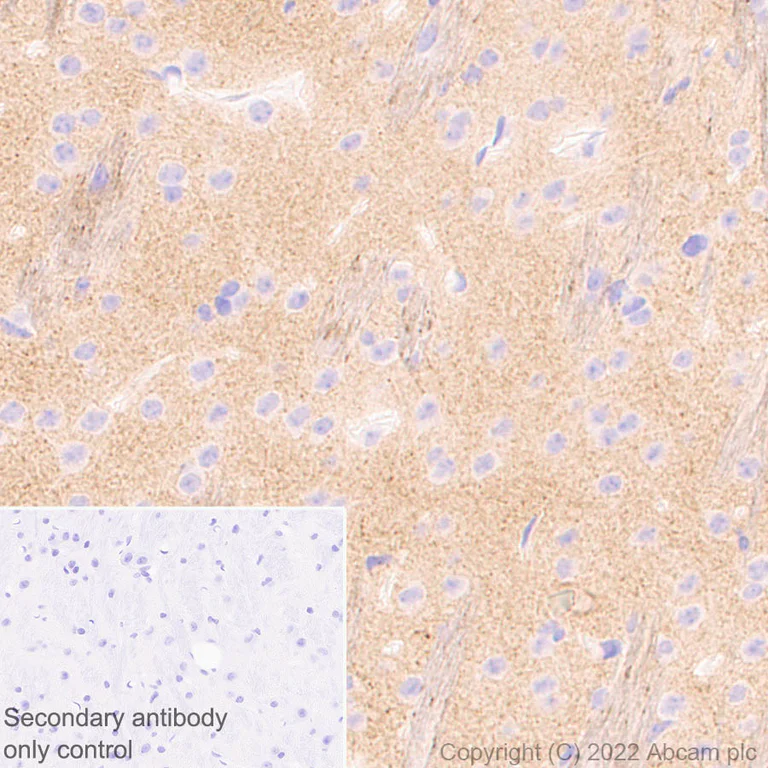
Immunohistochemistry - Anti-KCNQ3 antibody [EPR25237-57] (AB302782)
Immunohistochemical analysis of paraffin-embedded Mouse cerebrum tissue labeling KCNQ3 with ab302782 at 1/2000 (0.264 ug/ml) followed by a LeicaDS9800 (Bond Polymer Refine Detection) was used at Ready to use dilution. Positive staining on mouse cerebrum (PMID : 20534576). The section was incubated with ab302782 for 30 mins at room temperature.The immunostaining was performed on a Leica Biosystems BOND® RX instrument Counterstained with Hematoxylin. Secondary antibody only control : Secondary antibody is LeicaDS9800 (Bond Polymer Refine Detection) was used at Ready to use dilution. Heat mediated antigen retrieval with Tris-EDTA buffer (pH 9.0, epitope retrieval solution2) for 20 mins
- IHC
Supplier Data
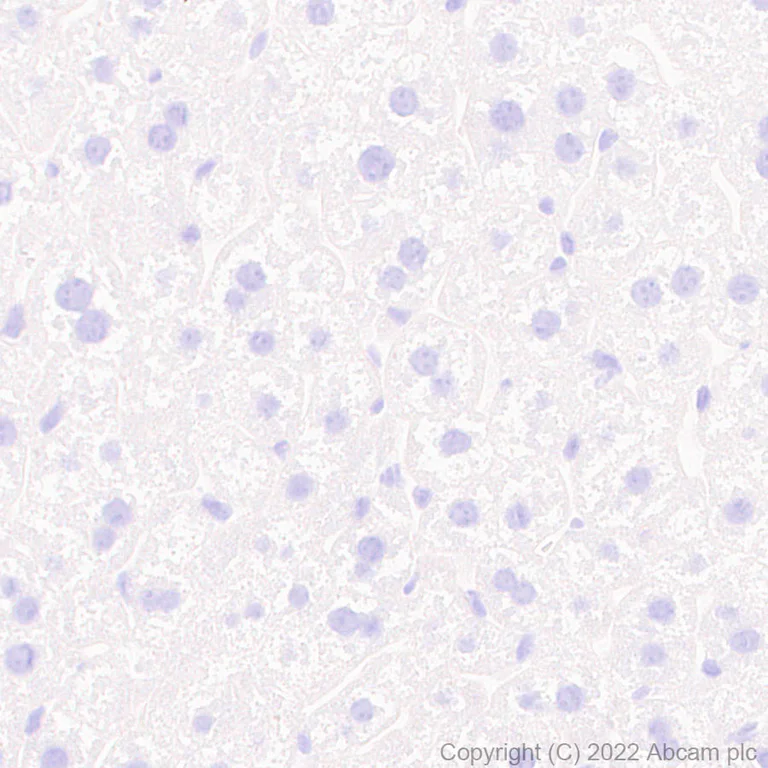
Immunohistochemistry - Anti-KCNQ3 antibody [EPR25237-57] (AB302782)
Immunohistochemical analysis of paraffin-embedded Mouse liver tissue labeling KCNQ3 with ab302782 at 1/2000 (0.264 ug/ml) followed by a LeicaDS9800 (Bond Polymer Refine Detection) was used at Ready to use dilution. Negative control : no staining on mouse liver (PMID : 9677360). The section was incubated with ab302782 for 30 mins at room temperature.The immunostaining was performed on a Leica Biosystems BOND® RX instrument Counterstained with Hematoxylin. Secondary antibody only control : Secondary antibody is LeicaDS9800 (Bond Polymer Refine Detection) was used at Ready to use dilution. Heat mediated antigen retrieval with Tris-EDTA buffer (pH 9.0, epitope retrieval solution2) for 20 mins
- IHC-Fr
Supplier Data
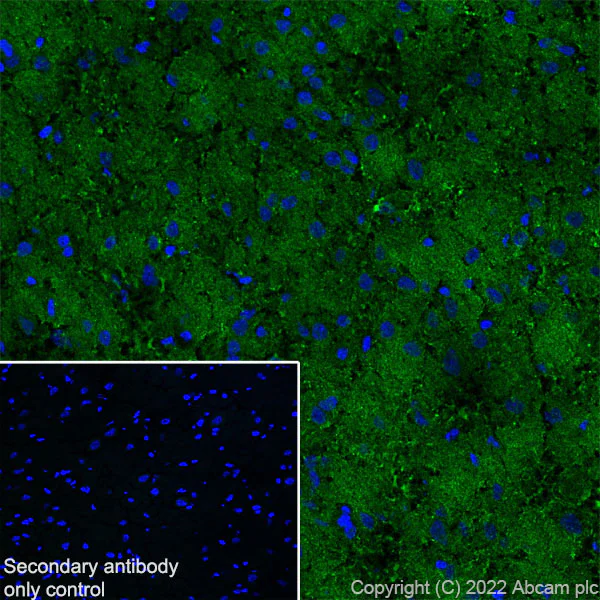
Immunohistochemistry (Frozen sections) - Anti-KCNQ3 antibody [EPR25237-57] (AB302782)
Immunohistochemical analysis of 4% PFA-fixed, 0.2% Triton X-100 permeabilized frozen Rat cerebrum (fresh) tissue labeling KCNQ3 with ab302782 at 1/50 (10.56 ug/ml) dilution followed by ab150081 Goat Anti-Rabbit IgG H&L (Alexa Fluor® 488) preadsorbed at 1/1000 2 ug/mL dilution (Green). Positive staining on rat cerebrum is observed. The nuclear counterstain was DAPI (Blue). Secondary antibody control : Secondary antibody is ab150081 Goat Anti-Rabbit IgG H&L (Alexa Fluor® 488) preadsorbedat 1/1000 2 ug/mL dilution.<\p> .
- IHC-Fr
Supplier Data
Immunohistochemistry (Frozen sections) - Anti-KCNQ3 antibody [EPR25237-57] (AB302782)
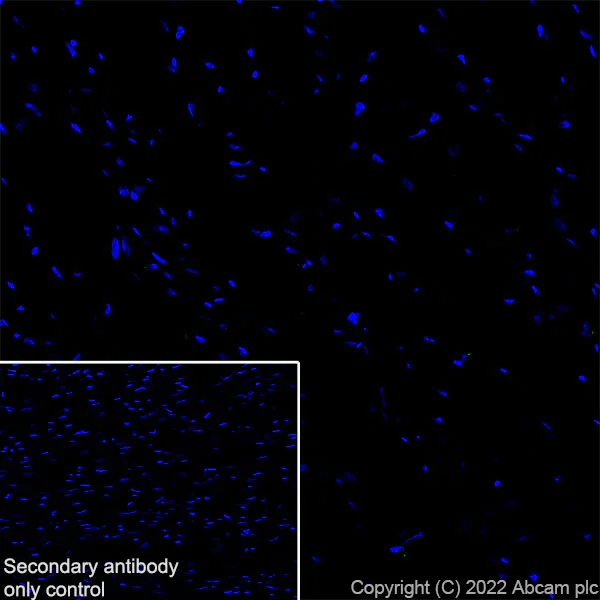
Immunohistochemical analysis of 4% PFA-fixed, 0.2% Triton X-100 permeabilized frozen Rat heart (fresh) tissue labeling KCNQ3 with ab302782 at 1/50 (10.56 ug/ml) dilution followed by ab150081 Goat Anti-Rabbit IgG H&L (Alexa Fluor® 488) preadsorbed at 1/1000 2 ug/mL dilution (Green). Negative control : no staining on rat heart (PMID : 9677360) is observed. The nuclear counterstain was DAPI (Blue). Secondary antibody control : Secondary antibody is ab150081 Goat Anti-Rabbit IgG H&L (Alexa Fluor® 488) preadsorbedat 1/1000 2 ug/mL dilution.<\p> .
- ICC
Supplier Data
Immunocytochemistry - Anti-KCNQ3 antibody [EPR25237-57] (AB302782)
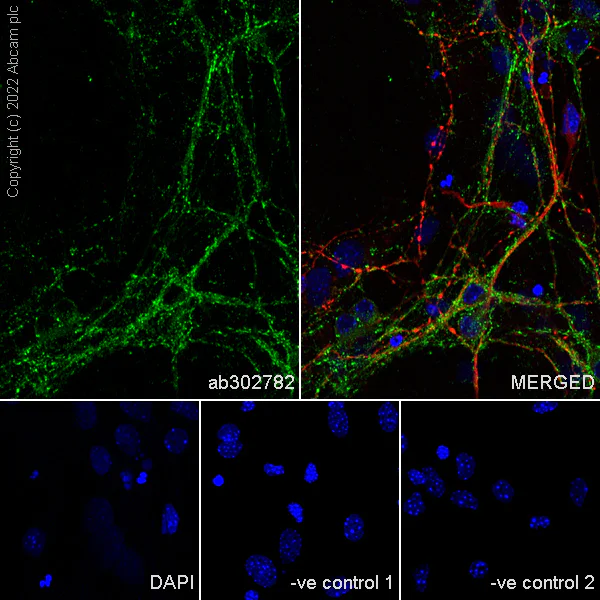
Immunofluorescent analysis of 4% Paraformaldehyde-fixed, 0.1% TritonX-100 permeabilized mouse primary neural/glia cell cells labelling KCNQ3 with ab302782 at 1/500 (1.056 ug/ml) dilution, followed by ab150081 Goat Anti-Rabbit IgG H&L (Alexa Fluor® 488) preadsorbed antibody at 1/1000 2 ug/ml dilution (Green). Confocal image showing cytoplasmic staining in mouse primary neural/glia cellConfocal scanning Z step was set as 0.3 µm followed by image processing with maximum Z projection is observed. ab11267 Anti-MAP2 mouse monoclonal antibody was used to counterstain tubulin at 1/500 4 ug/ml dilution (Red). The Nuclear counterstain was DAPI (Blue). Secondary antibody only control : Secondary antibody is ab150081 Goat Anti-Rabbit IgG H&L (Alexa Fluor® 488) preadsorbed at 1/1000 2 ug/ml dilution.
- IHC
Supplier Data
Immunohistochemistry - Anti-KCNQ3 antibody [EPR25237-57] (AB302782)
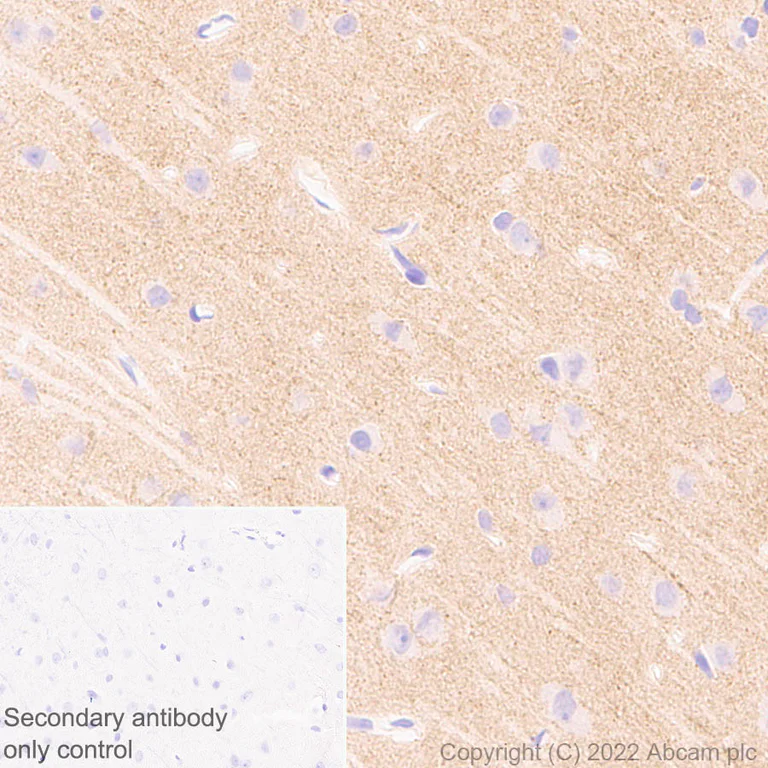
Immunohistochemical analysis of paraffin-embedded Rat cerebrum tissue labeling KCNQ3 with ab302782 at 1/2000 (0.264 ug/ml) followed by a LeicaDS9800 (Bond Polymer Refine Detection) was used at Ready to use dilution. Positive staining on rat cerebrum (PMID : 20534576). The section was incubated with ab302782 for 30 mins at room temperature.The immunostaining was performed on a Leica Biosystems BOND® RX instrument Counterstained with Hematoxylin. Secondary antibody only control : Secondary antibody is LeicaDS9800 (Bond Polymer Refine Detection) was used at Ready to use dilution. Heat mediated antigen retrieval with Tris-EDTA buffer (pH 9.0, epitope retrieval solution2) for 20 mins
관련 conjugated 항체와 다양한 조성의 항체 (1)
-
Anti-KCNQ3 antibody [EPR25237-57] (BSA and Azide free)
보완 제품
Primary Antibodies
AB305299
Anti-TRPV1 antibody [EPR25057-67]
BOND RX™ Validated|20ul selling size|RabMAb|Recombinant|KO Validated
- 3
- 1
Primary Antibodies
AB246502
Anti-Peripherin antibody [EPR23445-28]
BOND RX™ Validated|RabMAb|Recombinant|20ul selling size
- 5
- 4
Reactivity 정보
제품 세부 정보
Patented technology
Our RabMAb® technology is a patented hybridoma-based technology for making rabbit monoclonal antibodies. For details on our patents, please refer to RabMAb® patents.
What are the advantages of a recombinant monoclonal antibody?
This product is a recombinant monoclonal antibody, which offers several advantages including:
- - High batch-to-batch consistency and reproducibility
- - Improved sensitivity and specificity
- - Long-term security of supply
- - Animal-free batch production
For more information, read more on recombinant antibodies.
특성 및 보관 정보
제형
Purification 테크닉
보관 버퍼
배송 시 보관 조건
적절한 단기 보관 기간
적절한 단기 보관 조건
적절한 장기 보관 조건
분주 정보
보관 정보
제품 프로토콜
- Visit the General protocols
- Visit the Troubleshooting
타겟 정보
대체 명칭 보기
제품이 사용된 논문 (1)
Recent publications for all applications. Explore the 전체 목록and refine your search
Frontiers in pharmacology 15:1330167 PubMed38440182
2024
Applications
Unspecified application
Species
Unspecified reactive species
Product promise
Please note: All products are 'FOR RESEARCH USE ONLY. NOT FOR USE IN DIAGNOSTIC OR THERAPEUTIC PROCEDURES'.
For licensing inquiries, please contact partnerships@abcam.com