Anti-NMDAR1 antibody [EPR2480Y] - Neuronal Marker
- RabMAb
- Recombinant
- Lab Essentials
- 20ul selling size
- 각 태그의 뜻
Be the first to review this product! 리뷰 제출
|
(10 제품이 사용된 논문 )
- WB
Lab
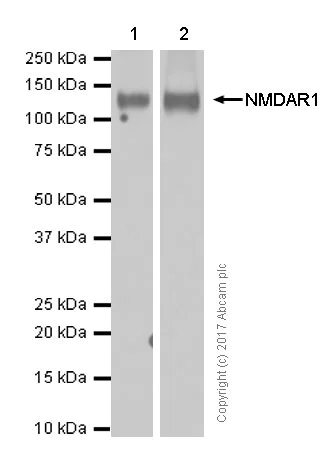
Western blot - Anti-NMDAR1 antibody [EPR2480Y] - Neuronal Marker (AB68144)
Blocking/diluting buffer : 5% NFDM/TBST
All lanes:
Western blot - Anti-NMDAR1 antibody [EPR2480Y] - Neuronal Marker (ab68144) at 1/1000 dilution
Lane 1:
Human fetal brain cell lysate at 15 µg
Lane 2:
Human forebrain cell lysate at 15 µg
Secondary
All lanes:
Western blot - Goat Anti-Rabbit IgG H&L (HRP) (<a href='/ko/products/secondary-antibodies/goat-rabbit-igg-h-l-hrp-ab97051'>ab97051</a>) at 1/20000 dilution
Predicted band size: 105 kDa
Observed band size: 120 kDa
false
Exposure time: 30s
- WB
Lab
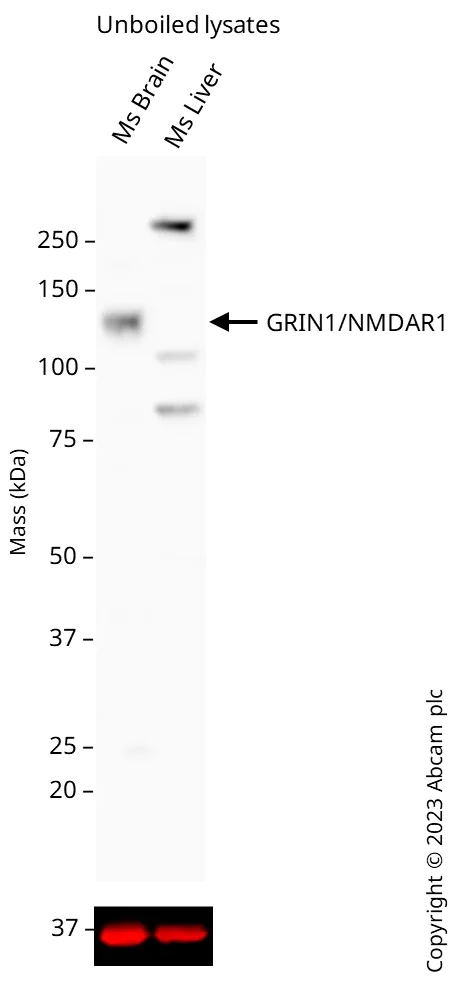
Western blot - Anti-NMDAR1 antibody [EPR2480Y] - Neuronal Marker (AB68144)
Anti-GRIN1 antibody [EPR2480Y] (ab68144) staining at 1/1000 dilution, shown in green; Mouse anti-GAPDH antibody [6C5] (ab8245) loading control staining at 1/20000 dilution, shown in red. In Western blot, ab68144 was shown to bind specifically to GRIN1. First, unboiled samples were run on an SDS-PAGE gel then transferred onto a nitrocellulose membrane. Membranes were blocked in 3 % milk in TBS-0.1 % Tween® 20 (TBS-T) before incubation with primary antibodies overnight at 4 °C. Blots were washed four times in TBS-T, incubated with secondary antibodies for 1 h at room temperature, washed again four times then imaged. Secondary antibodies used were HRP conjugated Goat anti-Rabbit (H+L) and Goat anti-Mouse IgG H&L 680RD at 1/20000 dilution.
All lanes:
Western blot - Anti-NMDAR1 antibody [EPR2480Y] - Neuronal Marker (ab68144) at 1/1000 dilution
Lane 1:
Mouse Brain (unboiled) cell lysate at 20 µg
Lane 2:
Mouse Liver (unboiled) cell lysate at 20 µg
Secondary
All lanes:
HRP conjugated Goat anti-Rabbit (H+L) and Goat anti-Mouse IgG H&L 680RD at 1/20000 dilution
Predicted band size: 105 kDa
Observed band size: 120 kDa
false
관련 conjugated 항체와 다양한 조성의 항체 (1)
-
Anti-NMDAR1 antibody [EPR2480Y] - BSA and Azide free
대체품
Primary Antibodies
AB109182
Anti-NMDAR1 antibody [EPR2481(2)] - Neuronal Marker
20ul selling size|KO Validated|RabMAb|Recombinant
- 4
- 4
보완 제품
Primary Antibodies
AB124913
Anti-NMDAR2A antibody [EPR2465(2)]
20ul selling size|RabMAb|Recombinant
- 0
- 0
Primary Antibodies
AB183797
Anti-Glutamate Receptor 1 (AMPA subtype) antibody [EPR19522]
20ul selling size|RabMAb|Recombinant
- 5
- 1
Primary Antibodies
AB192757
Anti-PSD95 antibody [K28/43] - Synaptic Marker
BOND RX™ Validated|Lab Essentials
- 0
- 0
Reactivity 정보
제품 세부 정보
Patented technology
Our RabMAb® technology is a patented hybridoma-based technology for making rabbit monoclonal antibodies. For details on our patents, please refer to RabMAb® patents.
What are the advantages of a recombinant monoclonal antibody?
This product is a recombinant monoclonal antibody, which offers several advantages including:
- - High batch-to-batch consistency and reproducibility
- - Improved sensitivity and specificity
- - Long-term security of supply
- - Animal-free batch production
For more information, read more on recombinant antibodies.
특성 및 보관 정보
제형
Purity
보관 버퍼
배송 시 보관 조건
적절한 단기 보관 조건
적절한 장기 보관 조건
분주 정보
보관 정보
추가 정보
This supplementary information is collated from multiple sources and compiled automatically.
Biological function summary
NMDA receptors including the NMDAR1 subunit serve essential functions in synaptic plasticity and memory processes. As part of the receptor complex NMDAR1 contributes to the control of synaptic strength. It requires co-activation by glutamate and glycine or D-serine linking its function to excitatory neurotransmission. The receptor's capacity to modulate synaptic connections forms the basis of learning and long-term memory.
Pathways
NMDAR1 plays a critical role in the glutamatergic pathway influencing synaptic plasticity and memory function. It interacts with other proteins like PSD-95 within the postsynaptic density. NMDAR1 is also involved in the calcium signaling pathway due to its ability to facilitate calcium entry into neurons upon synaptic activity. This positions the receptor as an important modulator in pathways that control neuronal communication and plasticity.
제품 프로토콜
- Visit the General protocols
- Visit the Troubleshooting
타겟 정보
대체 명칭 보기
제품이 사용된 논문 (10)
Recent publications for all applications. Explore the 전체 목록and refine your search
Frontiers in neurology 15:1384829 PubMed38765264
2024
Applications
Unspecified application
Species
Unspecified reactive species
Frontiers in neurology 13:1048953 PubMed36712446
2023
Applications
Unspecified application
Species
Unspecified reactive species
Neural regeneration research 18:368-374 PubMed35900432
2022
Applications
Unspecified application
Species
Unspecified reactive species
The international journal of neuropsychopharmacology 25:498-511 PubMed35152284
2022
Applications
Unspecified application
Species
Unspecified reactive species
Journal of neuroinflammation 18:241 PubMed34666797
2021
Applications
Unspecified application
Species
Unspecified reactive species
Aging 12:7801-7817 PubMed32357144
2020
Applications
Unspecified application
Species
Unspecified reactive species
Aging cell 19:e13055 PubMed31668016
2019
Applications
Unspecified application
Species
Unspecified reactive species
Experimental neurology 304:41-57 PubMed29481784
2018
Applications
WB
Species
Unspecified reactive species
Neuroscience 372:192-212 PubMed29292072
2018
Applications
Unspecified application
Species
Unspecified reactive species
PloS one 7:e49700 PubMed23209593
2012
Applications
WB
Species
Unspecified reactive species
Product promise
Please note: All products are 'FOR RESEARCH USE ONLY. NOT FOR USE IN DIAGNOSTIC OR THERAPEUTIC PROCEDURES'.
For licensing inquiries, please contact partnerships@abcam.com