JavaScript is disabled in your browser. Please enable JavaScript to view this website.
AB133612

Anti-Osteocalcin antibody [EPR3690]

Be the first to review this product! 리뷰 제출

|

(130 제품이 사용된 논문 )
Rabbit Recombinant Monoclonal Osteocalcin antibody. Suitable for WB and reacts with Human, Recombinant full length protein - Human samples. Cited in 130 publications.
3 이미지
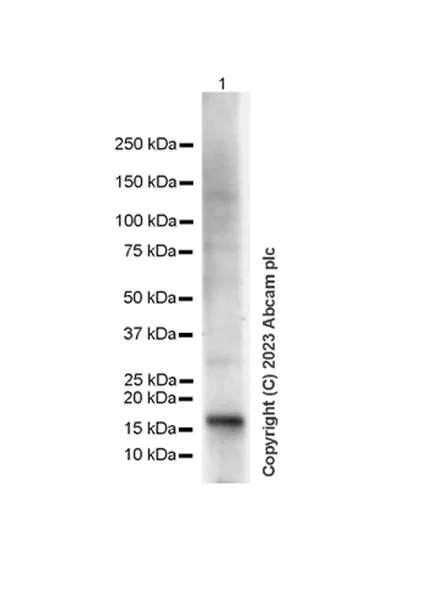
Western blot - Anti-Osteocalcin antibody [EPR3690] (AB133612)
  • WB

Lab

Western blot - Anti-Osteocalcin antibody [EPR3690] (AB133612)

Blocking and diluting buffer and concentration : 5% NFDM/TBST.

This blot was developed using a high sensitivity ECL substrate. The high-sensitivity ECL substrate used allows for the detection of proteins in the mid-femtogram range.

All lanes:

Western blot - Anti-Osteocalcin antibody [EPR3690] (ab133612) at 1/1000 dilution

All lanes:

Human articular cartilage tissue lysate at 20 µg

Secondary

All lanes:

Goat Anti-Rabbit IgG (HRP) with minimal cross-reactivity with human IgG at 1/1000 dilution

Predicted band size: 11 kDa

Observed band size: 19 kDa

true

Exposure time: 158s
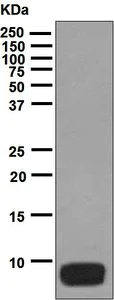
Western blot - Anti-Osteocalcin antibody [EPR3690] (AB133612)
  • WB

Unknown

Western blot - Anti-Osteocalcin antibody [EPR3690] (AB133612)

All lanes:

Western blot - Anti-Osteocalcin antibody [EPR3690] (ab133612) at 1/1000 dilution

All lanes:

Human Osteocalcin recombinant protein at 0.01 µg

Predicted band size: 11 kDa

false
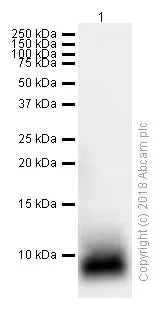
Western blot - Anti-Osteocalcin antibody [EPR3690] (AB133612)
  • WB

Unknown

Western blot - Anti-Osteocalcin antibody [EPR3690] (AB133612)

Blocking and diluting buffer : 5% NFDM/TBST.

All lanes:

Western blot - Anti-Osteocalcin antibody [EPR3690] (ab133612) at 1.2 µg/mL

All lanes:

Human osteocalcin recombinant protein at 0.015 µg

Secondary

All lanes:

Western blot - Goat Anti-Rabbit IgG H&L (HRP) (<a href='/ko/products/secondary-antibodies/goat-rabbit-igg-h-l-hrp-ab97051'>ab97051</a>) at 1/20000 dilution

Predicted band size: 11 kDa

false

관련 conjugated 항체와 다양한 조성의 항체 (1)

  • Carrier free

    Anti-Osteocalcin antibody [EPR3690] - BSA and Azide free

주요 정보

Host species

Rabbit

Clonality

Monoclonal

Clone number

EPR3690

Isotype

IgG

Carrier free

No

Reacts with

Human

Applications

WB

applications

Immunogen

The exact immunogen used to generate this antibody is proprietary information.

Specificity

<p>This antibody fails to detect endogenous Osteocalcin in cell lines and tissues tested. So we don`t guarantee WB in natural samples.</p>

Reactivity 정보

{ "title": "Reactivity Data", "filters": { "stats": ["", "Species", "Dilution Info", "Notes"], "tabs": { "all-applications": {"fullname" : "All Applications", "shortname": "All Applications"}, "WB" : {"fullname" : "Western blot", "shortname":"WB"} }, "product-promise": { "all": "all", "testedAndGuaranteed": "tested", "guaranteed": "expected", "predicted": "predicted", "notRecommended": "not-recommended" } }, "values": { "Human": { "WB-species-checked": "testedAndGuaranteed", "WB-species-dilution-info": "1/1000 - 1/10000", "WB-species-notes": "<p></p>" }, "Recombinant full length protein - Human": { "WB-species-checked": "testedAndGuaranteed", "WB-species-dilution-info": "1/1000 - 1/10000", "WB-species-notes": "<p></p>" } } }

제품 세부 정보

Species reactivity
Mouse, Rat: We have preliminary internal testing data to indicate this antibody may not react with these species.
Please contact us for more information.

Patented technology
Our RabMAb® technology is a patented hybridoma-based technology for making rabbit monoclonal antibodies. For details on our patents, please refer to RabMAb® patents.

What are the advantages of a recombinant monoclonal antibody?
This product is a recombinant monoclonal antibody, which offers several advantages including:

  • - High batch-to-batch consistency and reproducibility
  • - Improved sensitivity and specificity
  • - Long-term security of supply
  • - Animal-free batch production

For more information, read more on recombinant antibodies.

특성 및 보관 정보

제형
Liquid
Purification 테크닉
Affinity purification Protein A
보관 버퍼
pH: 7.2 - 7.4 Preservative: 0.01% Sodium azide Constituents: PBS, 40% Glycerol (glycerin, glycerine), 0.05% BSA
배송 시 보관 조건
Conditional Ambient
적절한 단기 보관 기간
1-2 weeks
적절한 단기 보관 조건
+4°C
적절한 장기 보관 조건
-20°C
분주 정보
Upon delivery aliquot
보관 정보
Avoid freeze / thaw cycle

추가 정보

This supplementary information is collated from multiple sources and compiled automatically.

Osteocalcin also known as bone gamma-carboxyglutamic acid-containing protein (BGLAP) is a small non-collagenous protein with a molecular weight of approximately 5.8 kDa. This protein is mainly expressed in osteoblasts which are bone-forming cells. It is an important component of the bone matrix and is involved in bone mineralization. Osteocalcin binds to calcium and incorporates into the hydroxyapatite crystals in the bone helping stabilize the bone structure. Researchers often study this protein as a marker for bone formation and turnover.
Biological function summary

Osteocalcin plays a significant role in regulating glucose metabolism and fat deposition. It acts as a hormone from the bone and influences energy metabolism and insulin sensitivity. Osteocalcin undergoes carboxylation a post-translational modification necessary for its function in bone. Beyond its structural role demineralized osteocalcin has been found to impact pancreatic β-cell function adipose tissue and male fertility although the pathways in these processes are not entirely understood yet.

Pathways

Osteocalcin is associated with the energy metabolism and bone remodeling pathways. It interacts with the insulin signaling pathway influencing insulin secretion by pancreatic β-cells and boosting insulin sensitivity. This interaction involves proteins like insulin receptor substrate 1 (IRS1) and glucose transporter type 4 (GLUT4) which play roles in glucose uptake. Osteocalcin also connects to bone remodeling pathways by influencing osteoclast differentiation and activity through osteoprotegrin and receptor activator of nuclear factor kappa-B ligand (RANKL).

Dysregulation of osteocalcin levels associates with metabolic syndrome and osteoporosis. It is linked with insulin resistance affecting glucose homeostasis and potentially contributing to diabetes development. Osteocalcin's involvement in bone density maintenance also makes it relevant in osteoporosis where bone formation balance is disrupted. The receptor activator of nuclear factor kappa-B ligand (RANKL) and osteoprotegrin which osteocalcin interacts with are other proteins connected to the pathogenesis of these conditions. Understanding osteocalcin's function helps in exploring therapeutic targets for these diseases.

제품 프로토콜

For this product, it's our understanding that no specific protocols are required. You can visit:

타겟 정보

The carboxylated form is one of the main organic components of the bone matrix, which constitutes 1-2% of the total bone protein (PubMed : 3019668, PubMed : 6967872). Acts as a negative regulator of bone formation and is required to limit bone formation without impairing bone resorption or mineralization (By similarity). Binds strongly to apatite and calcium upon gamma-carboxylation; this modification is essential for bone metabolism (PubMed : 6967872, PubMed : 39880952).. The uncarboxylated form acts as a hormone secreted by osteoblasts, which regulates different cellular processes, such as energy metabolism, male fertility and brain development. Regulates of energy metabolism by acting as a hormone favoring pancreatic beta-cell proliferation, insulin secretion and sensitivity and energy expenditure. Uncarboxylated osteocalcin hormone also promotes testosterone production in the testes : acts as a ligand for G protein-coupled receptor GPRC6A at the surface of Leydig cells, initiating a signaling response that promotes the expression of enzymes required for testosterone synthesis in a CREB-dependent manner. Also acts as a regulator of brain development : osteocalcin hormone crosses the blood-brain barrier and acts as a ligand for GPR158 on neurons, initiating a signaling response that prevents neuronal apoptosis in the hippocampus, favors the synthesis of all monoamine neurotransmitters and inhibits that of gamma-aminobutyric acid (GABA). Osteocalcin also crosses the placenta during pregnancy and maternal osteocalcin is required for fetal brain development.
See full target information BGLAP

대체 명칭 보기

Osteocalcin, Bone Gla protein, Gamma-carboxyglutamic acid-containing protein, BGP, BGLAP

제품이 사용된 논문 (130)

Recent publications for all applications. Explore the 전체 목록and refine your search

Scientific reports 15:35547 PubMed41073566

2025

Total flavonoids of rhizoma drynariae improved the osteogenic and pro-angiogenic capacities of BMSCs to accelerate long bone regeneration.

Applications

Unspecified application

Species

Unspecified reactive species

Hengjun Huang,Silu Li,Huang Zhan,Fenfang Gong,Jian Liu,Zhenya Liu,Hui Li,Chengyu Yang

Stem cell research & therapy 16:498 PubMed40999515

2025

SUV39H1 facilitate the osteogenic differentiation of dental pulp stem cells by modulating lipid metabolism and mitochondrial dynamics through FASN via non-histone methylation and ubiquitination mechanism.

Applications

Unspecified application

Species

Unspecified reactive species

Ning Wang,Wanqing Wang,Xiao Han,Yangyang Cao,Haoqing Yang,Chen Zhang,Huina Liu,Mengyuan Zhu,Dengsheng Xia,Zhipeng Fan

Hereditas 162:138 PubMed40696462

2025

miR-370-3p affects the progression of postmenopausal osteoporosis through targeting INO80.

Applications

Unspecified application

Species

Unspecified reactive species

Zhen Yang,Yuqi Sheng,Xiangjie Liu,Meini Cen,Yong Xu

Journal of traditional and complementary medicine 15:434-445 PubMed40677544

2025

Salvianic acid A promotes osteogenic differentiation of bone marrow mesenchymal stem cells in senile osteoporosis through bromodomain-containing protein 4/Ariadne RBR E3 ubiquitin-protein ligase 1/Rubicon axis.

Applications

Unspecified application

Species

Unspecified reactive species

Zhixian Xu,Jun Luo,Yongfa Zhang,Zhenyu Zhang,Jie Xu

Journal of ginseng research 49:395-405 PubMed40621075

2025

Ginsenoside Re promotes osteogenic differentiation via BMP2/p38 pathway and .

Applications

Unspecified application

Species

Unspecified reactive species

Yunjia Wang,Gengming Zhang,Linhua Deng,Hongqi Zhang,Emmanuel Alonge,Zhongjing Jiang

Stem cell research & therapy 16:315 PubMed40542372

2025

M2 macrophage-derived mitochondrial transplantation promotes periodontal bone regeneration by regulating metabolic homeostasis via activating p38-MAPK signaling pathway.

Applications

Unspecified application

Species

Unspecified reactive species

Yuzhuo Ma,Xiang Han,Ke Yan,Yiyang Yang,Kewei Zhang,Yue Wang,Xuerong Lv,Feiyang Wang,Xiaoqian Wang

BMC musculoskeletal disorders 26:548 PubMed40462026

2025

Icariin-loaded composite scaffold promotes osteogenic differentiation and bone regeneration.

Applications

Unspecified application

Species

Unspecified reactive species

Dong-Sheng Jin,Zhang-Hong Zhao,Shi-Qiang Ruan,Wen-Liang Huang,Ren-Yuan Tian,Yu Wan,Jiang Deng

Journal of translational medicine 23:604 PubMed40448194

2025

YTHDF3 regulates IL32 mRNA stability to promote osteogenic differentiation of bone mesenchymal stem cells in ankylosing spondylitis.

Applications

Unspecified application

Species

Unspecified reactive species

Bole Zhou,Xinzhe Feng,Changhao Han,Yang Wu,Junjie Qiao,Wenwen Tong,Weidong Xu

Cardiovascular therapeutics 2025:3845211 PubMed40231210

2025

Thrombospondin-1 Silencing Ameliorates Osteoblastic Differentiation of Aortic Valve Interstitial Cells via Inhibiting Nuclear Factor-B Pathway.

Applications

Unspecified application

Species

Unspecified reactive species

Qing Li,Chengxiang Song,Zisong Wei,Junli Li,Hao Zhou,Shuoding Wang,Hongde Li,Haoran Yang,Qiang Luo,Mao Chen

Biochemical genetics : PubMed40221950

2025

Identification of a Novel Mitochondrial-Related Gene Signature for BMSCs in Osteoporosis Combining Single-Cell and Bulk Transcriptome Data.

Applications

Unspecified application

Species

Unspecified reactive species

Jishi Jiang,Dan Li,Di Cui,Yunpeng Wan,Pinghui Zhou,Xilong Cui,Haiyang Yu
제품이 사용된 논문 모두 보기

Product promise

저희는 고품질 시약으로 고객님의 연구를 서포트하고자 최선을 다하고 있으며, 모든 단계에서 함께 하겠습니다. 만약 제품이 기대한 성능을 보이지 않을 경우에도 Product Promise로 보호받으실 수 있습니다.
자세한 내용은 이용 약관을 확인해 주세요.

Please note: All products are 'FOR RESEARCH USE ONLY. NOT FOR USE IN DIAGNOSTIC OR THERAPEUTIC PROCEDURES'.

For licensing inquiries, please contact partnerships@abcam.com