- I-ELISA
Lab
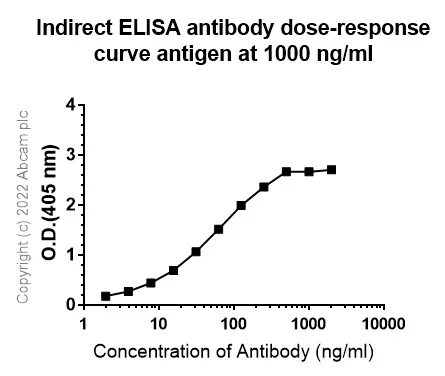
Indirect ELISA - Anti-p53 antibody [PAb 1801] (AB28)
Indirect ELISA analysis of ab28 at 2000-0 ng/ml. The Secondary antibody used was Alkaline Phosphatase-conjugated AffiniPure Goat Anti-Mouse IgG (H+L) at 1 : 1000 dilution.
Antigen : Human P53.
Antigen concentration : 1000 ng/ml
- WB
Lab
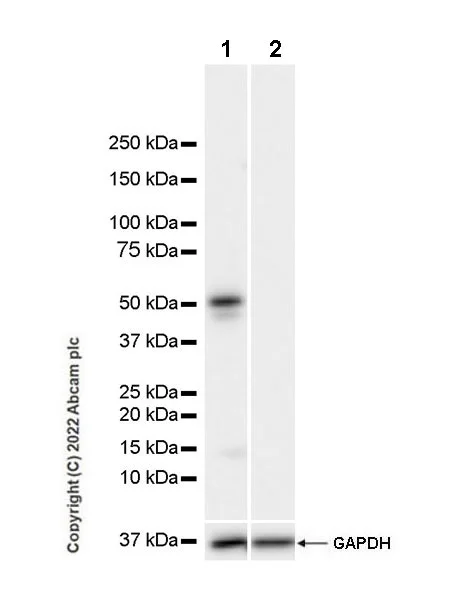
Western blot - Anti-p53 antibody [PAb 1801] (AB28)
Blocking and diluting buffer and concentration : 5% NFDM/TBST
Negative control : Saos-2 (PMID : 9568097)
All lanes:
Western blot - Anti-p53 antibody [PAb 1801] (ab28) at 1/1000 dilution
Lane 1:
A431 (Human epidermoid carcinoma) whole cell lysate at 10 µg
Lane 2:
Saos-2 (Human osteosarcoma cell line) whole cell lysate at 10 µg
Secondary
All lanes:
Peroxidase-Conjugated Goat anti-Mouse IgG (H+L) at 1/5000 dilution
Observed band size: 53 kDa
false
Exposure time: 15s
대체품
Primary Antibodies
AB1101
BOND RX™ Validated|KO Validated|Lab Essentials

- 4
- 14
Primary Antibodies
AB183544
Anti-p53 (acetyl K370) antibody [EPR17496]
RabMAb|Recombinant|Lab Essentials|20ul selling size

- 4
- 1
Primary Antibodies
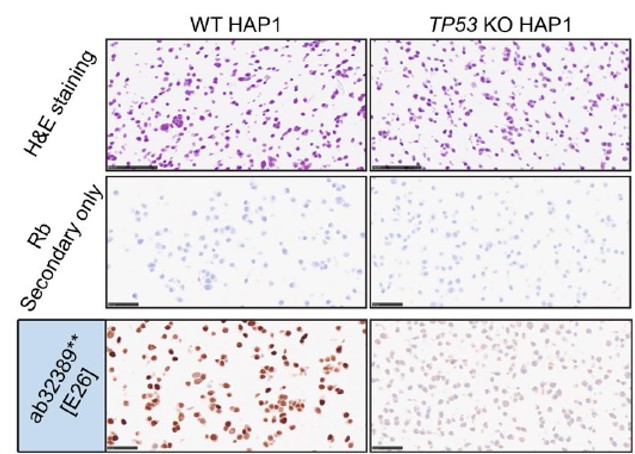
AB32389
BOND RX™ Validated|RabMAb|Recombinant|KO Validated|Lab Essentials|20ul selling size|Advanced Validation
- 0
- 0
Primary Antibodies
AB75754
Anti-p53 (acetyl K382) antibody [EPR358(2)]
RabMAb|Recombinant|Lab Essentials|20ul selling size

- 5
- 4
Primary Antibodies
AB33889
Anti-p53 (phospho S392) antibody [EP155Y]
RabMAb|Lab Essentials|20ul selling size|Recombinant

- 3
- 1
Primary Antibodies
AB76242
Anti-p53 (phospho S46) antibody [EP42Y]
RabMAb|Recombinant|Lab Essentials|20ul selling size

- 0
- 0
Primary Antibodies
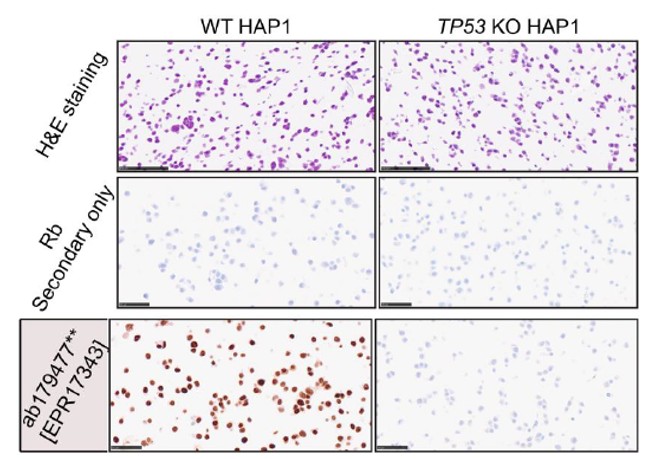
AB179477
RabMAb|Recombinant|KO Validated|Lab Essentials|20ul selling size
- 3
- 2
Primary Antibodies
AB154036
BOND RX™ Validated|KO Validated|Lab Essentials
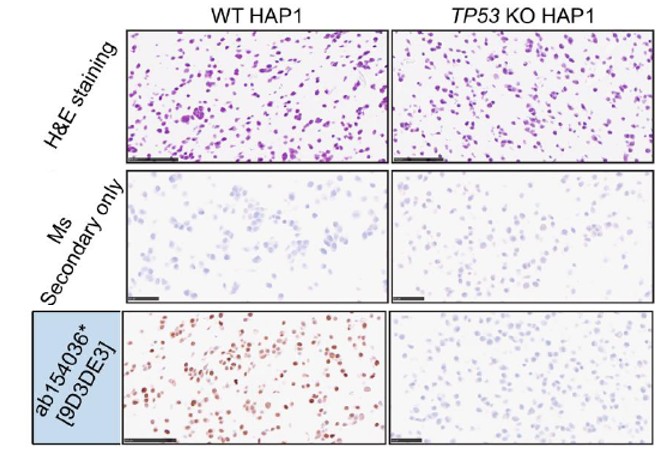
- 4
- 3
Primary Antibodies
AB223868
Anti-p53 (phospho S15) antibody [EPR64(N)] - ChIP Grade
RabMAb|Recombinant|Lab Essentials|20ul selling size|Advanced Validation

- 4
- 1
보완 제품

Primary Antibodies
AB109520
RabMAb|Recombinant|KO Validated|Lab Essentials|20ul selling size

- 5
- 17
Primary Antibodies
AB32503
BOND RX™ Validated|20ul selling size|RabMAb|Recombinant|KO Validated

- 4
- 12
Primary Antibodies
AB183544
Anti-p53 (acetyl K370) antibody [EPR17496]
RabMAb|Recombinant|Lab Essentials|20ul selling size
- 4
- 1
Primary Antibodies
AB184787
Anti-Caspase-3 antibody [EPR18297]
20ul selling size|RabMAb|Recombinant|KO Validated

- 3
- 3
Reactivity 정보
제품 세부 정보
This monoclonal p53 antibody has been knockout validated in Western blot. The expected band for p53 was observed in HCT116 cells treated with irinotecan and the band was not seen in TP53 knockout HCT116 cell lysate.
We recommend using ab1101 or ab154036, alternative mouse monoclonal antibodies, to detect human p53 by IHC, ICC/IF or flow cytometry since they perform better in these applications.
The production method for this product has been switched from hybridoma to recombinant on 7th Sept 2026.
Want a custom formulation?
This antibody clone is manufactured by Abcam. If you require a custom buffer formulation or conjugation for your experiments, please contact orders@abcam.com
What are the advantages of a recombinant monoclonal antibody?
This product is a recombinant monoclonal antibody, which offers several advantages including:
- - High batch-to-batch consistency and reproducibility
- - Improved sensitivity and specificity
- - Long-term security of supply
- - Animal-free batch production
For more information, read more on recombinant antibodies.
특성 및 보관 정보
제형
Purification 테크닉
보관 버퍼
배송 시 보관 조건
적절한 단기 보관 기간
적절한 단기 보관 조건
적절한 장기 보관 조건
분주 정보
보관 정보
추가 정보
This supplementary information is collated from multiple sources and compiled automatically.
Biological function summary
P53 functions to control cell division and apoptosis serving as a guardian of the genome by preventing mutation accumulation. It does not form part of a larger complex under normal conditions but interacts with various other molecules to execute its functions. p53 can activate or suppress the transcription of numerous genes involved in cell cycle arrest DNA repair and programmed cell death allowing it to halt the progression of damaged cells and trigger repair mechanisms or eliminate those that cannot be repaired.
Pathways
P53 acts within several key biological pathways such as the p53 signaling pathway and the intrinsic apoptotic pathway. Its activity involves interaction with proteins like MDM2 which regulates p53 through ubiquitin-mediated degradation and ATM kinase which phosphorylates p53 in response to DNA damage. These interactions ensure appropriate cellular responses during stress and are vital for maintaining homeostasis.
제품 프로토콜
- Visit the General protocols
- Visit the Troubleshooting
타겟 정보
대체 명칭 보기
제품이 사용된 논문 (63)
Recent publications for all applications. Explore the 전체 목록and refine your search
Cell reports. Medicine 6:101918 PubMed39809263
2025
Applications
Unspecified application
Species
Unspecified reactive species
Scientific reports 13:9674 PubMed37316553
2023
Applications
Unspecified application
Species
Unspecified reactive species
Scientific reports 11:6939 PubMed33767253
2021
Applications
Unspecified application
Species
Unspecified reactive species
Frontiers in immunology 11:599771 PubMed33628204
2021
Applications
Unspecified application
Species
Unspecified reactive species
International journal of medical sciences 18:1753-1759 PubMed33746592
2021
Applications
Unspecified application
Species
Unspecified reactive species
JBMR plus 4:e10376 PubMed32803108
2020
Applications
Unspecified application
Species
Unspecified reactive species
eLife 9: PubMed32223892
2020
Applications
Unspecified application
Species
Unspecified reactive species
Journal of the American Heart Association 9:e014008 PubMed31928155
2020
Applications
Unspecified application
Species
Unspecified reactive species
Current protocols in stem cell biology 52:e102 PubMed31883435
2019
Applications
Unspecified application
Species
Unspecified reactive species
Oncogene 39:1041-1048 PubMed31582835
2019
Applications
Unspecified application
Species
Unspecified reactive species
Product promise
Please note: All products are 'FOR RESEARCH USE ONLY. NOT FOR USE IN DIAGNOSTIC OR THERAPEUTIC PROCEDURES'.
For licensing inquiries, please contact partnerships@abcam.com