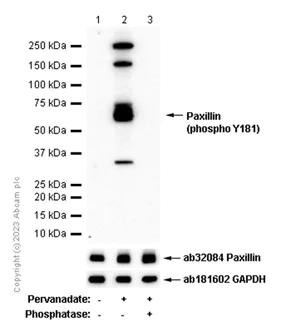
- WB
Supplier Data
Western blot - Anti-Paxillin (phospho Y181) antibody [EP41(2)Y] - BSA and Azide free (AB284748)
Blocking and diluting buffer and concentration : 5% NFDM/TBST.
This data was developed using the same antibody clone in a different buffer formulation containing PBS, BSA, glycerol, and sodium azide (ab76235).
All lanes:
Western blot - Anti-Paxillin (phospho Y181) antibody [EP41(2)Y] (<a href='/ko/products/primary-antibodies/paxillin-phospho-y181-antibody-ep412y-ab76235'>ab76235</a>) at 1/10000 dilution
Lane 1:
Untreated HeLa (human cervix adenocarcinoma epithelial cell) whole cell lysate at 15 µg
Lane 2:
HeLa treated with 1mM pervanadate for 30min whole cell lysate at 15 µg
Lane 3:
HeLa treated with 1mM pervanadate for 30min whole cell lysate. Then the membrane was incubated with phosphatase at 15 µg
Secondary
All lanes:
Western blot - Goat Anti-Rabbit IgG H&L (HRP) (<a href='/ko/products/secondary-antibodies/goat-rabbit-igg-h-l-hrp-ab97051'>ab97051</a>) at 1/20000 dilution
Predicted band size: 65 kDa
Observed band size: 68 kDa
false
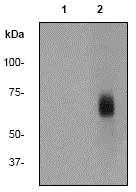
- WB
Unknown
Western blot - Anti-Paxillin (phospho Y181) antibody [EP41(2)Y] - BSA and Azide free (AB284748)
This data was developed using ab76235, the same antibody clone in a different buffer formulation.
All lanes:
Western blot - Anti-Paxillin (phospho Y181) antibody [EP41(2)Y] (<a href='/ko/products/primary-antibodies/paxillin-phospho-y181-antibody-ep412y-ab76235'>ab76235</a>) at 1/10000 dilution
Lane 1:
HeLa cell lysate at 10 µg
Lane 2:
HeLa cell lysate treated with pervanadate at 10 µg
Secondary
All lanes:
HRP labelled goat anti-rabbit at 1/2000 dilution
Predicted band size: 65 kDa
Observed band size: 68 kDa
false
관련 conjugated 항체와 다양한 조성의 항체 (1)
-
Anti-Paxillin (phospho Y181) antibody [EP41(2)Y]
보완 제품
Primary Antibodies
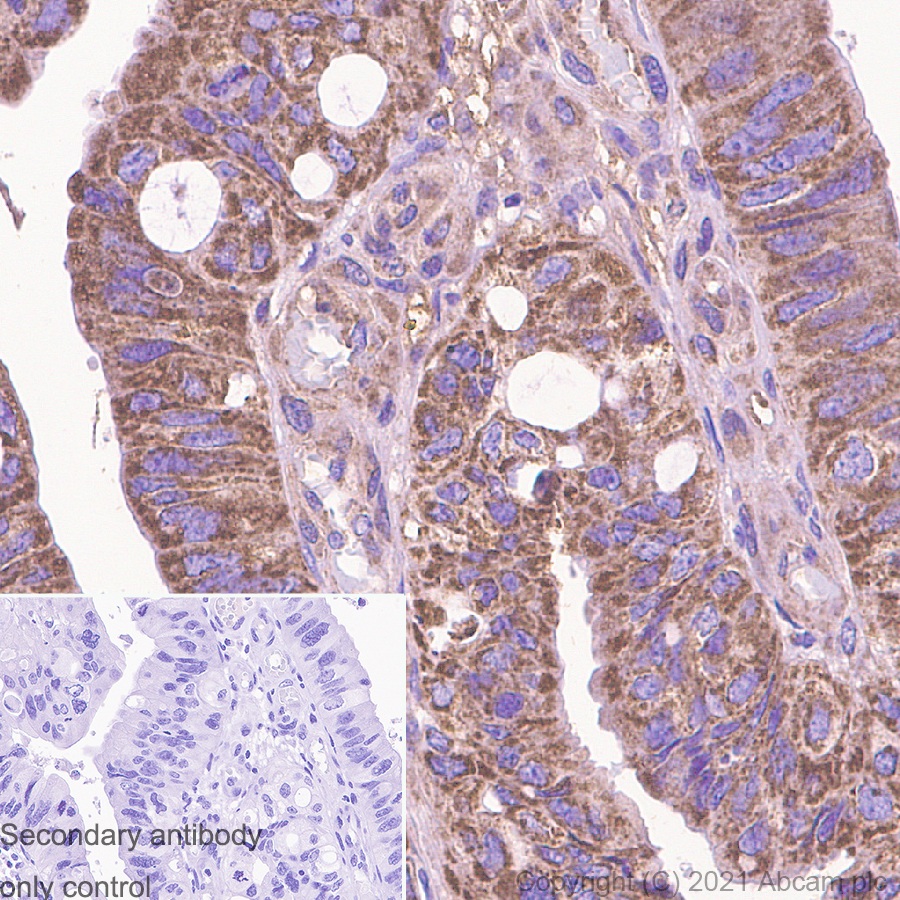
AB40794
20ul selling size|RabMAb|Recombinant|KO Validated
- 5
- 9

Primary Antibodies
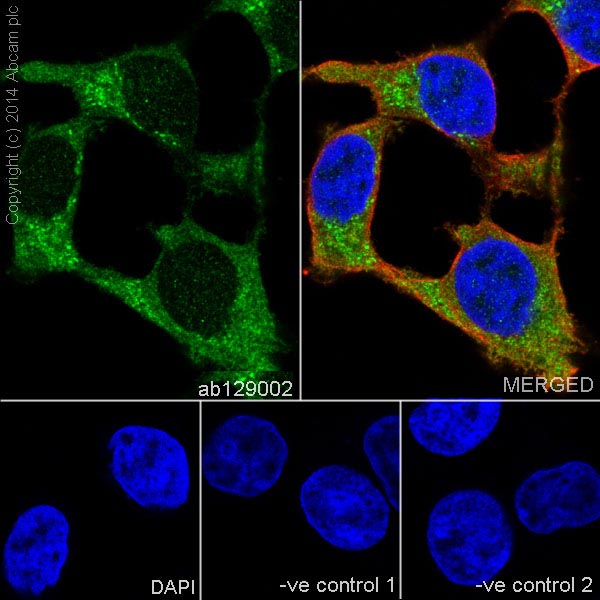
AB129002
Anti-Vinculin antibody [EPR8185] - Loading Control
20ul selling size|RabMAb|Recombinant|KO Validated
- 5
- 21
Reactivity 정보
제품 세부 정보
ab284748 is the carrier-free version of ab76235.
Patented technology
Our RabMAb® technology is a patented hybridoma-based technology for making rabbit monoclonal antibodies. For details on our patents, please refer to RabMAb® patents.
Conjugation ready
Our carrier-free antibodies are typically supplied in a PBS-only formulation, purified and free of BSA, sodium azide and glycerol. This conjugation-ready format is designed for use with fluorochromes, metal isotopes, oligonucleotides, and enzymes, which makes them ideal for antibody labelling, functional and cell-based assays, flow-based assays (e.g. mass cytometry) and Multiplex Imaging applications.
Use our conjugation kits for antibody conjugates that are ready-to-use in as little as 20 minutes with 1 minute hands-on-time and 100% antibody recovery: available for fluorescent dyes, HRP, biotin and gold.
Compatibility
This product is compatible with the Maxpar® Antibody Labeling Kit from Fluidigm, without the need for antibody preparation. Maxpar® is a trademark of Fluidigm Canada Inc.
What are the advantages of a recombinant monoclonal antibody?
This product is a recombinant monoclonal antibody, which offers several advantages including:
- - High batch-to-batch consistency and reproducibility
- - Improved sensitivity and specificity
- - Long-term security of supply
- - Animal-free batch production
For more information, read more on recombinant antibodies.
특성 및 보관 정보
제형
Purification 테크닉
보관 버퍼
배송 시 보관 조건
적절한 단기 보관 조건
적절한 장기 보관 조건
추가 정보
This supplementary information is collated from multiple sources and compiled automatically.
Biological function summary
Paxillin serves key functions in cellular processes such as migration proliferation and survival. It interacts with different proteins including vinculin and talin forming part of a complex at the focal adhesion sites. The phosphorylation state of Paxillin can modulate its interactions and in this way influence the assembly of signaling complexes that control dynamic cellular processes.
Pathways
Paxillin participates in the integrin signaling and MAPK pathways. It operates by linking integrin receptors to the actin cytoskeleton facilitating signal transduction. Paxillin phosphorylation is an important regulatory mechanism within these pathways. In particular its interaction with focal adhesion kinase (FAK) and Src family kinases signifies its role in transmitting signals from the extracellular matrix to the cellular interior which impacts cell behavior and response.
제품 프로토콜
- Visit the General protocols
- Visit the Troubleshooting
타겟 정보
대체 명칭 보기
Product promise
Please note: All products are 'FOR RESEARCH USE ONLY. NOT FOR USE IN DIAGNOSTIC OR THERAPEUTIC PROCEDURES'.
For licensing inquiries, please contact partnerships@abcam.com