JavaScript is disabled in your browser. Please enable JavaScript to view this website.
AB95613

PE Anti-CD163 antibody [GHI/61]

3

(2 리뷰들)

|

(8 제품이 사용된 논문 )

Anti-CD163 antibody [GHI/61] conjugated to PE - suitable for flow cytometry, and reacts with human samples. Clone [GHI/61] is a mouse monoclonal antibody and one of the most commonly used clones for flow cytometry.

Design your panel with our interactive flow cytometry panel builder. Click here.
1 이미지
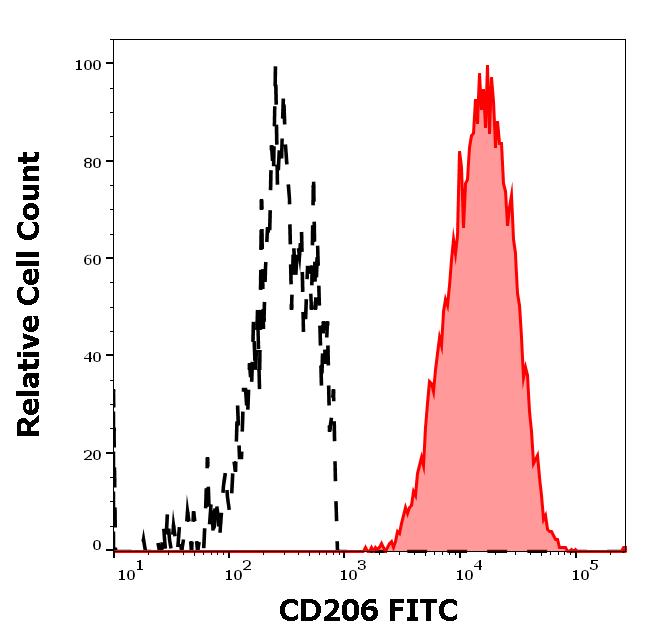
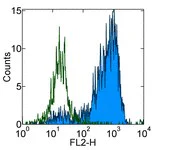
Flow Cytometry - PE Anti-CD163 antibody [GHI/61] (AB95613)
  • Flow Cyt

Unknown

Flow Cytometry - PE Anti-CD163 antibody [GHI/61] (AB95613)

Staining of normal Human peripheral blood cells with Mouse IgG1 kappa Isotype Control PE (open histogram) or ab95613 (filled histogram).
Cells in the monocyte gate were used for analysis.

관련 conjugated 항체와 다양한 조성의 항체 (5)

  • 660 APC

    APC Anti-CD163 antibody [GHI/61]

  • 578 PE

    PE Anti-CD163 antibody [GHI/61]

  • 695 PerCP/Cy5.5®

    PerCP/Cy5.5® Anti-CD163 antibody [GHI/61]

  • 387 mFluor™ UV375

    mFluor™ UV375 Anti-CD163 antibody [GHI/61]

  • 454 mFluor™ Violet 450

    mFluor™ Violet 450 Anti-CD163 antibody [GHI/61]

주요 정보

Host species

Mouse

Clonality

Monoclonal

Clone number

GHI/61

Isotype

IgG1

Light chain 타입

kappa

Conjugation

PE

Excitation/Emission

Ex: 480;565nm, Em: 578nm

Carrier free

No

Reacts with

Human

Applications

Flow Cyt

applications

Immunogen

Cell preparation containing CD163 protein. The exact immunogen used to generate this antibody is proprietary information.

Q86VB7

Reactivity 정보

{ "title": "Reactivity Data", "filters": { "stats": ["", "Species", "Dilution Info", "Notes"], "tabs": { "all-applications": {"fullname" : "All Applications", "shortname": "All Applications"}, "FlowCyt" : {"fullname" : "Flow Cytometry", "shortname":"Flow Cyt"} }, "product-promise": { "all": "all", "testedAndGuaranteed": "tested", "guaranteed": "expected", "predicted": "predicted", "notRecommended": "not-recommended" } }, "values": { "Human": { "FlowCyt-species-checked": "testedAndGuaranteed", "FlowCyt-species-dilution-info": "5 µL for 10^6 Cells", "FlowCyt-species-notes": "<p><a href='/ko/products/primary-antibodies/pe-mouse-igg1-b11-6-isotype-control-ab91357'>ab91357</a> - Mouse monoclonal IgG1, is suitable for use as an isotype control with this antibody.</p>" } } }

특성 및 보관 정보

제형
Liquid
Purification 테크닉
Affinity purification Protein G
보관 버퍼
pH: 7.2 Preservative: 0.09% Sodium azide
배송 시 보관 조건
Blue Ice
적절한 단기 보관 조건
+4°C
적절한 장기 보관 조건
+4°C

추가 정보

This supplementary information is collated from multiple sources and compiled automatically.

CD163 known also as hemoglobin scavenger receptor is a membrane glycoprotein with a molecular weight of approximately 130 kDa. It is predominantly expressed by monocytes and macrophages which are types of immune cells. Located on the cell surface CD163 functions as a receptor that aids in the clearance of hemoglobin-haptoglobin complexes playing a critical role in maintaining iron homeostasis and protecting tissues from oxidative damage. CD163 is not limited to human cells only; researchers often study its function using animal models such as chimeric rodents and chimeric rats.
Biological function summary

CD163 participates in anti-inflammatory processes and is linked to immune modulation. It plays a pivotal role in the resolution of inflammation and promotes the removal of damaged cells and tissues. Through its involvement in the endocytic pathway CD163 interacts with various ligands facilitating interactions with other proteins. In the context of research CD163 functionality can be analyzed using techniques like CD163 IHC CD163 ELISA and CD163 stain in both human and mouse models.

Pathways

CD163 is integral to the inflammation and immune response pathways. It participates in the heme-oxygenase pathway which is essential in the breakdown of heme into biliverdin free iron and carbon monoxide. This pathway involvement is tightly linked with heme oxygenase-1 (HO-1) a cytoprotective enzyme that helps to mitigate inflammatory responses. The interaction with haptoglobin and related proteins provides further insight into its regulatory roles within the immune system.

CD163 is associated with conditions like atherosclerosis and acute inflammation disorders. Its elevated levels indicate macrophage activation observed in chronic inflammations such as cardiovascular diseases. In atherosclerosis CD163 expression correlates with the uptake of oxidized LDL connecting it to progression of the disease. Additionally soluble CD163 levels serve as a biomarker in conditions like chronic liver disease where it is linked to macrophage activation and fibrosis. Within these disorders proteins like LDL and inflammatory cytokines are closely associated with CD163 function and regulation.

제품 프로토콜

For this product, it's our understanding that no specific protocols are required. You can visit:

타겟 정보

Acute phase-regulated receptor involved in clearance and endocytosis of hemoglobin/haptoglobin complexes by macrophages and may thereby protect tissues from free hemoglobin-mediated oxidative damage. May play a role in the uptake and recycling of iron, via endocytosis of hemoglobin/haptoglobin and subsequent breakdown of heme. Binds hemoglobin/haptoglobin complexes in a calcium-dependent and pH-dependent manner. Exhibits a higher affinity for complexes of hemoglobin and multimeric haptoglobin of HP*1F phenotype than for complexes of hemoglobin and dimeric haptoglobin of HP*1S phenotype. Induces a cascade of intracellular signals that involves tyrosine kinase-dependent calcium mobilization, inositol triphosphate production and secretion of IL6 and CSF1. Isoform 3 exhibits the higher capacity for ligand endocytosis and the more pronounced surface expression when expressed in cells.. After shedding, the soluble form (sCD163) may play an anti-inflammatory role, and may be a valuable diagnostic parameter for monitoring macrophage activation in inflammatory conditions.
See full target information CD163

대체 명칭 보기

CD163, M130, Scavenger receptor cysteine-rich type 1 protein M130, Hemoglobin scavenger receptor

제품이 사용된 논문 (8)

Recent publications for all applications. Explore the 전체 목록 and refine your search

BMC urology 24:147 PubMed39014364

2024

m6A reader IGF2BP2 promotes M2 macrophage polarization and malignant biological behavior of bladder cancer by stabilizing NRP1 mRNA expression.

Applications

Unspecified application

Species

Unspecified reactive species

Dian Fu,Xiuquan Shi,Xiaoming Yi,Ding Wu,Haowei He,Wenquan Zhou,Wen Cheng

Nature communications 14:7639 PubMed37993431

2023

Acoustofluidic Interfaces for the Mechanobiological Secretome of MSCs.

Applications

Unspecified application

Species

Unspecified reactive species

Ye He,Shujie Yang,Pengzhan Liu,Ke Li,Ke Jin,Ryan Becker,Jinxin Zhang,Chuanchuan Lin,Jianping Xia,Zhehan Ma,Zhiteng Ma,Ruoyu Zhong,Luke P Lee,Tony Jun Huang

Environmental toxicology 38:172-184 PubMed36346222

2022

CCL3-CCR5 axis promotes cell migration and invasion of colon adenocarcinoma via Akt signaling pathway.

Applications

Unspecified application

Species

Unspecified reactive species

Bugao Guan,Hongbo Li,Jian Yao,Jinbao Guo,Fei Yu,Guangrun Li,Benhai Wan,Jun Ma,Desong Huang,Lu Sun,Yan Chen

Journal of orthopaedic research : official publication of the Orthopaedic Research Society 40:1563-1576 PubMed34727384

2021

Mg -mediated autophagy-dependent polarization of macrophages mediates the osteogenesis of bone marrow stromal stem cells by interfering with macrophage-derived exosomes containing miR-381.

Applications

Unspecified application

Species

Unspecified reactive species

Yong Zhu,Shushan Zhao,Liang Cheng,Zhangyuan Lin,Min Zeng,Zhe Ruan,Buhua Sun,Zhongwei Luo,Yifu Tang,Haitao Long

Aging 12:6928-6946 PubMed32291381

2020

AKT3 deficiency in M2 macrophages impairs cutaneous wound healing by disrupting tissue remodeling.

Applications

Unspecified application

Species

Unspecified reactive species

Song Gu,Hanhao Dai,Xilian Zhao,Chang Gui,Jianchao Gui

American journal of physiology. Heart and circulat 299:H656-63 PubMed20622108

2010

Adiponectin primes human monocytes into alternative anti-inflammatory M2 macrophages.

Applications

Unspecified application

Species

Unspecified reactive species

Fina Lovren,Yi Pan,Adrian Quan,Paul E Szmitko,Krishna K Singh,Praphulla C Shukla,Milan Gupta,Lawrence Chan,Mohammed Al-Omran,Hwee Teoh,Subodh Verma

European journal of immunology 23:2320-5 PubMed8370408

1993

A new macrophage differentiation antigen which is a member of the scavenger receptor superfamily.

Applications

Unspecified application

Species

Unspecified reactive species

S K Law,K J Micklem,J M Shaw,X P Zhang,Y Dong,A C Willis,D Y Mason

Immunology 75:588-95 PubMed1592433

1992

A monocyte/macrophage antigen recognized by the four antibodies GHI/61, Ber-MAC3, Ki-M8 and SM4.

Applications

Flow Cyt

Species

Unspecified reactive species

K Pulford,K Micklem,S McCarthy,J Cordell,M Jones,D Y Mason
제품이 사용된 논문 모두 보기

Product promise

저희는 고품질 시약으로 고객님의 연구를 서포트하고자 최선을 다하고 있으며, 모든 단계에서 함께 하겠습니다. 만약 제품이 기대한 성능을 보이지 않을 경우에도 Product Promise로 보호받으실 수 있습니다.
자세한 내용은 이용 약관을 확인해 주세요.

Please note: All products are 'FOR RESEARCH USE ONLY. NOT FOR USE IN DIAGNOSTIC OR THERAPEUTIC PROCEDURES'.

For licensing inquiries, please contact partnerships@abcam.com