- Flow Cyt
Lab
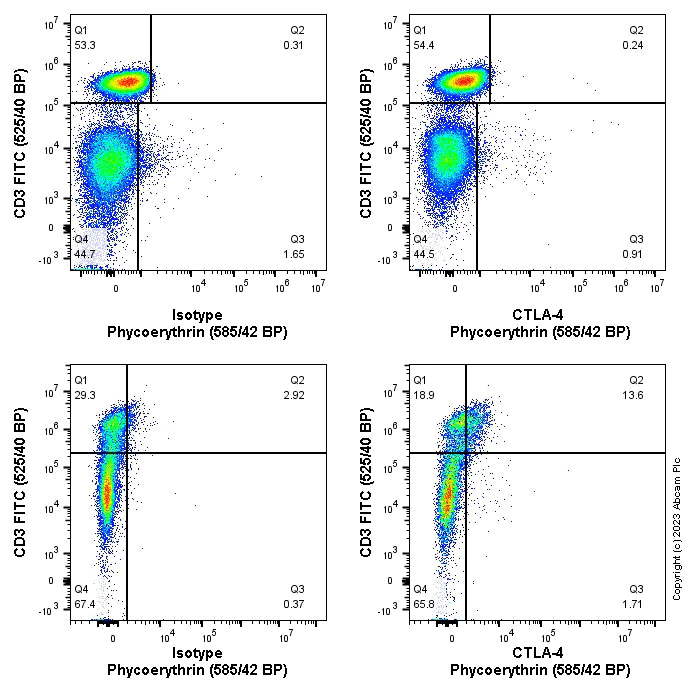
Flow Cytometry - PE Anti-CTLA-4/CD152 antibody [EPR22860-65] (AB313757)
Flow cytometry staining of human peripheral blood mononuclear cells (PBMCs) (top) or PBMCs treated with 10 μg/mL PHA for 48h (bottom), with ab313757 (right) or Rabbit IgG (monoclonal) Phycoerythrin (ab209478) (left). PBMCs were incubated for 30 min at 4°C in 1x PBS containing 10 μg/ml human IgG and 10% normal goat serum to block FC receptors and non-specific protein-protein interaction followed by the antibody ab313757 or Rabbit IgG (monoclonal) Phycoerythrin (ab209478) (1x 10⁶ in 100 μl at 0.04 μg/ml (1/12500)) for 30 min at 4°C. The cells were simultaneously stained with CD3.
Acquisition of >30000 events were collected using a 50 mW Yellow/Green laser (561nm) and 585/42 bandpass filter.
Events were gated on viable cells.
관련 conjugated 항체와 다양한 조성의 항체 (2)
-
Anti-CTLA-4/CD152 antibody [EPR22860-65]
-
Anti-CTLA-4/CD152 antibody [EPR22860-65] - BSA and Azide free
보완 제품
Primary Antibodies
AB305048
Alexa Fluor® 647 Anti-CD8 alpha antibody [CAL66]
BOND RX™ Validated|RabMAb|Recombinant

- 5
- 1

Primary Antibodies
AB279695
Alexa Fluor® 647 Anti-PD-1/CD279 antibody [NAT105]
Recombinant|Trial Size

- 0
- 0
Reactivity 정보
제품 세부 정보
Patented technology
Our RabMAb® technology is a patented hybridoma-based technology for making rabbit monoclonal antibodies. For details on our patents, please refer to RabMAb® patents.
What are the advantages of a recombinant monoclonal antibody?
This product is a recombinant monoclonal antibody, which offers several advantages including:
- - High batch-to-batch consistency and reproducibility
- - Improved sensitivity and specificity
- - Long-term security of supply
- - Animal-free batch production
For more information, read more on recombinant antibodies.
특성 및 보관 정보
제형
Purification 테크닉
보관 버퍼
배송 시 보관 조건
적절한 단기 보관 기간
적절한 단기 보관 조건
적절한 장기 보관 조건
분주 정보
보관 정보
추가 정보
This supplementary information is collated from multiple sources and compiled automatically.
Biological function summary
The CTLA-4 protein functions as a critical regulator of the immune system. It interacts with CD80/CD86 in a complex that effectively transmits inhibitory signals to T-cells. CTLA-4 controls the amplitude of the initial activation of T-cells ensuring that the body's immune responses are kept under control. In regulatory T-cells CTLA-4 engagement contributes to their immunosuppressive functions through which they maintain tolerance to self-antigens and prevent overactive immune reactions.
Pathways
CTLA-4 involves itself in the adaptive immune response pathways specifically the regulation of T-cell activity. CTLA-4's interaction with CD80/CD86 modulates pathways associated with TCR (T-cell receptor) signaling. When CTLA-4 binds its ligands it recruits phosphatases such as SHP-2 that dephosphorylate signaling proteins leading to the downregulation of T-cell interaction. This pathway interaction exemplifies how CTLA-4 acts in concert with proteins like CD28 to finely tune immune responses.
제품 프로토콜
- Visit the General protocols
- Visit the Troubleshooting
타겟 정보
대체 명칭 보기
Product promise
Please note: All products are 'FOR RESEARCH USE ONLY. NOT FOR USE IN DIAGNOSTIC OR THERAPEUTIC PROCEDURES'.
For licensing inquiries, please contact partnerships@abcam.com