JavaScript is disabled in your browser. Please enable JavaScript to view this website.
AB246713

PE Anti-GSDMD antibody [EPR20859]

Be the first to review this product! 리뷰 제출

|

(3 제품이 사용된 논문 )
Rabbit Recombinant Monoclonal GSDMD antibody - conjugated to PE. Suitable for Flow Cyt (Intra), ICC/IF, IHC-P and reacts with Mouse, Human, Rat samples. Cited in 3 publications.
1 이미지
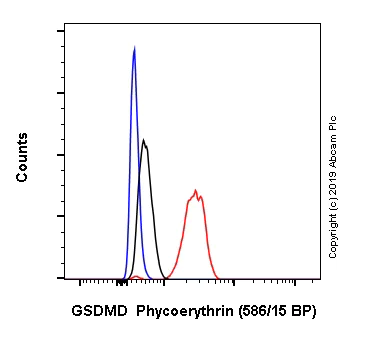
Flow Cytometry (Intracellular) - PE Anti-GSDMD antibody [EPR20859] (AB246713)
  • Flow Cyt (Intra)

Unknown

Flow Cytometry (Intracellular) - PE Anti-GSDMD antibody [EPR20859] (AB246713)

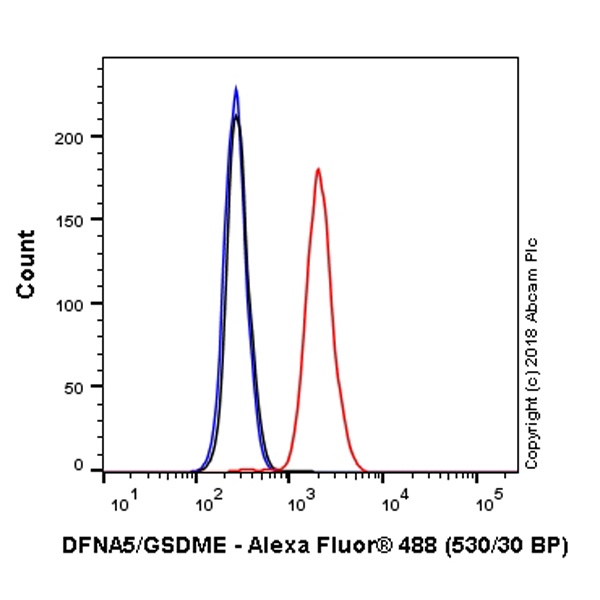
Overlay histogram showing RAW 264.7 cells stained with ab246713 (red line). The cells were fixed with 80% methanol (5 min) and then permeabilized with 0.1% PBS-Triton X-100 for 15 min. The cells were then incubated in 1x PBS / 10% normal Goat serum to block non-specific protein-protein interactions followed by the antibody (ab246713) (1x 10⁶ cells in 100 μl at 2 μg/ml (1/250 dilution)) for 30 min at 22°C.

Isotype control antibody (black line) was Rabbit IgG (monoclonal) Phycoerythrin (ab209478) used at the same concentration and conditions as the primary antibody. Unlabelled sample (blue line) was also used as a control. Acquisition of >5,000 events were collected using a 50 mW Yellow/Green laser (561nm) and 586/15 bandpass filter.

관련 conjugated 항체와 다양한 조성의 항체 (5)

주요 정보

Host species

Rabbit

Clonality

Monoclonal

Clone number

EPR20859

Isotype

IgG

Conjugation

PE

Excitation/Emission

Ex: 480;565nm, Em: 578nm

Carrier free

No

Reacts with

Mouse, Human, Mouse, Rat

Applications

IHC-P, ICC/IF, Flow Cyt (Intra)

applications

Immunogen

The exact immunogen used to generate this antibody is proprietary information.

Reactivity 정보

{ "title": "Reactivity Data", "filters": { "stats": ["", "Species", "Dilution Info", "Notes"], "tabs": { "all-applications": {"fullname" : "All Applications", "shortname": "All Applications"}, "FlowCytIntra" : {"fullname" : "Flow Cytometry (Intracellular)", "shortname":"Flow Cyt (Intra)"}, "ICCIF" : {"fullname" : "Immunocytochemistry/ Immunofluorescence", "shortname":"ICC/IF"}, "IHCP" : {"fullname" : "Immunohistochemistry (Formalin/PFA-fixed paraffin-embedded sections)", "shortname":"IHC-P"} }, "product-promise": { "all": "all", "testedAndGuaranteed": "tested", "guaranteed": "expected", "predicted": "predicted", "notRecommended": "not-recommended" } }, "values": { "Human": { "FlowCytIntra-species-checked": "guaranteed", "FlowCytIntra-species-dilution-info": "", "FlowCytIntra-species-notes": "<p></p>", "ICCIF-species-checked": "guaranteed", "ICCIF-species-dilution-info": "", "ICCIF-species-notes": "<p></p>", "IHCP-species-checked": "guaranteed", "IHCP-species-dilution-info": "", "IHCP-species-notes": "<p></p>" }, "Mouse": { "FlowCytIntra-species-checked": "testedAndGuaranteed", "FlowCytIntra-species-dilution-info": "1/250", "FlowCytIntra-species-notes": "<p>The cellular localisation of this product has been verified in ICC/IF.</p>", "ICCIF-species-checked": "guaranteed", "ICCIF-species-dilution-info": "", "ICCIF-species-notes": "<p></p>", "IHCP-species-checked": "guaranteed", "IHCP-species-dilution-info": "", "IHCP-species-notes": "<p></p>" }, "Rat": { "FlowCytIntra-species-checked": "guaranteed", "FlowCytIntra-species-dilution-info": "", "FlowCytIntra-species-notes": "<p></p>", "ICCIF-species-checked": "guaranteed", "ICCIF-species-dilution-info": "", "ICCIF-species-notes": "<p></p>", "IHCP-species-checked": "guaranteed", "IHCP-species-dilution-info": "", "IHCP-species-notes": "<p></p>" } } }

제품 세부 정보

Patented technology
Our RabMAb® technology is a patented hybridoma-based technology for making rabbit monoclonal antibodies. For details on our patents, please refer to RabMAb® patents.

What are the advantages of a recombinant monoclonal antibody?
This product is a recombinant monoclonal antibody, which offers several advantages including:

  • - High batch-to-batch consistency and reproducibility
  • - Improved sensitivity and specificity
  • - Long-term security of supply
  • - Animal-free batch production

For more information, read more on recombinant antibodies.

특성 및 보관 정보

제형
Liquid
Purification 테크닉
Affinity purification Protein A
보관 버퍼
pH: 7.4 Preservative: 0.02% Sodium azide Constituents: PBS, 1% BSA
배송 시 보관 조건
Blue Ice
적절한 단기 보관 기간
1-2 weeks
적절한 단기 보관 조건
+4°C
적절한 장기 보관 조건
+4°C
분주 정보
Upon delivery aliquot
보관 정보
Store in the dark

추가 정보

This supplementary information is collated from multiple sources and compiled automatically.

GSDMD also known as gasdermin D is a protein known for its role in pyroptosis a form of programmed cell death. Its molecular weight is approximately 53 kDa. Mechanically GSDMD operates by forming pores in cell membranes. These pores disrupt cellular homeostasis and eventually lead to cell lysis. GSDMD is mainly expressed in immune cells including macrophages and neutrophils. Researchers frequently use GSDMD Western blot and GSDMD ELISA for its detection and quantification in various studies.
Biological function summary

Gasdermin D functions in the execution of immune responses against infections. It acts as an effector molecule that participates directly in pyroptosis by disrupting mitochondrial membranes. GSDMD operates as part of a larger inflammasome complex initiated by inflammatory signals. The inflammasome activates inflammatory caspases that cleave GSDMD enabling its active form to execute pyroptosis. This process releases cytokines like IL-1β enhancing the inflammatory response.

Pathways

GSDMD is important in the pyroptosis pathway initiated by the inflammasome. This process involves Caspase-1 a protease responsible for cleaving pro-inflammatory cytokines and initiating pyroptosis. Another significant pathway includes NLRP3 inflammasome which acts upstream to activate Caspase-1 and subsequently GSDMD establishing the overall inflammatory response in the innate immune system. Through these pathways GSDMD interacts closely with proteins like IL-18 an essential inflammatory mediator.

Gasdermin D has links to inflammatory diseases such as rheumatoid arthritis and sepsis. In rheumatoid arthritis the excessive activation of GSDMD leads to chronic joint inflammation mediated by activated immune cells. In sepsis over-activation of the pyroptosis pathway may cause severe systemic inflammation driven by GSDMD activity exacerbating cytokine release. Connections exist between GSDMD and other proteins such as Caspase-11 which can also initiate GSDMD cleavage independently and has roles in non-canonical inflammasome pathways influencing these conditions.

제품 프로토콜

For this product, it's our understanding that no specific protocols are required. You can visit:

타겟 정보

Gasdermin-D. Precursor of a pore-forming protein that plays a key role in host defense against pathogen infection and danger signals (PubMed : 26375003, PubMed : 26375259, PubMed : 26611636, PubMed : 27383986, PubMed : 27385778, PubMed : 27418190). This form constitutes the precursor of the pore-forming protein : upon cleavage, the released N-terminal moiety (Gasdermin-D, N-terminal) binds to membranes and forms pores, triggering pyroptosis (PubMed : 26375003, PubMed : 26375259, PubMed : 26611636, PubMed : 27383986, PubMed : 27385778, PubMed : 27418190).. Gasdermin-D, N-terminal. Promotes pyroptosis in response to microbial infection and danger signals (PubMed : 26375003, PubMed : 26375259, PubMed : 26611636, PubMed : 27383986, PubMed : 27385778, PubMed : 27418190, PubMed : 32820063, PubMed : 34289345, PubMed : 35705808, PubMed : 37988464, PubMed : 38530158, PubMed : 38538834, PubMed : 38632402). Produced by the cleavage of gasdermin-D by inflammatory caspases CASP1 or CASP4/CASP11 in response to canonical, as well as non-canonical (such as cytosolic LPS) inflammasome activators (PubMed : 26375003, PubMed : 26375259, PubMed : 26611636, PubMed : 27383986, PubMed : 27385778, PubMed : 27418190, PubMed : 35705808, PubMed : 38632402). After cleavage, moves to the plasma membrane where it strongly binds to inner leaflet lipids, including monophosphorylated phosphatidylinositols, such as phosphatidylinositol 4-phosphate, bisphosphorylated phosphatidylinositols, such as phosphatidylinositol (4,5)-bisphosphate, as well as phosphatidylinositol (3,4,5)-bisphosphate, and more weakly to phosphatidic acid and phosphatidylserine (PubMed : 27339137, PubMed : 27383986). Homooligomerizes within the membrane and forms pores of 10-15 nanometers (nm) of inner diameter, allowing the release of mature interleukin-1 (IL1B and IL18) and triggering pyroptosis (PubMed : 27383986, PubMed : 29195811, PubMed : 29274245, PubMed : 33883744, PubMed : 38530158, PubMed : 38538834). Gasdermin pores also allow the release of mature caspase-7 (CASP7) (PubMed : 35705808). In some, but not all, cells types, pyroptosis is followed by pyroptotic cell death, which is caused by downstream activation of ninjurin-1 (NINJ1), which mediates membrane rupture (cytolysis) (PubMed : 38632402). Also forms pores in the mitochondrial membrane, resulting in release of mitochondrial DNA (mtDNA) into the cytosol (PubMed : 37001519). Gasdermin-D, N-terminal released from pyroptotic cells into the extracellular milieu rapidly binds to and kills both Gram-negative and Gram-positive bacteria, without harming neighboring mammalian cells, as it does not disrupt the plasma membrane from the outside due to lipid-binding specificity (PubMed : 27383986). Under cell culture conditions, also active against intracellular bacteria, such as Listeria monocytogenes (PubMed : 27383986). Also active in response to MAP3K7/TAK1 inactivation by Yersinia toxin YopJ, which triggers cleavage by CASP8 and subsequent activation (PubMed : 30361383, PubMed : 30381458). Required for mucosal tissue defense against enteric pathogens (PubMed : 37988464). Activation of the non-canonical inflammasome in brain endothelial cells can lead to excessive pyroptosis, leading to blood-brain barrier breakdown (PubMed : 38632402). Strongly binds to bacterial and mitochondrial lipids, including cardiolipin. Does not bind to unphosphorylated phosphatidylinositol, phosphatidylethanolamine nor phosphatidylcholine (PubMed : 27383986).. Gasdermin-D, p13. Transcription coactivator produced by the cleavage by CASP3 or CASP7 in the upper small intestine in response to dietary antigens (PubMed : 37327784). Required to maintain food tolerance in small intestine : translocates to the nucleus and acts as a coactivator for STAT1 to induce the transcription of CIITA and MHC class II molecules, which in turn induce type 1 regulatory T (Tr1) cells in upper small intestine (PubMed : 37327784).. Gasdermin-D, p40. Produced by the cleavage by papain allergen (PubMed : 35794369). After cleavage, moves to the plasma membrane and homooligomerizes within the membrane and forms pores of 10-15 nanometers (nm) of inner diameter, allowing the specific release of mature interleukin-33 (IL33), promoting type 2 inflammatory immune response (PubMed : 35749514, PubMed : 35794369).
See full target information Gsdmd

대체 명칭 보기

Gsdmdc1, Gsdmd, Gasdermin-D, Gasdermin domain-containing protein 1

제품이 사용된 논문 (3)

Recent publications for all applications. Explore the 전체 목록and refine your search

International journal of biological sciences 19:1413-1429 PubMed37056920

2023

PD-L1 promotes GSDMD-mediated NET release by maintaining the transcriptional activity of Stat3 in sepsis-associated encephalopathy.

Applications

Unspecified application

Species

Unspecified reactive species

Cheng-Long Zhu,Jian Xie,Qiang Liu,Yi Wang,Hui-Ru Li,Chang-Meng Yu,Peng Li,Xiao-Ming Deng,Jin-Jun Bian,Jia-Feng Wang

Nature communications 13:7658 PubMed36496445

2022

Sirt6 attenuates chondrocyte senescence and osteoarthritis progression.

Applications

Unspecified application

Species

Unspecified reactive species

Ming-Liang Ji,Hua Jiang,Zhuang Li,Rui Geng,Jun Zheng Hu,Yu Cheng Lin,Jun Lu

Cell 185:3214-3231.e23 PubMed35907404

2022

Mitochondrial ROS promotes susceptibility to infection via gasdermin D-mediated necroptosis.

Applications

Unspecified application

Species

Unspecified reactive species

Chi G Weindel,Eduardo L Martinez,Xiao Zhao,Cory J Mabry,Samantha L Bell,Krystal J Vail,Aja K Coleman,Jordyn J VanPortfliet,Baoyu Zhao,Allison R Wagner,Sikandar Azam,Haley M Scott,Pingwei Li,A Phillip West,Jason Karpac,Kristin L Patrick,Robert O Watson
제품이 사용된 논문 모두 보기

Product promise

저희는 고품질 시약으로 고객님의 연구를 서포트하고자 최선을 다하고 있으며, 모든 단계에서 함께 하겠습니다. 만약 제품이 기대한 성능을 보이지 않을 경우에도 Product Promise로 보호받으실 수 있습니다.
자세한 내용은 이용 약관을 확인해 주세요.

Please note: All products are 'FOR RESEARCH USE ONLY. NOT FOR USE IN DIAGNOSTIC OR THERAPEUTIC PROCEDURES'.

For licensing inquiries, please contact partnerships@abcam.com