JavaScript is disabled in your browser. Please enable JavaScript to view this website.
AB210827

PE Anti-HDAC2 antibody [Y461]

Be the first to review this product! 리뷰 제출

|

(1 출판물)

Rabbit Recombinant Monoclonal HDAC2 antibody - conjugated to PE. Suitable for ICC/IF, Flow Cyt (Intra), IHC-P and reacts with Human, Mouse, Rat samples. Cited in 1 publication.
2 이미지
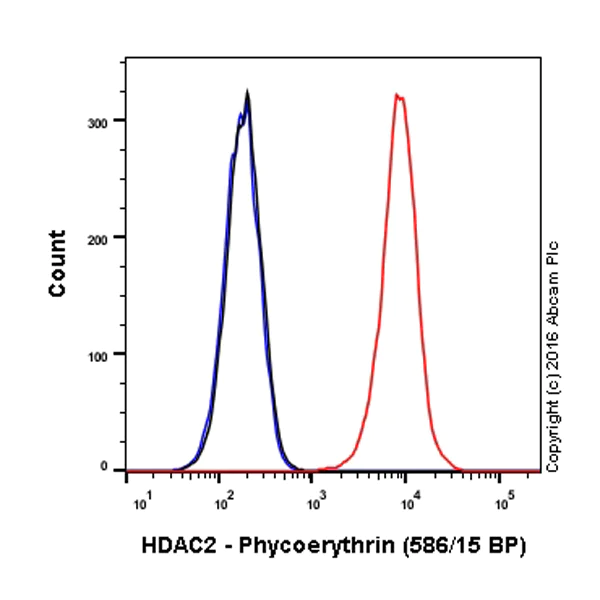
Flow Cytometry (Intracellular) - PE Anti-HDAC2 antibody [Y461] (AB210827)
  • Flow Cyt (Intra)

Lab

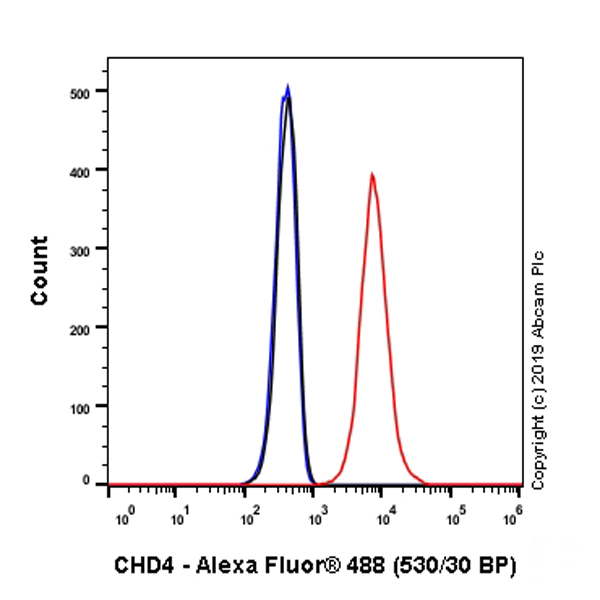
Flow Cytometry (Intracellular) - PE Anti-HDAC2 antibody [Y461] (AB210827)

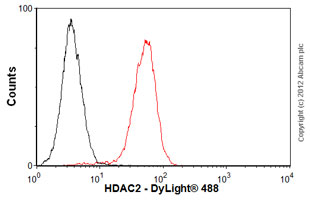
Overlay histogram showing HeLa cells stained with ab210827 (red line). The cells were fixed with 4% formaldehyde (10 min) and then permeabilized with 90% methanol for 30 min at -20°C. The cells were then incubated in 1x PBS / 10% normal goat serum to block non-specific protein-protein interactions followed by the antibody (ab210827, 1/500 dilution) for 30 min at 22°C.

Isotype control antibody (black line) was rabbit IgG (monoclonal) Phycoerythrin (ab209478) used at the same concentration and conditions as the primary antibody. Unlabelled sample (blue line) was also used as a control.

Acquisition of >5,000 events were collected using a 50mW Yellow-Green laser (561nm) and 586/15 bandpass filter.
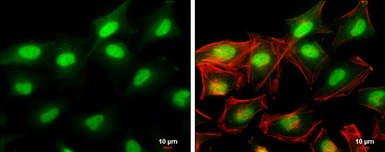
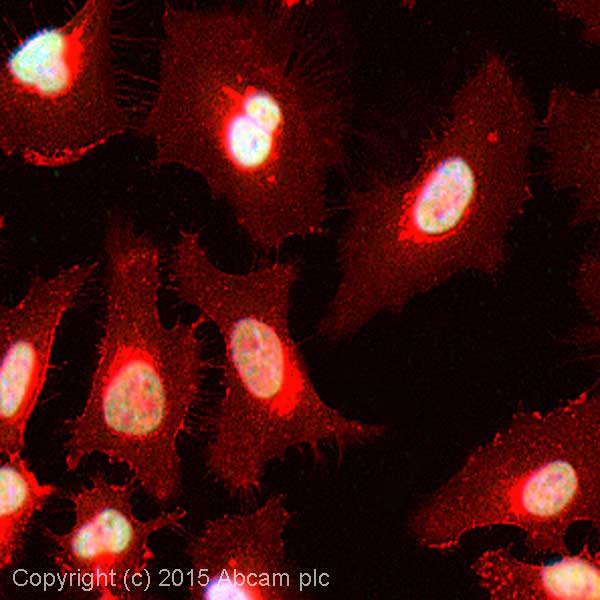
Immunocytochemistry/ Immunofluorescence - PE Anti-HDAC2 antibody [Y461] (AB210827)
  • ICC/IF

Lab

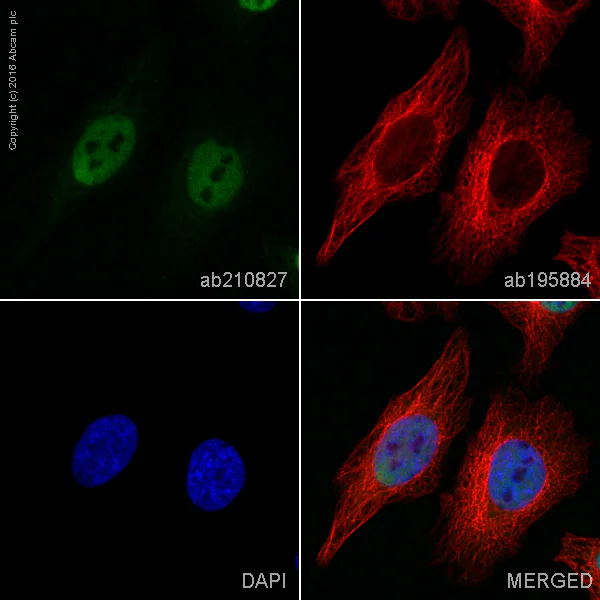
Immunocytochemistry/ Immunofluorescence - PE Anti-HDAC2 antibody [Y461] (AB210827)

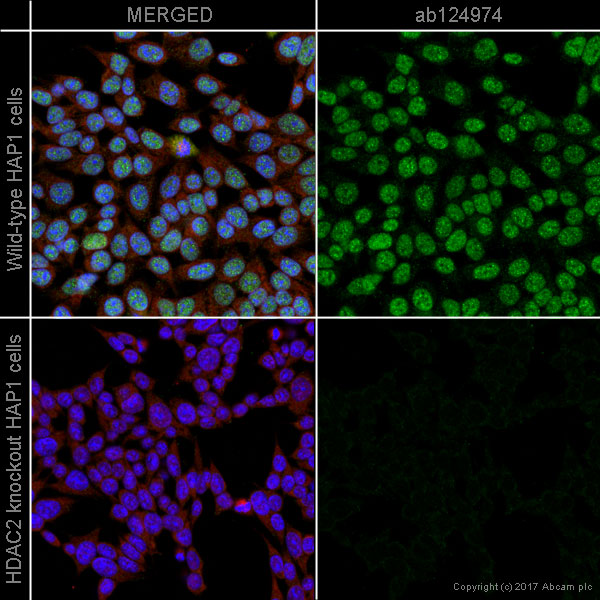
ab210827 staining HDAC2 in HeLa cells. The cells were fixed with 4% formaldehyde (10 min), permeabilized with 0.1% Triton X-100 for 5 minutes and then blocked with 1% BSA/10% normal goat serum/0.3M glycine in 0.1% PBS-Tween for 1h. The cells were then incubated overnight at +4°C with ab210827 at 1/100 dilution (pseudocolored in green) and ab195884, Rat monoclonal to Tubulin (Alexa Fluor® 647), at 1/250 dilution (shown in red). Nuclear DNA was labelled with DAPI (shown in blue).

Image was taken with a confocal microscope (Leica-Microsystems, TCS SP8).

This product also gave a positive signal under the same testing conditions in HeLa cells fixed with 100% methanol (5min).

관련 conjugated 항체와 다양한 조성의 항체 (9)

주요 정보

Host species

Rabbit

Clonality

Monoclonal

Clone number

Y461

Isotype

IgG

Conjugation

PE

Excitation/Emission

Ex: 480;565nm, Em: 578nm

Carrier free

No

Reacts with

Human, Human, Mouse, Rat

Applications

Flow Cyt (Intra), ICC/IF, IHC-P

applications

Immunogen

The exact immunogen used to generate this antibody is proprietary information.

Reactivity 정보

{ "title": "Reactivity Data", "filters": { "stats": ["", "Species", "Dilution Info", "Notes"], "tabs": { "all-applications": {"fullname" : "All Applications", "shortname": "All Applications"}, "ICCIF" : {"fullname" : "Immunocytochemistry/ Immunofluorescence", "shortname":"ICC/IF"}, "FlowCytIntra" : {"fullname" : "Flow Cytometry (Intracellular)", "shortname":"Flow Cyt (Intra)"}, "IHCP" : {"fullname" : "Immunohistochemistry (Formalin/PFA-fixed paraffin-embedded sections)", "shortname":"IHC-P"} }, "product-promise": { "all": "all", "testedAndGuaranteed": "tested", "guaranteed": "expected", "predicted": "predicted", "notRecommended": "not-recommended" } }, "values": { "Human": { "ICCIF-species-checked": "testedAndGuaranteed", "ICCIF-species-dilution-info": "1/100", "ICCIF-species-notes": "<p>This product gave a positive signal in HeLa cells fixed with 4% formaldehyde (10 min) and 100% methanol (5 min)</p>", "FlowCytIntra-species-checked": "testedAndGuaranteed", "FlowCytIntra-species-dilution-info": "1/500", "FlowCytIntra-species-notes": "<p></p>", "IHCP-species-checked": "guaranteed", "IHCP-species-dilution-info": "", "IHCP-species-notes": "<p></p>" }, "Mouse": { "ICCIF-species-checked": "guaranteed", "ICCIF-species-dilution-info": "", "ICCIF-species-notes": "<p></p>", "FlowCytIntra-species-checked": "guaranteed", "FlowCytIntra-species-dilution-info": "", "FlowCytIntra-species-notes": "<p></p>", "IHCP-species-checked": "guaranteed", "IHCP-species-dilution-info": "", "IHCP-species-notes": "<p></p>" }, "Rat": { "ICCIF-species-checked": "guaranteed", "ICCIF-species-dilution-info": "", "ICCIF-species-notes": "<p></p>", "FlowCytIntra-species-checked": "guaranteed", "FlowCytIntra-species-dilution-info": "", "FlowCytIntra-species-notes": "<p></p>", "IHCP-species-checked": "guaranteed", "IHCP-species-dilution-info": "", "IHCP-species-notes": "<p></p>" } } }

제품 세부 정보

Patented technology
Our RabMAb® technology is a patented hybridoma-based technology for making rabbit monoclonal antibodies. For details on our patents, please refer to RabMAb® patents.

특성 및 보관 정보

제형
Liquid
Purification 테크닉
Affinity purification Protein A
보관 버퍼
pH: 7.4 Preservative: 0.02% Sodium azide Constituents: PBS, 1% BSA
배송 시 보관 조건
Blue Ice
적절한 단기 보관 기간
Up to 12 months
적절한 단기 보관 조건
+4°C
적절한 장기 보관 조건
+4°C
분주 정보
Upon delivery aliquot
보관 정보
Do Not Freeze|Store in the dark

추가 정보

This supplementary information is collated from multiple sources and compiled automatically.

HDAC2 or Histone Deacetylase 2 is an important enzyme that plays a role in chromatin remodeling and gene expression regulation. It removes acetyl groups from histone tails allowing chromatin to condense and silencing gene expression. HDAC2 has a molecular weight of approximately 55 kDa. It is expressed in various tissues including brain heart and skeletal muscles indicating its importance in different physiological areas. HDAC2 proteins are often studied using methods like HDAC2 ELISA and HDAC2 anticuero in research settings.
Biological function summary

HDAC2 is involved in cell cycle regulation and differentiation. It is part of the co-repressor complex and interacts with other proteins such as Sin3 and NuRD to repress transcription. These interactions are vital for maintaining normal cellular functions and ensuring proper response to external signals. This protein is also connected to HEK293T cells which are a common model in scientific studies due to their robust expression of proteins like HDAC2.

Pathways

HDAC2 participates in the regulation of transcriptional activity and cellular stress response. It is an important player in the histone modification pathway interacting with proteins such as HDAC1 and transcriptional regulators like REST. HDAC2 is also linked with the Notch signaling pathway which is essential for cell fate decisions. These pathways highlight its role in both maintaining cellular homeostasis and adapting to changes in the cellular environment.

HDAC2 has a significant connection to neurodegenerative diseases and various cancers. Alzheimer's disease for instance shows altered expression levels of HDAC2 affecting synaptic plasticity and memory formation. In cancer HDAC2 interacts with oncogenic proteins such as p53 influencing tumor progression and metastasis. Monitoring HDAC2 levels and activity could provide insights into disease mechanisms and potential therapeutic targets.

제품 프로토콜

For this product, it's our understanding that no specific protocols are required. You can visit:

타겟 정보

Histone deacetylase that catalyzes the deacetylation of lysine residues on the N-terminal part of the core histones (H2A, H2B, H3 and H4) (PubMed : 28497810). Histone deacetylation gives a tag for epigenetic repression and plays an important role in transcriptional regulation, cell cycle progression and developmental events (By similarity). Histone deacetylases act via the formation of large multiprotein complexes (By similarity). Forms transcriptional repressor complexes by associating with MAD, SIN3, YY1 and N-COR (PubMed : 12724404). Component of a RCOR/GFI/KDM1A/HDAC complex that suppresses, via histone deacetylase (HDAC) recruitment, a number of genes implicated in multilineage blood cell development (By similarity). Acts as a component of the histone deacetylase NuRD complex which participates in the remodeling of chromatin (PubMed : 16428440, PubMed : 28977666). Component of the SIN3B complex that represses transcription and counteracts the histone acetyltransferase activity of EP300 through the recognition H3K27ac marks by PHF12 and the activity of the histone deacetylase HDAC2 (PubMed : 37137925). Also deacetylates non-histone targets : deacetylates TSHZ3, thereby regulating its transcriptional repressor activity (PubMed : 19343227). May be involved in the transcriptional repression of circadian target genes, such as PER1, mediated by CRY1 through histone deacetylation (By similarity). Involved in MTA1-mediated transcriptional corepression of TFF1 and CDKN1A (PubMed : 21965678). In addition to protein deacetylase activity, also acts as a protein-lysine deacylase by recognizing other acyl groups : catalyzes removal of (2E)-butenoyl (crotonyl), lactoyl (lactyl) and 2-hydroxyisobutanoyl (2-hydroxyisobutyryl) acyl groups from lysine residues, leading to protein decrotonylation, delactylation and de-2-hydroxyisobutyrylation, respectively (PubMed : 28497810, PubMed : 29192674, PubMed : 35044827).
See full target information HDAC2

대체 명칭 보기

Histone deacetylase 2, HD2, Protein deacylase HDAC2, HDAC2

제품이 사용된 논문 (1)

Recent publications for all applications. Explore the 전체 목록and refine your search

European journal of medical research 30:942 PubMed41068947

2025

Molecular interplay between TXNIP and GLUT9 underlies uric acid transport dysregulation in vitro under hyperuricemic stress.

Applications

Unspecified application

Species

Unspecified reactive species

Yuqiu Zhu,Bei Zhang,Yi He,Manxi Du,Wujin Chen,Xiaoyu Chen,Qingqing Yang,Mayina Kahaer,Yuping Sun
제품이 사용된 논문 모두 보기

Product promise

저희는 고품질 시약으로 고객님의 연구를 서포트하고자 최선을 다하고 있으며, 모든 단계에서 함께 하겠습니다. 만약 제품이 기대한 성능을 보이지 않을 경우에도 Product Promise로 보호받으실 수 있습니다.
자세한 내용은 이용 약관을 확인해 주세요.

Please note: All products are 'FOR RESEARCH USE ONLY. NOT FOR USE IN DIAGNOSTIC OR THERAPEUTIC PROCEDURES'.

For licensing inquiries, please contact partnerships@abcam.com