JavaScript is disabled in your browser. Please enable JavaScript to view this website.
AB210189

PE Anti-PD-L1 antibody [10F.9G2]

Be the first to review this product! 리뷰 제출

|

(2 제품이 사용된 논문 )

Anti-PD-L1 antibody [10F.9G2] conjugated to PE - suitable for flow cytometry, and reacts with mouse samples. Clone [10F.9G2] is a rat monoclonal antibody and one of the most commonly used clones for flow cytometry.

Design your panel with our interactive flow cytometry panel builder. Click here.
1 이미지
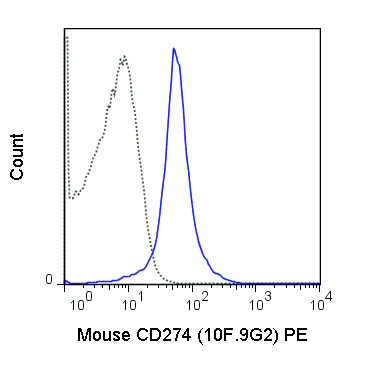
Flow Cytometry - PE Anti-PD-L1 antibody [10F.9G2] (AB210189)
  • Flow Cyt

Supplier Data

Flow Cytometry - PE Anti-PD-L1 antibody [10F.9G2] (AB210189)

Flow cytometric analysis of mouse C57BI/6 splenocytes labeling PD-L1 with 0.25 μg ab210189 (solid line) or 0.25 μg PE rat IgG2b isotype control (dashed line).

관련 conjugated 항체와 다양한 조성의 항체 (1)

  • 660 APC

    APC Anti-PD-L1 antibody [10F.9G2]

주요 정보

Host species

Rat

Clonality

Monoclonal

Clone number

10F.9G2

Isotype

IgG2b

Light chain 타입

kappa

Conjugation

PE

Excitation/Emission

Ex: 480;565nm, Em: 578nm

Carrier free

No

Reacts with

Mouse

Applications

Flow Cyt

applications

Immunogen

CHO-mPD-L1 transfectants. Database link Q9EP73

Reactivity 정보

{ "title": "Reactivity Data", "filters": { "stats": ["", "Species", "Dilution Info", "Notes"], "tabs": { "all-applications": {"fullname" : "All Applications", "shortname": "All Applications"}, "FlowCyt" : {"fullname" : "Flow Cytometry", "shortname":"Flow Cyt"} }, "product-promise": { "all": "all", "testedAndGuaranteed": "tested", "guaranteed": "expected", "predicted": "predicted", "notRecommended": "not-recommended" } }, "values": { "Mouse": { "FlowCyt-species-checked": "testedAndGuaranteed", "FlowCyt-species-dilution-info": "", "FlowCyt-species-notes": "<p>Use 0.25 μg.</p>" } } }

특성 및 보관 정보

제형
Liquid
Purification 테크닉
Affinity purification Protein A
Purification 관련 사항
ab210189 was purified from tissue culture supernatant via affinity chromatography. The purified antibody was conjugated under optimal conditions, with unreacted dye removed from the preparation.
보관 버퍼
pH: 7.2 Preservative: 0.09% Sodium azide Constituents: 0.87% Sodium chloride, 0.12% Sodium dihydrogen phosphate, 0.1% Gelatin
배송 시 보관 조건
Blue Ice
적절한 단기 보관 조건
+4°C
적절한 장기 보관 조건
+4°C
보관 정보
Store in the dark

추가 정보

This supplementary information is collated from multiple sources and compiled automatically.

PD-L1 also known as Programmed Death-Ligand 1 or CD274 is a protein involved in immune modulation. Mechanically PD-L1 interacts with its receptors particularly PD-1 to regulate cellular immune responses. This transmembrane protein has a calculated molecular weight of approximately 33 kDa. PD-L1 is expressed on various cell types including tumor cells and immune cells such as dendritic cells macrophages and B cells. Its expression is often upregulated in response to inflammatory cytokines.
Biological function summary

PD-L1 plays a central role in immune evasion mechanisms utilized by tumors. It is not part of a larger protein complex but directly interacts with PD-1 and CD80. When PD-L1 binds to PD-1 it sends inhibitory signals leading to decreased T cell activation and proliferation allowing cancer cells to avoid immune destruction. PD-L1 expression provides a mechanism for tumors to suppress immune surveillance facilitating tumor progression.

Pathways

PD-L1 is integral to the immune checkpoint pathway which is an important regulator of immune response. The interaction between PD-L1 and PD-1 provides a mechanism for immune tolerance which is part of the broader adaptive immune system pathway. PD-L1 is related to other immune checkpoint proteins such as CTLA-4 in its function to limit autoreactivity and promote immune homeostasis.

PD-L1 is most associated with cancer particularly in tumors such as melanoma and non-small cell lung cancer. PD-L1 expression on tumor cells often correlates with poor prognosis. PD-L1 directly interacts with PD-1 in these cancers a target for immunotherapies such as checkpoint inhibitors which aim to block this interaction and restore immune activity against tumors. PD-L1 involvement extends to autoimmune disorders where altered expression can impact tolerance and lead to immune-related tissue damage.

제품 프로토콜

For this product, it's our understanding that no specific protocols are required. You can visit:

타겟 정보

Plays a critical role in induction and maintenance of immune tolerance to self (PubMed : 11238124). As a ligand for the inhibitory receptor PDCD1/PD-1, modulates the activation threshold of T-cells and limits T-cell effector response (PubMed : 11238124). Through a yet unknown activating receptor, may costimulate T-cell subsets that predominantly produce interleukin-10 (IL10) (PubMed : 11015443, PubMed : 12719480).. The PDCD1-mediated inhibitory pathway is exploited by tumors to attenuate anti-tumor immunity and escape destruction by the immune system, thereby facilitating tumor survival (PubMed : 12218188, PubMed : 27281199). The interaction with PDCD1/PD-1 inhibits cytotoxic T lymphocytes (CTLs) effector function (PubMed : 12218188). The blockage of the PDCD1-mediated pathway results in the reversal of the exhausted T-cell phenotype and the normalization of the anti-tumor response, providing a rationale for cancer immunotherapy (PubMed : 12218188).
See full target information Cd274

대체 명칭 보기

CD274, B7h1, Pdcd1l1, Pdcd1lg1, Pdl1, Cd274, Programmed cell death 1 ligand 1, PD-L1, PDCD1 ligand 1, Programmed death ligand 1, B7 homolog 1, B7-H1

제품이 사용된 논문 (2)

Recent publications for all applications. Explore the 전체 목록and refine your search

Nature communications 9:4777 PubMed30429468

2018

MR imaging tracking of inflammation-activatable engineered neutrophils for targeted therapy of surgically treated glioma.

Applications

Unspecified application

Species

Unspecified reactive species

Meiying Wu,Haixian Zhang,Changjun Tie,Chunhong Yan,Zhiting Deng,Qian Wan,Xin Liu,Fei Yan,Hairong Zheng

Microcirculation (New York, N.Y. : 1994) 9:133-45 PubMed11932780

2002

Expression and regulation of the PD-L1 immunoinhibitory molecule on microvascular endothelial cells.

Applications

Unspecified application

Species

Unspecified reactive species

Michael J Eppihimer,Jason Gunn,Gordon J Freeman,Edward A Greenfield,Tetyana Chernova,Jamie Erickson,John P Leonard
제품이 사용된 논문 모두 보기

Product promise

저희는 고품질 시약으로 고객님의 연구를 서포트하고자 최선을 다하고 있으며, 모든 단계에서 함께 하겠습니다. 만약 제품이 기대한 성능을 보이지 않을 경우에도 Product Promise로 보호받으실 수 있습니다.
자세한 내용은 이용 약관을 확인해 주세요.

Please note: All products are 'FOR RESEARCH USE ONLY. NOT FOR USE IN DIAGNOSTIC OR THERAPEUTIC PROCEDURES'.

For licensing inquiries, please contact partnerships@abcam.com