JavaScript is disabled in your browser. Please enable JavaScript to view this website.
AB86930

Anti-Phospholamban antibody

Be the first to review this product! 리뷰 제출

|

(8 제품이 사용된 논문 )

Rabbit Polyclonal Phospholamban antibody. Suitable for WB and reacts with Mouse, Rat, Human samples. Cited in 8 publications. Immunogen corresponding to Synthetic Peptide within Human PLN aa 1-50.
2 이미지
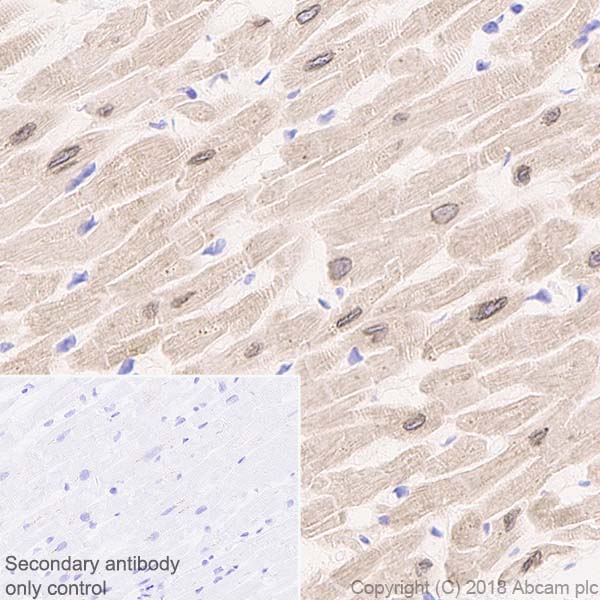
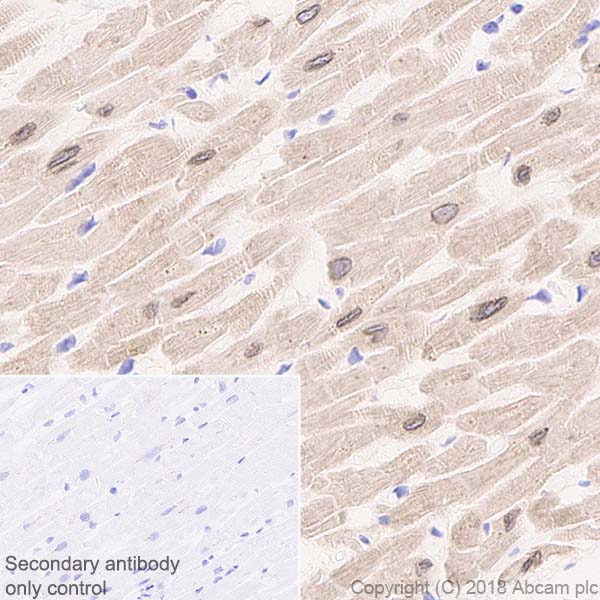
Western blot - Anti-Phospholamban antibody (AB86930)
  • WB

Unknown

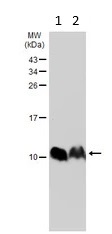
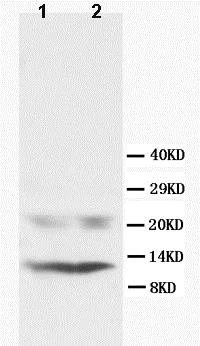
Western blot - Anti-Phospholamban antibody (AB86930)

All lanes:

Western blot - Anti-Phospholamban antibody (ab86930) at 1 µg/mL

All lanes:

Rat heart tissue lysate

Predicted band size: 6 kDa

Observed band size: 11 kDa

false
Western blot - Anti-Phospholamban antibody (AB86930)
  • WB

CiteAb

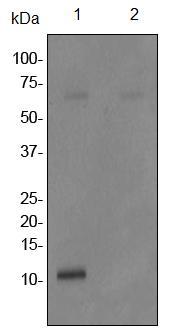
Western blot - Anti-Phospholamban antibody (AB86930)

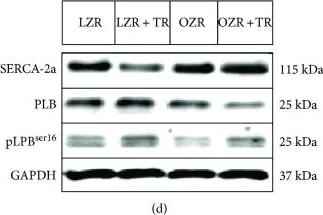
Phospholamban western blot using anti-Phospholamban antibody ab86930. Publication image and figure legend from Silveira, A. C., Fernandes, T., et al., 2017, Oxid Med Cell Longev, PubMed 29138674.

ab86930 was used in this publication in western blot. This may not be the same as the application(s) guaranteed by Abcam. For a full list of applications guaranteed by Abcam for ab86930 please see the product overview.

Effects of AET and obesity on calcium signaling proteins. SERCA-2a (a), phospholamban (PLB) (b), and phospholamban phosphorylated on serine16 (pPLBser16) (c) protein levels were evaluated by probing western blots of left ventricle (LV) proteins. (d) Representative blots of SERCA-2a, PLB, pPLBser16, and GAPDH in LZR (lean group control), LZR + TR (lean trained group), OZR (obese group control), and OZR + TR (obese trained group). *p < 0.05 versus OZR and LZR.

false

주요 정보

Host species

Rabbit

Clonality

Polyclonal

Isotype

IgG

Carrier free

No

Reacts with

Mouse, Rat, Human

Applications

WB

applications

Immunogen

Synthetic Peptide within Human PLN aa 1-50. The exact immunogen used to generate this antibody is proprietary information.

P26678

Reactivity 정보

{ "title": "Reactivity Data", "filters": { "stats": ["", "Species", "Dilution Info", "Notes"], "tabs": { "all-applications": {"fullname" : "All Applications", "shortname": "All Applications"}, "WB" : {"fullname" : "Western blot", "shortname":"WB"} }, "product-promise": { "all": "all", "testedAndGuaranteed": "tested", "guaranteed": "expected", "predicted": "predicted", "notRecommended": "not-recommended" } }, "values": { "Human": { "WB-species-checked": "testedAndGuaranteed", "WB-species-dilution-info": "1 µg/mL", "WB-species-notes": "<p></p>" }, "Mouse": { "WB-species-checked": "testedAndGuaranteed", "WB-species-dilution-info": "", "WB-species-notes": "<p></p>" }, "Rat": { "WB-species-checked": "testedAndGuaranteed", "WB-species-dilution-info": "1 µg/mL", "WB-species-notes": "<p></p>" } } }

특성 및 보관 정보

제형
Liquid
Purification 테크닉
Affinity purification Immunogen
보관 버퍼
Preservative: 0.025% Sodium azide, 0.025% Thimerosal (merthiolate) Constituents: 2.5% BSA, 0.45% Sodium chloride, 0.1% Disodium hydrogenorthophosphate
배송 시 보관 조건
Blue Ice
적절한 단기 보관 조건
+4°C
적절한 장기 보관 조건
-20°C
분주 정보
Upon delivery aliquot
보관 정보
Avoid freeze / thaw cycle

추가 정보

This supplementary information is collated from multiple sources and compiled automatically.

Phospholamban abbreviated as PLN is an important regulatory protein in cardiac muscle cells often referred to interchangeably with its phosphorylated form phospho-phospholamban. This protein with a molecular mass of about 6 kDa is primarily expressed in cardiac and skeletal muscles. It functions mechanically by regulating the calcium pump (SERCA2a) in the sarcoplasmic reticulum modulating calcium uptake during muscle relaxation. In its unphosphorylated state phospholamban inhibits the activity of SERCA2a reducing calcium uptake and affecting muscle contractility.
Biological function summary

Phospholamban serves as an important mediator in the control of cardiac muscle contraction and relaxation. It is a component of the calcium cycling process within heart cells and associates directly with SERCA2a to form a regulatory complex. This association allows phospholamban to influence calcium homeostasis significantly affecting myocardial contractility and relaxation. Phosphorylation of phospholamban typically induced by beta-adrenergic signaling results in diminished interaction with SERCA2a enhancing calcium uptake into the sarcoplasmic reticulum.

Pathways

Several important pathways involve phospholamban including the adrenergic signaling pathway in cardiomyocytes and calcium signaling pathways. Phospholamban's role in these pathways is linked with proteins like SERCA2a and Protein Kinase A (PKA). PKA phosphorylates phospholamban an important step in the beta-adrenergic cascade that leads to increased heart muscle contractility. This phosphorylation event highlights phospholamban's participation in modulating cardiac output under sympathetic nervous system influence.

Phospholamban's regulation of calcium homeostasis connects it directly to conditions like heart failure and cardiomyopathy. In heart failure the dysregulation of phospholamban phosphorylation can lead to impaired cardiac function due to disrupted calcium cycling reducing cardiac output. Mutations in the phospholamban gene can lead to dilated cardiomyopathy a condition characterized by the enlargement and weakening of the heart muscle. These mutations affect the interaction with SERCA2a highlighting the role of phospholamban in maintaining cardiac muscle health.

제품 프로토콜

For this product, it's our understanding that no specific protocols are required. You can visit:

타겟 정보

Reversibly inhibits the activity of ATP2A2/SERCA2 in cardiac sarcoplasmic reticulum by decreasing the apparent affinity of the ATPase for Ca(2+) (PubMed : 28890335). Binds preferentially to the ATP-bound E1 conformational form of ATP2A2 which predominates at low Ca(2+) concentrations during the diastolic phase of the cardiac cycle (By similarity). Inhibits ATP2A2 Ca(2+) affinity by disrupting its allosteric activation by ATP (By similarity). Modulates the contractility of the heart muscle in response to physiological stimuli via its effects on ATP2A2. Modulates calcium re-uptake during muscle relaxation and plays an important role in calcium homeostasis in the heart muscle. The degree of ATP2A2 inhibition depends on the oligomeric state of PLN. ATP2A2 inhibition is alleviated by PLN phosphorylation (By similarity). Also inhibits the activity of ATP2A3/SERCA3 (By similarity). Controls intracellular Ca(2+) levels in elongated spermatids and may play a role in germ cell differentiation (By similarity). In the thalamic reticular nucleus of the brain, plays a role in the regulation of sleep patterns and executive functioning (By similarity).
See full target information PLN

대체 명칭 보기

PLB, PLN, Phospholamban

제품이 사용된 논문 (8)

Recent publications for all applications. Explore the 전체 목록and refine your search

The Journal of physiology 601:4033-4052 PubMed37561554

2023

Cardiomyocytes from female compared to male mice have larger ryanodine receptor clusters and higher calcium spark frequency.

Applications

Unspecified application

Species

Unspecified reactive species

Martin Laasmaa,Jelena Branovets,Jekaterina Stolova,Xin Shen,Triinu Rätsepso,Mihkel Jaan Balodis,Cärolin Grahv,Eliise Hendrikson,William Edward Louch,Rikke Birkedal,Marko Vendelin

Acta physiologica (Oxford, England) 228:e13378 PubMed31520455

2019

Disturbed cardiac mitochondrial and cytosolic calcium handling in a metabolic risk-related rat model of heart failure with preserved ejection fraction.

Applications

Unspecified application

Species

Unspecified reactive species

Daniela Miranda-Silva,Rob C I Wüst,Glória Conceição,Patrícia Gonçalves-Rodrigues,Nádia Gonçalves,Alexandre Gonçalves,Diederik W D Kuster,Adelino F Leite-Moreira,Jolanda van der Velden,Jorge M de Sousa Beleza,José Magalhães,Ger J M Stienen,Inês Falcão-Pires

Nature communications 8:1258 PubMed29097735

2017

Mammalian γ2 AMPK regulates intrinsic heart rate.

Applications

Unspecified application

Species

Unspecified reactive species

Arash Yavari,Mohamed Bellahcene,Annalisa Bucchi,Syevda Sirenko,Katalin Pinter,Neil Herring,Julia J Jung,Kirill V Tarasov,Emily J Sharpe,Markus Wolfien,Gabor Czibik,Violetta Steeples,Sahar Ghaffari,Chinh Nguyen,Alexander Stockenhuber,Joshua R St Clair,Christian Rimmbach,Yosuke Okamoto,Dongmei Yang,Mingyi Wang,Bruce D Ziman,Jack M Moen,Daniel R Riordon,Christopher Ramirez,Manuel Paina,Joonho Lee,Jing Zhang,Ismayil Ahmet,Michael G Matt,Yelena S Tarasova,Dilair Baban,Natasha Sahgal,Helen Lockstone,Rathi Puliyadi,Joseph de Bono,Owen M Siggs,John Gomes,Hannah Muskett,Mahon L Maguire,Youlia Beglov,Matthew Kelly,Pedro P N Dos Santos,Nicola J Bright,Angela Woods,Katja Gehmlich,Henrik Isackson,Gillian Douglas,David J P Ferguson,Jürgen E Schneider,Andrew Tinker,Olaf Wolkenhauer,Keith M Channon,Richard J Cornall,Eduardo B Sternick,David J Paterson,Charles S Redwood,David Carling,Catherine Proenza,Robert David,Mirko Baruscotti,Dario DiFrancesco,Edward G Lakatta,Hugh Watkins,Houman Ashrafian

Oxidative medicine and cellular longevity 2017:1549014 PubMed29138674

2017

Exercise Training Restores Cardiac MicroRNA-1 and MicroRNA-29c to Nonpathological Levels in Obese Rats.

Applications

Unspecified application

Species

Unspecified reactive species

André C Silveira,Tiago Fernandes,Úrsula P R Soci,João L P Gomes,Diego L Barretti,Glória G F Mota,Carlos Eduardo Negrão,Edilamar M Oliveira

American journal of physiology. Heart and circulat 312:H728-H741 PubMed28235788

2017

A systems genetics approach identifies as a link between cardiomyocyte glucose utilization and hypertrophic response.

Applications

Unspecified application

Species

Unspecified reactive species

Marcus M Seldin,Eric D Kim,Milagros C Romay,Shen Li,Christoph D Rau,Jessica J Wang,Karthickeyan Chella Krishnan,Yibin Wang,Arjun Deb,Aldons J Lusis

Cardiovascular research 110:200-14 PubMed26825555

2016

Selective phosphorylation of PKA targets after β-adrenergic receptor stimulation impairs myofilament function in Mybpc3-targeted HCM mouse model.

Applications

Unspecified application

Species

Unspecified reactive species

Aref Najafi,Vasco Sequeira,Michiel Helmes,Ilse A E Bollen,Max Goebel,Jessica A Regan,Lucie Carrier,Diederik W D Kuster,Jolanda Van Der Velden

BMC cardiovascular disorders 15:166 PubMed26646371

2015

Exercise training restores the cardiac microRNA-1 and -214 levels regulating Ca2+ handling after myocardial infarction.

Applications

WB

Species

Rat

Stéphano Freitas Soares Melo,Valério Garrone Barauna,Vander José Neves,Tiago Fernandes,Lucienne da Silva Lara,Diego Robles Mazzotti,Edilamar Menezes Oliveira

Life sciences 117:67-74 PubMed25283082

2014

Swimming training promotes cardiac remodeling and alters the expression of mRNA and protein levels involved in calcium handling in hypertensive rats.

Applications

Unspecified application

Species

Unspecified reactive species

Jamille Locatelli,Leonardo Vinícius Monteiro de Assis,Carolina Morais Araújo,Andréia Carvalho Alzamora, Wanderson Geraldo de Lima,Maria José Campagnole-Santos,Robson Augusto dos Santos,Mauro César Isoldi
제품이 사용된 논문 모두 보기

Product promise

저희는 고품질 시약으로 고객님의 연구를 서포트하고자 최선을 다하고 있으며, 모든 단계에서 함께 하겠습니다. 만약 제품이 기대한 성능을 보이지 않을 경우에도 Product Promise로 보호받으실 수 있습니다.
자세한 내용은 이용 약관을 확인해 주세요.

Please note: All products are 'FOR RESEARCH USE ONLY. NOT FOR USE IN DIAGNOSTIC OR THERAPEUTIC PROCEDURES'.

For licensing inquiries, please contact partnerships@abcam.com