Anti-Prosurfactant Protein C antibody [EPR21012-72] - BSA and Azide free (Capture)
- RabMAb
- Recombinant
- 각 태그의 뜻
Be the first to review this product! 리뷰 제출
|
(0 출판물)
- ICC/IF
Lab
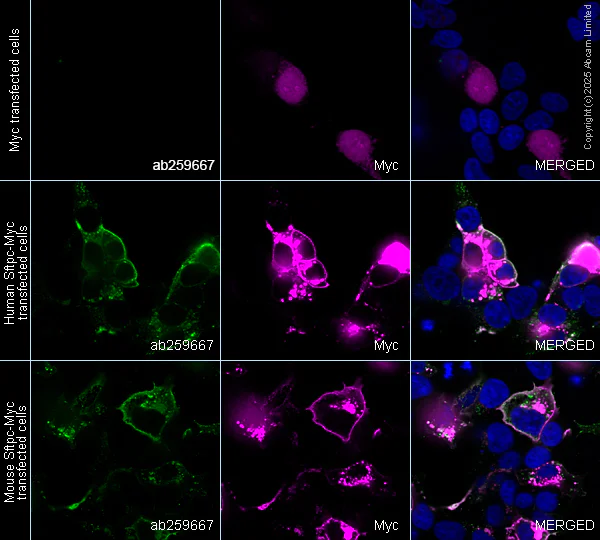
Immunocytochemistry/ Immunofluorescence - Anti-Prosurfactant Protein C antibody [EPR21012-72] - BSA and Azide free (Capture) (AB259667)
Immunofluorescent analysis of 4% paraformaldehyde-fixed, 0.1% TritonX-100 permeabilized HEK-293T cells transfected with an empty expression vector containing a myc-His-tag®; HEK-293T cells transfected with a mouse SFTPC expression vector containing a myc-His-tag®; HEK-293T cells transfected with a human SFTPC expression vector containing a myc-His-tag® cells labeling Prosurfactant Protein C with ab259667 at 1/5000 dilution following ab150081 Goat Anti-Rabbit IgG H&L (Alexa Fluor® 488) preadsorbed at 1/1000 dilution (Green).
Confocal image showing cytoplasmic staining in 293T cells (shown in green) transfected a mouse SFTPC expression vectorcontaining a myc-His-tag® and 293T cells transfected a human SFTPC expression vector containing a myc-His-tag®. The counterstain was observed in magenta. Nuclear DNA was labelled with DAPI (shown in blue). Image was taken with a confocal microscope (Leica-Microsystems, TCS SP8).
ab223894 Anti-Myc tag mouse monoclonal antibody (Alexa Fluor® 594) was used to counterstain at 1/100 dilution (Magenta). The nuclear counterstain was DAPI (Blue).
- Flow Cyt (Intra)
Lab
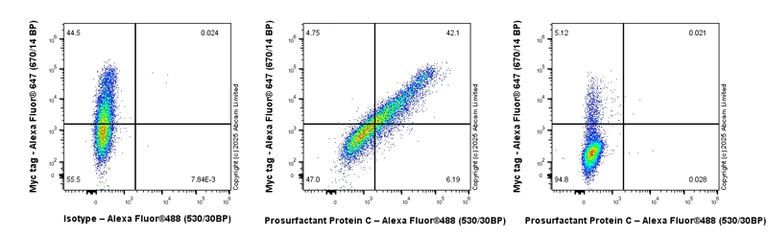
Flow Cytometry (Intracellular) - Anti-Prosurfactant Protein C antibody [EPR21012-72] - BSA and Azide free (Capture) (AB259667)
Flow cytometric analysis of 4% paraformaldehyde fixed 90% methanol permeabilized 293T cells transfected with a human SFTPC expression vector containing a myc-His-tag® (Middle); 293T cells transfected with an empty expression vector containing a myc-His-tag® (Right) cells labelling Prosurfactant Protein C with ab259667 at 1/10000 dilution (0.01 ug) / Middle and right compared with a Rabbit monoclonal IgG (ab172730) / Left isotype control and an unlabelled control (cells without incubation with primary antibody and secondary antibody).
Goat Anti-Rabbit IgG (Alexa Fluor® 488, ab150081) at 1/5000 dilution was used as the secondary antibody.
Cells were co-stained with anti-myc conjugated to Alexa Fluor®647.
- Flow Cyt (Intra)
Lab
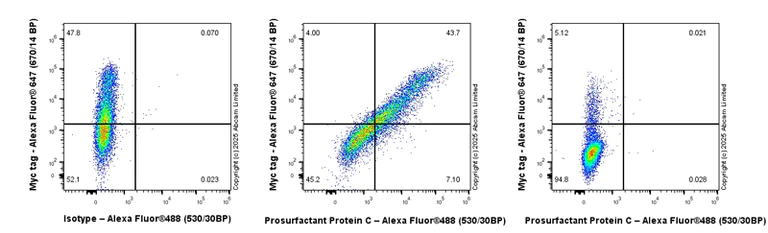
Flow Cytometry (Intracellular) - Anti-Prosurfactant Protein C antibody [EPR21012-72] - BSA and Azide free (Capture) (AB259667)
Flow cytometric analysis of 4% paraformaldehyde fixed 90% methanol permeabilized 293T cells transfected with a mouse SFTPC expression vector containing a myc-His-tag® (Middle); 293T cells transfected with an empty expression vector containing a myc-His-tag® (Right) cells labelling Prosurfactant Protein C with ab259667 at 1/10000 dilution (0.01 ug) / Middle and right compared with a Rabbit monoclonal IgG (ab172730) / Left isotype control and an unlabelled control (cells without incubation with primary antibody and secondary antibody).
Goat Anti-Rabbit IgG (Alexa Fluor® 488, ab150081) at 1/5000 dilution was used as the secondary antibody.
Cells were co-stained with anti-myc conjugated to Alexa Fluor®647.
- sELISA
Unknown
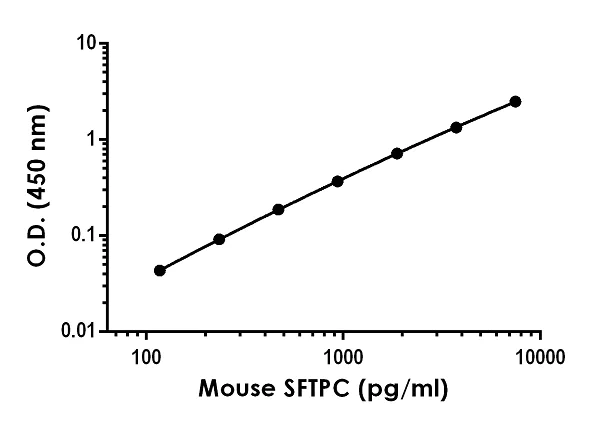
Sandwich ELISA - Anti-Prosurfactant Protein C antibody [EPR21012-72] - BSA and Azide free (Capture) (AB259667)
Representative standard curve from corresponding SimpleStep ELISA® Kit (ab252366).
- WB
Lab
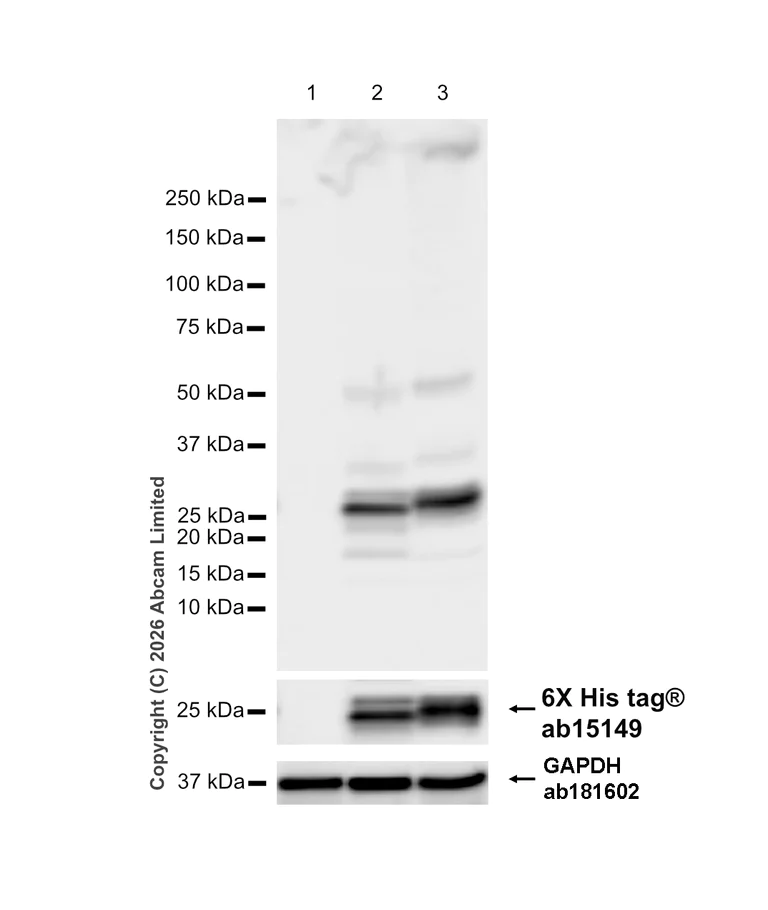
Western blot - Anti-Prosurfactant Protein C antibody [EPR21012-72] - BSA and Azide free (Capture) (AB259667)
Blocking and diluting buffer and concentration : 5% NFDM/TBST.
In Western blot, Anti-GAPDH antibody [EPR16891] - Loading Control (ab181602) was used at 1/200000 dilution (36KDa).
All lanes:
Western blot - Anti-Prosurfactant Protein C antibody [EPR21012-72] - BSA and Azide free (Capture) (ab259667) at 1/1000 dilution
Lane 1:
293T (human embryonic kidney epithelial cell) transfected with an empty vector containing a His-tag, whole cell lysate at 20 µg
Lane 2:
293T transfected with a human SFTPC expression vector containing a His-tag, whole cell lysate at 20 µg
Lane 3:
293T transfected with a mouse SFTPC expression vector containing a His-tag, whole cell lysate at 20 µg
Secondary
All lanes:
Western blot - Goat Anti-Rabbit IgG H&L (HRP) (<a href='/ko/products/secondary-antibodies/goat-rabbit-igg-h-l-hrp-ab97051'>ab97051</a>) at 1/100000 dilution
Observed band size: 21 kDa
false
Exposure time: 4s
보완 제품


Primary Antibodies
AB76013
Anti-TTF1/Nkx2-1 antibody [EP1584Y]
RabMAb|Recombinant|20ul selling size

- 5
- 18
Primary Antibodies
AB183734
RabMAb|Recombinant|Lab Essentials|20ul selling size

- 5
- 24
Primary Antibodies
AB124964
Anti-alpha smooth muscle Actin antibody [EPR5368]
BOND RX™ Validated|RabMAb|Recombinant|KO Validated|20ul selling size

- 5
- 19
Reactivity 정보
제품 세부 정보
ab259667 is a BSA and Azide Free antibody supplied in an unconjugated format and it is suitable for sandwich ELISAs to quantify Mouse SFTPC. The recommended pair for sandwich ELISA is:
Capture: ab259667, Mouse SFTPC Capture Antibody (unconjugated)
Detector: ab259668, Mouse SFTPC Detector Antibody (unconjugated)
The reference range value is 117.19 - 7500 pg/ml.
Patented technology
Our RabMAb® technology is a patented hybridoma-based technology for making rabbit monoclonal antibodies. For details on our patents, please refer to RabMAb® patents.
What are the advantages of a recombinant monoclonal antibody?
This product is a recombinant monoclonal antibody, which offers several advantages including:
- - High batch-to-batch consistency and reproducibility
- - Improved sensitivity and specificity
- - Long-term security of supply
- - Animal-free batch production
For more information, read more on recombinant antibodies.
Conjugation ready
Our carrier-free antibodies are typically supplied in a PBS-only formulation, purified and free of BSA, sodium azide and glycerol. This conjugation-ready format is designed for use with fluorochromes, metal isotopes, oligonucleotides, and enzymes, which makes them ideal for antibody labelling, functional and cell-based assays, flow-based assays (e.g. mass cytometry) and Multiplex Imaging applications.
Use our conjugation kits for antibody conjugates that are ready-to-use in as little as 20 minutes with 1 minute hands-on-time and 100% antibody recovery: available for fluorescent dyes, HRP, biotin and gold.
Sandwich ELISA
The recommended antibody orientation is based on internal optimization for ELISA-based assays. Antibody orientation is assay dependent and needs to be optimized for each assay type. Please note that the range provided for this antibody is only an estimation based on the performance of the product using the recommended antibody pair. Performance of the antibody pair will depend on the specific characteristics of your assay. We guarantee the product works in sandwich ELISA, but we do not guarantee the sensitivity or dynamic range of the antibody in your assay.
특성 및 보관 정보
제형
Purification 테크닉
보관 버퍼
배송 시 보관 조건
적절한 단기 보관 조건
적절한 장기 보관 조건
추가 정보
This supplementary information is collated from multiple sources and compiled automatically.
Biological function summary
In surfactant homeostasis Prosurfactant Protein C associates with surfactant protein complexes where it interacts with phospholipids like phosphatidylcholine to stabilize the alveolar structures. As part of this complex it aids in reducing surface tension at the air-liquid interface in the alveoli and contributes to the host defense system by fostering pathogen clearance and modulating inflammation. The intricate processing of Pro-SP-C into its mature form involves fucosylation and other post-translational modifications which are key for functional surfactant activity.
Pathways
The role of Prosurfactant Protein C is integral to the surfactant metabolism pathway affecting lung function and homeostasis. This pathway is important for proper respiratory mechanics and is closely linked to other surfactant proteins like SP-B and SP-D. These proteins work together within the lipid-protein matrix of the surfactant to ensure proper alveolar deflation and reinflation during respiration. Disruption within these pathways can have significant impact on lung health and respiratory physiology.
제품 프로토콜
- Visit the General protocols
- Visit the Troubleshooting
타겟 정보
대체 명칭 보기
Product promise
Please note: All products are 'FOR RESEARCH USE ONLY. NOT FOR USE IN DIAGNOSTIC OR THERAPEUTIC PROCEDURES'.
For licensing inquiries, please contact partnerships@abcam.com