Anti-Smad1 (phospho S463 + S465) antibody [EPR20662-20] - BSA and Azide free
- RabMAb
- Recombinant
- 각 태그의 뜻
Be the first to review this product! 리뷰 제출
|
(1 출판물)
- ICC/IF
Supplier Data
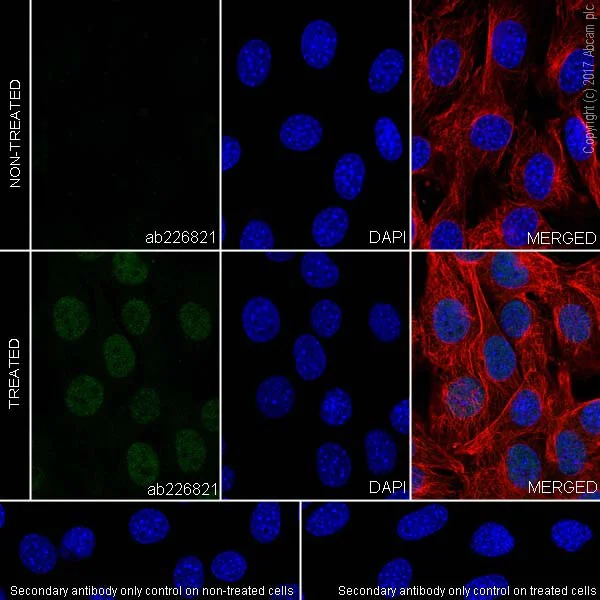
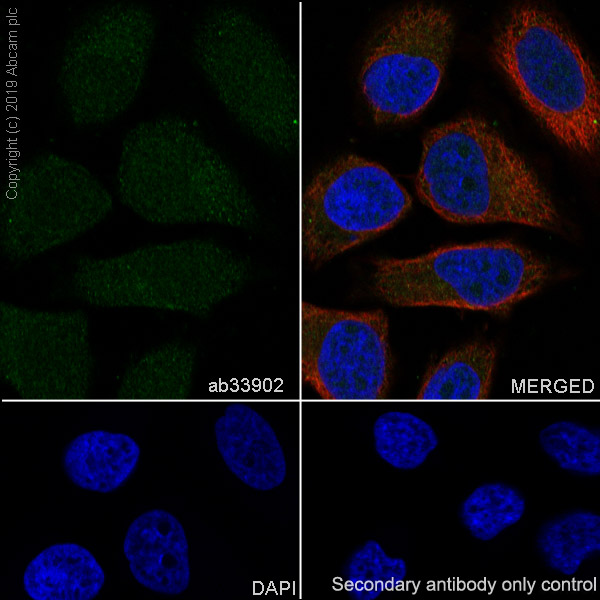
Immunocytochemistry/ Immunofluorescence - Anti-Smad1 (phospho S463 + S465) antibody [EPR20662-20] - BSA and Azide free (AB228457)
Immunofluorescent analysis of 4% paraformaldehyde-fixed, 0.1% Triton X-100 permeabilized NIH/3T3 (mouse embryo fibroblast cell line) cells labeling Smad1 (phospho S463 + S465) with ab226821 at 1/100 dilution, followed by Goat Anti-Rabbit IgG H&L (Alexa Fluor® 488) (ab150077) secondary antibody at 1/1000 dilution (green). Nuclear staining in hBMP2-treated NIH/3T3 cells. Cells were FBS-deprived overnight before treatment with 50 ng/ml hBMP2 for 30 minutes.
The nuclear counter stain is DAPI (blue). Tubulin is detected with Anti-alpha Tubulin antibody [DM1A] - Microtubule Marker (Alexa Fluor® 594) (ab195889) (red) at 1/200 dilution.
Secondary antibody only control : Used PBS instead of primary antibody, secondary antibody is Goat Anti-Rabbit IgG H&L (Alexa Fluor® 488) (ab150077) secondary antibody at 1/1000 dilution.
This data was developed using the same antibody clone in a different buffer formulation containing PBS, BSA, glycerol, and sodium azide (ab226821).

- IP
Supplier Data
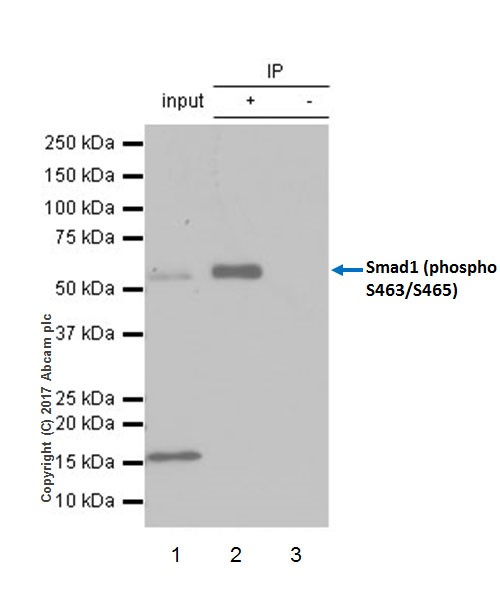
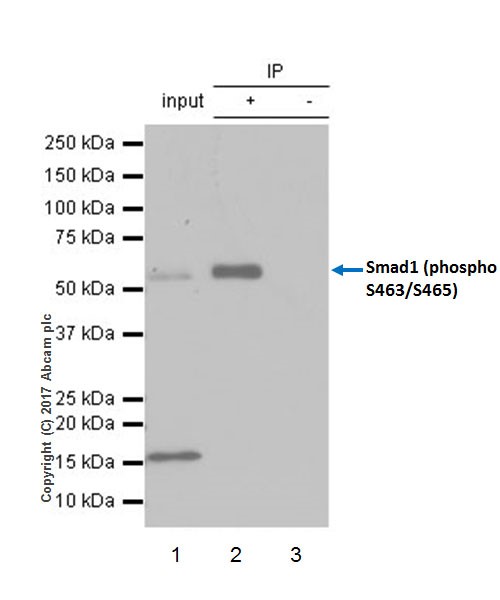
Immunoprecipitation - Anti-Smad1 (phospho S463 + S465) antibody [EPR20662-20] - BSA and Azide free (AB228457)
Smad 1 (phospho S463 + S465) was immunoprecipitated from 0.35 mg NIH/3T3 (mouse embryo fibroblast cell line) grown in serum-free media overnight, then treated with 50 ng/ml BMP2 for 30 minutes, whole cell lysate with ab226821 at 1/30 dilution. Western blot was performed from the immunoprecipitate using ab226821 at 1/1000 dilution. VeriBlot for IP Detection Reagent (HRP) (ab131366), was used for detection at 1/1000 dilution.
Lane 1 : NIH/3T3 grown in serum-free media overnight, then treated with 50 ng/ml BMP2 for 30 minutes, whole cell lysate 10 μg (Input).
Lane 2 : ab226821 IP in NIH/3T3 grown in serum-free media overnight, then treated with 50 ng/ml BMP2 for 30 minutes, whole cell lysate.
Lane 3 : Rabbit monoclonal IgG (ab172730) instead of ab226821 in NIH/3T3 grown in serum-free media overnight, then treated with 50 ng/ml BMP2 for 30 minutes, whole cell lysate.
Blocking and dilution buffer and concentration : 5% NFDM/TBST.
Exposure time : 10 seconds.
This data was developed using the same antibody clone in a different buffer formulation containing PBS, BSA, glycerol, and sodium azide (ab226821).
All lanes:
Immunoprecipitation - Anti-Smad1 (phospho S463 + S465) antibody [EPR20662-20] (<a href='/ko/products/primary-antibodies/smad1-phospho-s463-s465-antibody-epr20662-20-ab226821'>ab226821</a>)
Predicted band size: 52 kDa
false

- Dot
Supplier Data
Dot Blot - Anti-Smad1 (phospho S463 + S465) antibody [EPR20662-20] - BSA and Azide free (AB228457)
Dot blot analysis of Smad1 (phospho S463 + S465) labeled with ab226821 at 1/1000 dilution.
Lane 1 : Smad1 (phospho S463/S465) peptide;
Lane 2 : Smad1 (phospho S463) peptide;
Lane 3 : Smad1 (phospho S465) peptide;
Lane 4 : Smad1 peptide (not phosphorylated);
Lane 5 : Smad5 (phospho S463/S465) peptide;
Lane 6 : Smad5 (phospho S463) peptide;
Lane 7 : Smad5 (phospho S465) peptide;
Lane 9 : Smad5 peptide (not phosphorylated).
Goat Anti-Rabbit IgG H&L (HRP) (ab97051) at 1/100000 dilution was used as secondary antibody.
Blocking/Dilution buffer : 5% NFDM/TBST.
Exposure time : 3 minutes.
Based on sequence homology, this antibody cross-reacts with Smad5 (phospho S463/S465) and Smad9 (phospho S465/S467).
This data was developed using the same antibody clone in a different buffer formulation containing PBS, BSA, glycerol, and sodium azide (ab226821).
관련 conjugated 항체와 다양한 조성의 항체 (1)
-
Anti-Smad1 (phospho S463 + S465) antibody [EPR20662-20]
대체품
Primary Antibodies
AB214423
Anti-Smad1 (phospho S463 + S465) antibody [EPR20662-29]
20ul selling size|RabMAb|Recombinant|Trial Size
- 0
- 0
Primary Antibodies
AB126761
20ul selling size|KO Validated|RabMAb|Recombinant
- 0
- 0
Primary Antibodies
AB236156
Anti-Smad1 (phospho S463 + S465) antibody [EPR20662-29] - BSA and Azide free
RabMAb|Recombinant
- 0
- 0
Primary Antibodies
AB172642
Anti-Smad1 antibody [EP565Y] - BSA and Azide free
KO Validated|RabMAb|Recombinant
- 0
- 0
Primary Antibodies
AB33902
20ul selling size|KO Validated|RabMAb|Recombinant
- 5
- 3
보완 제품
Primary Antibodies
AB33902
20ul selling size|KO Validated|RabMAb|Recombinant
- 5
- 3
Primary Antibodies
AB92698
Anti-SMAD1 + SMAD5 + SMAD9 (phospho S463 + S465 + S467) antibody [MMC-1-104-3]
20ul selling size|RabMAb|Recombinant
- 4
- 2
Primary Antibodies
AB52903
Anti-SMAD3 (pS423/425) + SMAD5 (pS463/465) + SMAD1 (pS463/465) + SMAD2 (pS465/467) antibody [EP823Y]
20ul selling size|Recombinant|Advanced Validation|RabMAb
- 4
- 21
Primary Antibodies
AB33875
20ul selling size|RabMAb|Advanced Validation|Recombinant|KO Validated
- 4
- 2
Reactivity 정보
제품 세부 정보
ab228457 is the carrier-free version of ab226821.
Patented technology
Our RabMAb® technology is a patented hybridoma-based technology for making rabbit monoclonal antibodies. For details on our patents, please refer to RabMAb® patents.
What are the advantages of a recombinant monoclonal antibody?
This product is a recombinant monoclonal antibody, which offers several advantages including:
- - High batch-to-batch consistency and reproducibility
- - Improved sensitivity and specificity
- - Long-term security of supply
- - Animal-free batch production
For more information, read more on recombinant antibodies.
Conjugation ready
Our carrier-free antibodies are typically supplied in a PBS-only formulation, purified and free of BSA, sodium azide and glycerol. This conjugation-ready format is designed for use with fluorochromes, metal isotopes, oligonucleotides, and enzymes, which makes them ideal for antibody labelling, functional and cell-based assays, flow-based assays (e.g. mass cytometry) and Multiplex Imaging applications.
Use our conjugation kits for antibody conjugates that are ready-to-use in as little as 20 minutes with 1 minute hands-on-time and 100% antibody recovery: available for fluorescent dyes, HRP, biotin and gold.
Compatibility
This product is compatible with the Maxpar® Antibody Labeling Kit from Fluidigm, without the need for antibody preparation. Maxpar® is a trademark of Fluidigm Canada Inc.
특성 및 보관 정보
제형
Purification 테크닉
보관 버퍼
배송 시 보관 조건
적절한 단기 보관 조건
적절한 장기 보관 조건
보관 정보
추가 정보
This supplementary information is collated from multiple sources and compiled automatically.
Biological function summary
Smad1 participates in the transmission of BMP signals from the cell surface to the nucleus ensuring transcriptional regulation of target genes. In the presence of BMPs Smad1 forms complexes with Smad4 upon activation. These Smad complexes then translocate to the nucleus where they regulate gene expression. Smad1 influences cellular responses such as proliferation differentiation and apoptosis. In particular it plays a significant role in bone development and osteogenesis.
Pathways
Smad1 plays an important role within the BMP signaling pathway which is important for early development and tissue homeostasis. Within this pathway BMPs trigger the phosphorylation of Smad1 which then associates with Smad4 to propagate downstream signaling. Another associated pathway includes the TGF-beta signaling pathway where Smads like Smad2 and Smad3 show functional similarities and differences with Smad1. The interactions of Smad1 with related proteins like Smad4 highlight its significant contribution to cellular processes regulated by these pathways.
제품 프로토콜
- Visit the General protocols
- Visit the Troubleshooting
타겟 정보
대체 명칭 보기
제품이 사용된 논문 (1)
Recent publications for all applications. Explore the 전체 목록and refine your search
iScience 25:103785 PubMed35146396
2022
Applications
Unspecified application
Species
Unspecified reactive species
Product promise
Please note: All products are 'FOR RESEARCH USE ONLY. NOT FOR USE IN DIAGNOSTIC OR THERAPEUTIC PROCEDURES'.
For licensing inquiries, please contact partnerships@abcam.com