Rabbit Polyclonal TDP43 antibody. Suitable for IP, IHC-P, WB, ICC/IF and reacts with Human, Rat, Mouse samples. Cited in 3 publications. Immunogen corresponding to Recombinant Fragment Protein within Human TARDBP aa 1-300.
대체 명칭 보기
TDP43, TARDBP, TAR DNA-binding protein 43, TDP-43
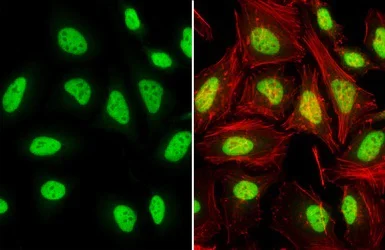
- ICC/IF
Supplier Data
Immunocytochemistry/ Immunofluorescence - Anti-TDP43 antibody (AB154047)
Immunofluorescence analysis of HeLa cells fixed in 4% paraformaldehyde at RT for 15 min labelling TDP43 protein at nucleus using ab154047 at a 1/2000 dilution (Green). phalloidin, a cytoskeleton marker was stained by anti-phalloidin antibody at a 1/200 dilution (Red).
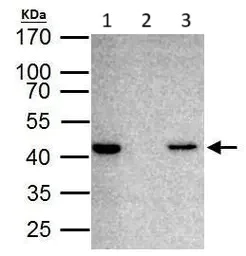
- IP
Supplier Data
Immunoprecipitation - Anti-TDP43 antibody (AB154047)
Samples were separated by 12% SDS-PAGE. The immunoprecipitated TARDBP protein was detected by ab154047 diluted at 1/1000 dilution.
All lanes:
Immunoprecipitation - Anti-TDP43 antibody (ab154047) at 2 µg
Lane 1:
HeLa whole cell lysate at 40 µg
Lane 2:
HeLa whole cell lysate with IgG control
Lane 3:
HeLa whole cell lysate
Secondary
All lanes:
Anti-rabbit IgG
Predicted band size: 45 kDa
false
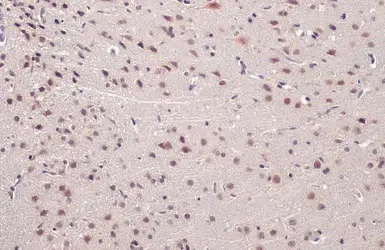
- IHC-P
Supplier Data
Immunohistochemistry (Formalin/PFA-fixed paraffin-embedded sections) - Anti-TDP43 antibody (AB154047)
Immunohistochemical analysis of paraffin-embedded rat brain tissue stained for TDP43 protein at nucleus with ab154047 at a 1/500 dilution.
Antigen retrieval : Citrate buffer, pH 6.0, 15 min.
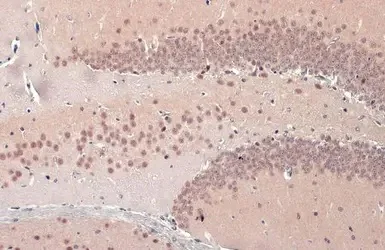
- IHC-P
Supplier Data
Immunohistochemistry (Formalin/PFA-fixed paraffin-embedded sections) - Anti-TDP43 antibody (AB154047)
Immunohistochemical analysis of paraffin-embedded mouse brain tissue stained for TDP43 protein at nucleus with ab154047 at a 1/500 dilution.
Antigen retrieval : Citrate buffer, pH 6.0, 15 min.
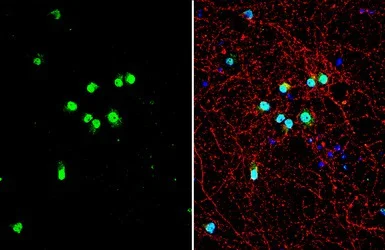
- ICC/IF
Supplier Data
Immunocytochemistry/ Immunofluorescence - Anti-TDP43 antibody (AB154047)
Immunofluorescence analysis of DIV10 rat E18 primary cortical neuron cells fixed in 4% paraformaldehyde at RT for 15 min labelling TDP43 protein using ab154047 at a 1/500 dilution (Green). Tau, stained by Tau antibody at a 1/500 dilution (Red). DAPI was used for nuclear staining (Blue).
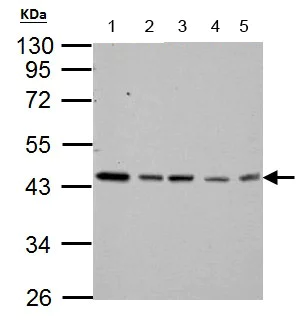
- WB
Supplier Data
Western blot - Anti-TDP43 antibody (AB154047)
10 % SDS-PAGE
All lanes:
Western blot - Anti-TDP43 antibody (ab154047) at 1/3000 dilution
Lane 1:
Neuro2A whole cell lysate at 30 µg
Lane 2:
GL261 whole cell lysate at 30 µg
Lane 3:
NIH 3T3 whole cell lysate at 30 µg
Lane 4:
BCL1 whole cell lysate at 30 µg
Lane 5:
RAW 264.7 whole cell lysate at 30 µg
Predicted band size: 44 kDa
false
대체품
Primary Antibodies
AB109535
20ul selling size|BOND RX™ Validated|KO Validated|RabMAb|Recombinant
- 5
- 1
Primary Antibodies
AB193842
Alexa Fluor® 488 Anti-TDP43 antibody [EPR5810]
RabMAb|Recombinant|KO Validated
- 0
- 1
Primary Antibodies
AB133547
20ul selling size|BOND RX™ Validated|KO Validated|RabMAb|Recombinant

- 4
- 3
Primary Antibodies
AB185133
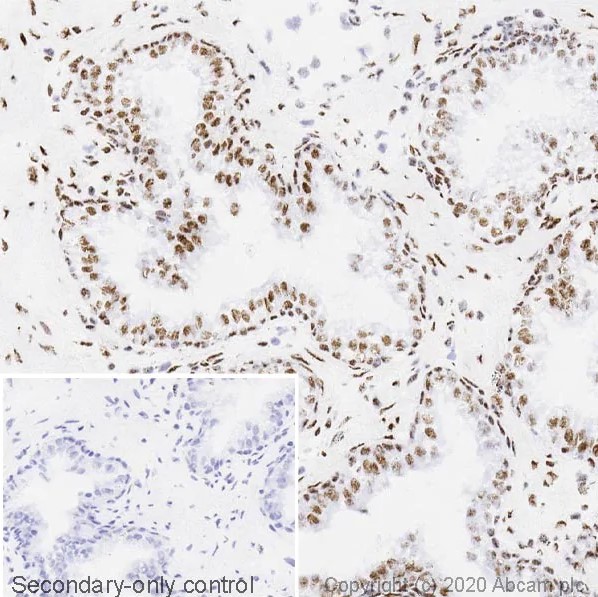
Anti-TDP43 antibody [EPR5810] - BSA and Azide free
BOND RX™ Validated|KO Validated|RabMAb|Recombinant
- 0
- 0
Primary Antibodies
AB238443
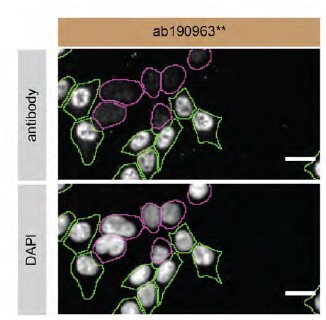
Anti-TDP43 antibody [EPR18554] - BSA and Azide free
KO Validated|RabMAb|Recombinant
- 0
- 0
Primary Antibodies
AB208542
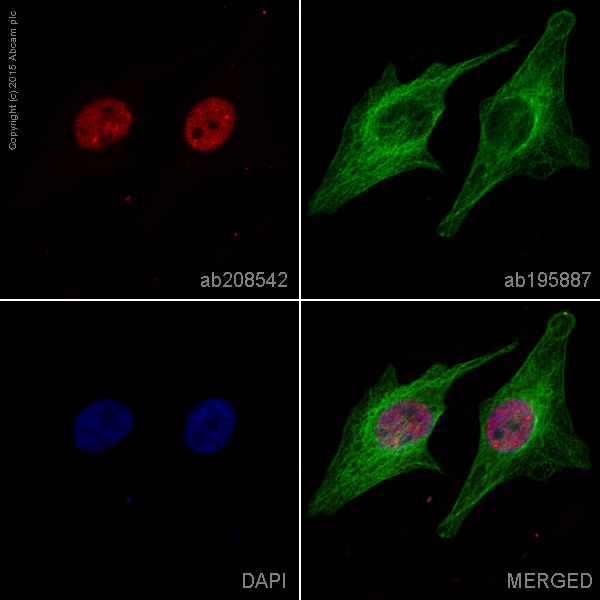
Alexa Fluor® 594 Anti-TDP43 antibody [EPR5811]
RabMAb|Recombinant|KO Validated
- 0
- 0
Primary Antibodies
AB190963
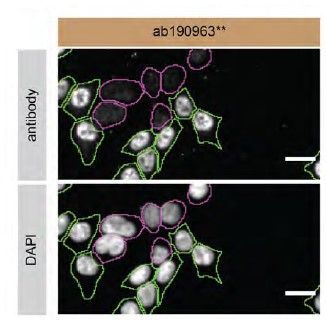
Anti-TDP43 antibody [EPR18554]
20ul selling size|KO Validated|RabMAb|Recombinant
- 4
- 1
보완 제품
Primary Antibodies
AB183734
RabMAb|Recombinant|Lab Essentials|20ul selling size
- 5
- 24

Primary Antibodies
AB52623
Anti-beta III Tubulin antibody [EP1569Y] - Neuronal Marker
BOND RX™ Validated|KO Validated|RabMAb|Advanced Validation|Recombinant|Lab Essentials|20ul selling size

- 5
- 6
Primary Antibodies
AB181602
Anti-GAPDH antibody [EPR16891] - Loading Control
RabMAb|Recombinant|Lab Essentials|20ul selling size

- 5
- 23
Reactivity 정보
특성 및 보관 정보
제형
Purification 테크닉
보관 버퍼
배송 시 보관 조건
적절한 단기 보관 조건
적절한 장기 보관 조건
분주 정보
보관 정보
추가 정보
This supplementary information is collated from multiple sources and compiled automatically.
Biological function summary
TDP43 acts as a regulator of RNA splicing and transcription by forming ribonucleoprotein complexes. The protein can bind to specific sequences in RNA helping in the proper processing and transport of mRNA. Furthermore TDP43 has a role in stress granule formation a cell response to stress. Researchers have identified that the protein undergoes various post-translational modifications which could influence its behavior and function within the cellular environment.
Pathways
Several important pathways include TDP43 due to its functions in RNA metabolism. This protein contributes to the spliceosomal cycle and other pathways involved in mRNA processing. TDP43 interacts with proteins such as FUS and hnRNP which are also involved in RNA splicing and are essential for maintaining mRNA integrity. These relations make TDP43 an important player in regulating gene expression and protein synthesis.
제품 프로토콜
- Visit the General protocols
- Visit the Troubleshooting
타겟 정보
제품이 사용된 논문 (3)
Recent publications for all applications. Explore the 전체 목록 and refine your search
Proceedings of the National Academy of Sciences of 117:3568-3574 PubMed32019887
2020
Applications
Unspecified application
Species
Unspecified reactive species
Journal of Alzheimer's disease : JAD 68:1287-1307 PubMed30909235
2019
Applications
Unspecified application
Species
Unspecified reactive species
Journal of neuropathology and experimental neurology 77:608-627 PubMed29788265
2018
Applications
Unspecified application
Species
Unspecified reactive species
Product promise
Please note: All products are 'FOR RESEARCH USE ONLY. NOT FOR USE IN DIAGNOSTIC OR THERAPEUTIC PROCEDURES'.
For licensing inquiries, please contact partnerships@abcam.com