JavaScript is disabled in your browser. Please enable JavaScript to view this website.
AB38171

Anti-Transferrin Receptor antibody [13E4]

4

(2 리뷰들)

|

(13 제품이 사용된 논문 )
Mouse Monoclonal Transferrin Receptor antibody. Suitable for Flow Cyt, ICC/IF and reacts with Human samples. Cited in 13 publications. Immunogen corresponding to Native Full Length Protein corresponding to Human TFRC.
2 이미지
Flow Cytometry - Anti-Transferrin Receptor antibody [13E4] (AB38171)
  • Flow Cyt

Unknown

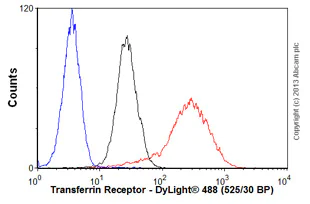
Flow Cytometry - Anti-Transferrin Receptor antibody [13E4] (AB38171)

Overlay histogram showing Jurkat cells stained with ab38171 (red line). The cells were fixed with 4% paraformaldehyde (10 min) and then permeabilized with 0.1% PBS-Tween for 20 min. The cells were then incubated in 1x PBS / 10% normal goat serum / 0.3M glycine to block non-specific protein-protein interactions followed by the antibody (ab38171, 0.5μg/1x106 cells) for 30 min at 22°C. The secondary antibody used was DyLight® 488 goat anti-mouse IgG (H+L) (ab96879) at 1/500 dilution for 30 min at 22°C. Isotype control antibody (black line) was mouse IgG2a [ICIGG2A] (ab91361, 1μg/1x106 cells) used under the same conditions. Unlabelled sample (blue line). Acquisition of >5,000 events were collected using a 20mW Argon ion laser (488nm) and 525/30 bandpass filter. This antibody gave a positive signal in Jurkat cells fixed with 80% methanol (5 min)/permeabilized with 0.1% PBS-Tween for 20 min used under the same conditions.
Immunocytochemistry/ Immunofluorescence - Anti-Transferrin Receptor antibody [13E4] (AB38171)
  • ICC/IF

Unknown

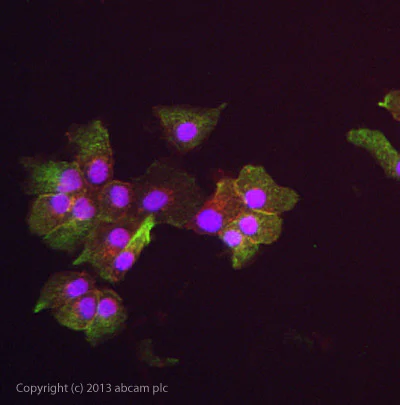
Immunocytochemistry/ Immunofluorescence - Anti-Transferrin Receptor antibody [13E4] (AB38171)

ICC/IF image of ab38171 stained DU145 cells. The cells were 4% formaldehyde fixed (10 min) and then incubated in 1%BSA / 10% normal goat serum / 0.3M glycine in 0.1% PBS-Tween for 1h to permeabilise the cells and block non-specific protein-protein interactions. The cells were then incubated with the antibody ab38171 at 5μg/ml overnight at +4°C. The secondary antibody (green) was DyLight® 488 goat anti- mouse (ab96879) IgG (H+L) used at a 1/250 dilution for 1h. Alexa Fluor® 594 WGA was used to label plasma membranes (red) at a 1/200 dilution for 1h. DAPI was used to stain the cell nuclei (blue) at a concentration of 1.43μM.

주요 정보

Host species

Mouse

Clonality

Monoclonal

Clone number

13E4

Isotype

IgG2a

Carrier free

No

Reacts with

Human

Applications

Flow Cyt, ICC/IF

applications

Immunogen

Native Full Length Protein corresponding to Human TFRC.

P02786

Specificity

This antibody is specific for Transferrin Receptor and the complex between soluble Transferrin Receptor and Transferrin.

Reactivity 정보

{ "title": "Reactivity Data", "filters": { "stats": ["", "Species", "Dilution Info", "Notes"], "tabs": { "all-applications": {"fullname" : "All Applications", "shortname": "All Applications"}, "FlowCyt" : {"fullname" : "Flow Cytometry", "shortname":"Flow Cyt"}, "ICCIF" : {"fullname" : "Immunocytochemistry/ Immunofluorescence", "shortname":"ICC/IF"} }, "product-promise": { "all": "all", "testedAndGuaranteed": "tested", "guaranteed": "expected", "predicted": "predicted", "notRecommended": "not-recommended" } }, "values": { "Human": { "FlowCyt-species-checked": "testedAndGuaranteed", "FlowCyt-species-dilution-info": "0.5 µg for 10^6 Cells", "FlowCyt-species-notes": "<p><a href='/ko/products/primary-antibodies/mouse-igg2c-kappa-monoclonal-18c8bc7ad10-isotype-control-ab170191'>ab170191</a> - Mouse monoclonal IgG2a, is suitable for use as an isotype control with this antibody.</p>", "ICCIF-species-checked": "testedAndGuaranteed", "ICCIF-species-dilution-info": "5 µg/mL", "ICCIF-species-notes": "<p></p>" } } }

제품 세부 정보

This product was changed from ascites to tissue culture supernatant on 16th July 2018. Please note that the dilutions may need to be adjusted accordingly. If you have any questions, please do not hesitate to contact our scientific support team.

특성 및 보관 정보

제형
Liquid
Purification 테크닉
Affinity purification Protein A
보관 버퍼
pH: 7.4 Preservative: 0.1% Sodium azide Constituents: PBS
배송 시 보관 조건
Blue Ice
적절한 단기 보관 조건
+4°C
적절한 장기 보관 조건
-20°C
분주 정보
Upon delivery aliquot
보관 정보
Avoid freeze / thaw cycle

추가 정보

This supplementary information is collated from multiple sources and compiled automatically.

The transferrin receptor commonly referred to as TfR or CD71 is an integral membrane protein that facilitates the uptake of transferrin-bound iron into cells. This receptor has a molecular weight of around 95 kDa and often exists as a homodimer on the cell surface. It is widely expressed in many tissues especially in erythroid precursors and rapidly dividing cells. Alternate names for this receptor include TfR1 and TfR2 though they have distinct roles and distributions. Other transmembrane proteins like OX26 and MEM have been studied in relation to the transferrin receptor due to their involvement in drug delivery.
Biological function summary

TfR plays a critical role in iron homeostasis by mediating the internalization of transferrin and release of iron in the endosomes. It operates as part of the transferrin-transferrin receptor complex facilitating iron assimilation necessary for DNA synthesis and cell growth. Iron release involves acidifying endosomes allowing transferrin to bind with specific cellular receptors including alternate forms like beta 2 transferrin. The process subsequently contributes to erythropoiesis and various metabolic processes by regulating essential cellular iron levels.

Pathways

The transferrin receptor is central to iron metabolism and the receptor-mediated endocytosis pathway. It tightly interacts with transferrin and intracellular pathways process the iron released from transferrin within endosomes. The receptor's role in this pathway involves a dynamic with other proteins such as HFE and hepcidin. These interactions help control systemic iron levels linking closely to the maintenance of erythroid cell health and proliferation.

Disruptions in transferrin receptor function correlate with anemia and neurodegenerative disorders. In anemia related to iron deficiency impaired TfR activity reduces iron uptake culminating in insufficient erythropoiesis. Altered receptor expression or function also connects to neurological diseases like Alzheimer's where iron dysregulation is a concern. Here the transferrin receptor interacts with proteins like Amyloid precursor protein contributing to disease pathology through improper metal homeostasis.

제품 프로토콜

For this product, it's our understanding that no specific protocols are required. You can visit:

타겟 정보

Cellular uptake of iron occurs via receptor-mediated endocytosis of ligand-occupied transferrin receptor into specialized endosomes (PubMed : 26214738). Endosomal acidification leads to iron release. The apotransferrin-receptor complex is then recycled to the cell surface with a return to neutral pH and the concomitant loss of affinity of apotransferrin for its receptor. Transferrin receptor is necessary for development of erythrocytes and the nervous system (By similarity). A second ligand, the hereditary hemochromatosis protein HFE, competes for binding with transferrin for an overlapping C-terminal binding site. Positively regulates T and B cell proliferation through iron uptake (PubMed : 26642240). Acts as a lipid sensor that regulates mitochondrial fusion by regulating activation of the JNK pathway (PubMed : 26214738). When dietary levels of stearate (C18 : 0) are low, promotes activation of the JNK pathway, resulting in HUWE1-mediated ubiquitination and subsequent degradation of the mitofusin MFN2 and inhibition of mitochondrial fusion (PubMed : 26214738). When dietary levels of stearate (C18 : 0) are high, TFRC stearoylation inhibits activation of the JNK pathway and thus degradation of the mitofusin MFN2 (PubMed : 26214738). Mediates uptake of NICOL1 into fibroblasts where it may regulate extracellular matrix production (By similarity).. (Microbial infection) Acts as a receptor for new-world arenaviruses : Guanarito, Junin and Machupo virus.. (Microbial infection) Acts as a host entry factor for rabies virus that hijacks the endocytosis of TFRC to enter cells.. (Microbial infection) Acts as a host entry factor for SARS-CoV, MERS-CoV and SARS-CoV-2 viruses that hijack the endocytosis of TFRC to enter cells.. (Microbial infection) Acts as a receptor for Plasmodium vivax.
See full target information TFRC

대체 명칭 보기

CD71, Transferrin receptor protein 1, TR, TfR, TfR1, Trfr, T9, Transferrin receptor 1, p90, TFRC

제품이 사용된 논문 (13)

Recent publications for all applications. Explore the 전체 목록and refine your search

The Journal of cell biology 223: PubMed38048228

2023

Phosphatidylserine synthesis controls oncogenic B cell receptor signaling in B cell lymphoma.

Applications

Unspecified application

Species

Unspecified reactive species

Jumpei Omi,Taiga Kato,Yohei Yoshihama,Koki Sawada,Nozomu Kono,Junken Aoki

Journal of structural biology: X 6:100056 PubMed34977554

2022

Multimodal imaging reveals membrane skeleton reorganisation during reticulocyte maturation and differences in dimple and rim regions of mature erythrocytes.

Applications

Unspecified application

Species

Unspecified reactive species

Adam J Blanch,Juan Nunez-Iglesias,Arman Namvar,Sebastien Menant,Oliver Looker,Vijay Rajagopal,Wai-Hong Tham,Leann Tilley,Matthew W A Dixon

American journal of cancer research 11:691-711 PubMed33791148

2021

Artesunate induces ER-derived-ROS-mediated cell death by disrupting labile iron pool and iron redistribution in hepatocellular carcinoma cells.

Applications

Unspecified application

Species

Unspecified reactive species

Zhongyong Jiang,Ziwen Wang,Long Chen,Chi Zhang,Fengying Liao,Yawei Wang,Yang Wang,Peng Luo,Min Luo,Chunmeng Shi

Molecules (Basel, Switzerland) 25: PubMed33348564

2020

Quantification of Trastuzumab-HER2 Engagement In Vitro and In Vivo.

Applications

Unspecified application

Species

Unspecified reactive species

Alena Rudkouskaya,Jason T Smith,Xavier Intes,Margarida Barroso

Cellular microbiology 23:e13270 PubMed32981231

2020

Surface area-to-volume ratio, not cellular viscoelasticity, is the major determinant of red blood cell traversal through small channels.

Applications

Unspecified application

Species

Unspecified reactive species

Arman Namvar,Adam J Blanch,Matthew W Dixon,Olivia M S Carmo,Boyin Liu,Snigdha Tiash,Oliver Looker,Dean Andrew,Li-Jin Chan,Wai-Hong Tham,Peter V S Lee,Vijay Rajagopal,Leann Tilley

Nature communications 10:2621 PubMed31197168

2019

Hypoxia-enhanced Blood-Brain Barrier Chip recapitulates human barrier function and shuttling of drugs and antibodies.

Applications

Unspecified application

Species

Unspecified reactive species

Tae-Eun Park,Nur Mustafaoglu,Anna Herland,Ryan Hasselkus,Robert Mannix,Edward A FitzGerald,Rachelle Prantil-Baun,Alexander Watters,Olivier Henry,Maximilian Benz,Henry Sanchez,Heather J McCrea,Liliana Christova Goumnerova,Hannah W Song,Sean P Palecek,Eric Shusta,Donald E Ingber

The Journal of cell biology 217:2549-2564 PubMed29891722

2018

HRS-WASH axis governs actin-mediated endosomal recycling and cell invasion.

Applications

Unspecified application

Species

Unspecified reactive species

Ewan MacDonald,Louise Brown,Arnaud Selvais,Han Liu,Thomas Waring,Daniel Newman,Jessica Bithell,Douglas Grimes,Sylvie Urbé,Michael J Clague,Tobias Zech

Scientific reports 8:8867 PubMed29891921

2018

Prostate-Specific Membrane Antigen-Targeted Site-Directed Antibody-Conjugated Apoferritin Nanovehicle Favorably Influences In Vivo Side Effects of Doxorubicin.

Applications

Unspecified application

Species

Unspecified reactive species

Simona Dostalova,Hana Polanska,Marketa Svobodova,Jan Balvan,Olga Krystofova,Yazan Haddad,Sona Krizkova,Michal Masarik,Tomas Eckschlager,Marie Stiborova,Zbynek Heger,Vojtech Adam

Nature communications 6:6289 PubMed25662504

2015

A leak pathway for luminal protons in endosomes drives oncogenic signalling in glioblastoma.

Applications

WB

Species

Unspecified reactive species

Kalyan C Kondapalli,Jose P Llongueras,Vivian Capilla-González,Hari Prasad,Anniesha Hack,Christopher Smith,Hugo Guerrero-Cázares,Alfredo Quiñones-Hinojosa,Rajini Rao

Neurourology and urodynamics 35:382-9 PubMed25597596

2015

Urethral musculature and innervation in the female rat.

Applications

Unspecified application

Species

Unspecified reactive species

Xiaoyu Zhang,Amjad Alwaal,Guiting Lin,Huixi Li,Uwais B Zaid,Guifang Wang,Lin Wang,Lia Banie,Hongxiu Ning,Ching-Shwun Lin,Yinglu Guo,Liqun Zhou,Tom F Lue
제품이 사용된 논문 모두 보기

Product promise

저희는 고품질 시약으로 고객님의 연구를 서포트하고자 최선을 다하고 있으며, 모든 단계에서 함께 하겠습니다. 만약 제품이 기대한 성능을 보이지 않을 경우에도 Product Promise로 보호받으실 수 있습니다.
자세한 내용은 이용 약관을 확인해 주세요.

Please note: All products are 'FOR RESEARCH USE ONLY. NOT FOR USE IN DIAGNOSTIC OR THERAPEUTIC PROCEDURES'.

For licensing inquiries, please contact partnerships@abcam.com