JavaScript is disabled in your browser. Please enable JavaScript to view this website.
AB1086

Anti-Transferrin Receptor antibody [MEM-189]

5

(4 리뷰들)

|

(38 제품이 사용된 논문 )

Anti-Transferrin Receptor antibody [MEM-189] (ab1086) is a mouse monoclonal antibody detecting Transferrin Receptor in Flow Cytometry. Suitable for Human.

- Over 30 publications
- Trusted since 2002
1 이미지
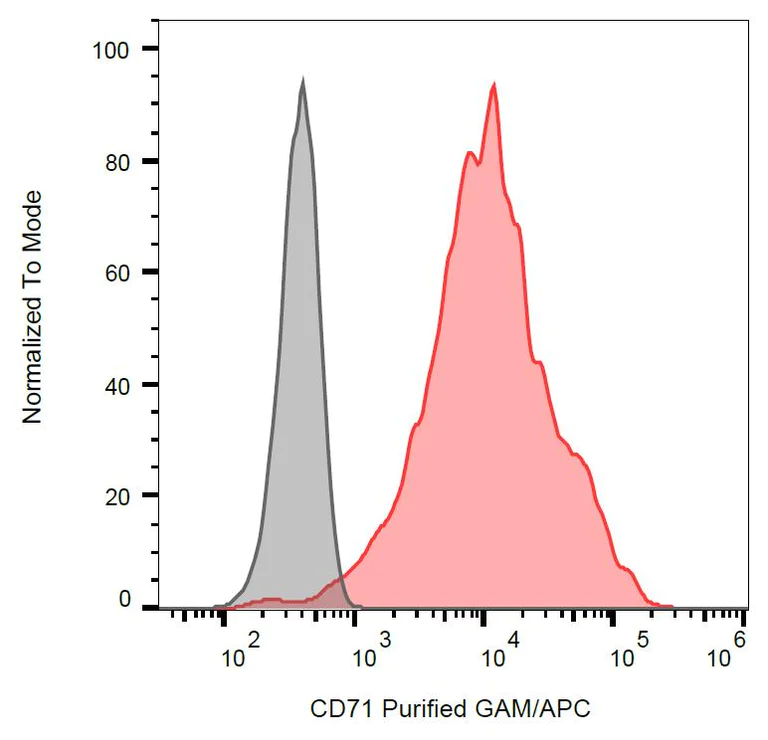
Flow Cytometry - Anti-Transferrin Receptor antibody [MEM-189] (AB1086)
  • Flow Cyt

Unknown

Flow Cytometry - Anti-Transferrin Receptor antibody [MEM-189] (AB1086)

Flow Cytometry analysis of K562 cells labelling Transferrin with ab1086 at 2 μg/ml.

주요 정보

Host species

Mouse

Clonality

Monoclonal

Clone number

MEM-189

Isotype

IgG1

Carrier free

No

Reacts with

Human

Applications

Flow Cyt

applications

Immunogen

Cell preparation containing TFRC protein. The exact immunogen used to generate this antibody is proprietary information.

P02786

Specificity

The antibody MEM-189 reacts with CD71 antigen (transferrin receptor), a 95 kDa type II homodimeric transmembrane glycoprotein expressed on activated B and lymphocytes, macrophages and erythroid precursors; it is lost on resting blood leukocytes.The antibody MEM-189 does not block binding of transferrin to the receptor.

Reactivity 정보

{ "title": "Reactivity Data", "filters": { "stats": ["", "Species", "Dilution Info", "Notes"], "tabs": { "all-applications": {"fullname" : "All Applications", "shortname": "All Applications"}, "FlowCyt" : {"fullname" : "Flow Cytometry", "shortname":"Flow Cyt"}, "ICCIF" : {"fullname" : "Immunocytochemistry/ Immunofluorescence", "shortname":"ICC/IF"} }, "product-promise": { "all": "all", "testedAndGuaranteed": "tested", "guaranteed": "expected", "predicted": "predicted", "notRecommended": "not-recommended" } }, "values": { "Human": { "FlowCyt-species-checked": "testedAndGuaranteed", "FlowCyt-species-dilution-info": "2 µg/mL", "FlowCyt-species-notes": "<p></p>", "ICCIF-species-checked": "notRecommended", "ICCIF-species-dilution-info": "", "ICCIF-species-notes": "<p></p>" } } }

제품 세부 정보

What is this antibody validated in?
Anti-Transferrin Receptor antibody [MEM-189] (ab1086) is a mouse monoclonal antibody and is validated for use in Flow Cytometry (Flow Cyt) in Human samples.

Trusted by the scientific community
Anti-Transferrin Receptor [MEM-189] (ab1086) was first used in a scientific publication in 2002 and has been cited over 30 times in peer-reviewed journals.

Other related products
We have a range of other formats of antibody clone [MEM-189] also available for your convenience: ab1086, Carrier free - ab313322

특성 및 보관 정보

제형
Liquid
Purity
Tissue culture supernatant
Purification 테크닉
Affinity purification Protein A
보관 버퍼
pH: 8 Preservative: 0.097% Sodium azide Constituents: Tris buffer
배송 시 보관 조건
Blue Ice
적절한 단기 보관 기간
1-2 weeks
적절한 단기 보관 조건
+4°C
적절한 장기 보관 조건
-20°C
분주 정보
Upon delivery aliquot
보관 정보
Avoid freeze / thaw cycle

추가 정보

This supplementary information is collated from multiple sources and compiled automatically.

The transferrin receptor commonly referred to as TfR or CD71 is an integral membrane protein that facilitates the uptake of transferrin-bound iron into cells. This receptor has a molecular weight of around 95 kDa and often exists as a homodimer on the cell surface. It is widely expressed in many tissues especially in erythroid precursors and rapidly dividing cells. Alternate names for this receptor include TfR1 and TfR2 though they have distinct roles and distributions. Other transmembrane proteins like OX26 and MEM have been studied in relation to the transferrin receptor due to their involvement in drug delivery.
Biological function summary

TfR plays a critical role in iron homeostasis by mediating the internalization of transferrin and release of iron in the endosomes. It operates as part of the transferrin-transferrin receptor complex facilitating iron assimilation necessary for DNA synthesis and cell growth. Iron release involves acidifying endosomes allowing transferrin to bind with specific cellular receptors including alternate forms like beta 2 transferrin. The process subsequently contributes to erythropoiesis and various metabolic processes by regulating essential cellular iron levels.

Pathways

The transferrin receptor is central to iron metabolism and the receptor-mediated endocytosis pathway. It tightly interacts with transferrin and intracellular pathways process the iron released from transferrin within endosomes. The receptor's role in this pathway involves a dynamic with other proteins such as HFE and hepcidin. These interactions help control systemic iron levels linking closely to the maintenance of erythroid cell health and proliferation.

Disruptions in transferrin receptor function correlate with anemia and neurodegenerative disorders. In anemia related to iron deficiency impaired TfR activity reduces iron uptake culminating in insufficient erythropoiesis. Altered receptor expression or function also connects to neurological diseases like Alzheimer's where iron dysregulation is a concern. Here the transferrin receptor interacts with proteins like Amyloid precursor protein contributing to disease pathology through improper metal homeostasis.

제품 프로토콜

For this product, it's our understanding that no specific protocols are required. You can visit:

타겟 정보

Cellular uptake of iron occurs via receptor-mediated endocytosis of ligand-occupied transferrin receptor into specialized endosomes (PubMed : 26214738). Endosomal acidification leads to iron release. The apotransferrin-receptor complex is then recycled to the cell surface with a return to neutral pH and the concomitant loss of affinity of apotransferrin for its receptor. Transferrin receptor is necessary for development of erythrocytes and the nervous system (By similarity). A second ligand, the hereditary hemochromatosis protein HFE, competes for binding with transferrin for an overlapping C-terminal binding site. Positively regulates T and B cell proliferation through iron uptake (PubMed : 26642240). Acts as a lipid sensor that regulates mitochondrial fusion by regulating activation of the JNK pathway (PubMed : 26214738). When dietary levels of stearate (C18 : 0) are low, promotes activation of the JNK pathway, resulting in HUWE1-mediated ubiquitination and subsequent degradation of the mitofusin MFN2 and inhibition of mitochondrial fusion (PubMed : 26214738). When dietary levels of stearate (C18 : 0) are high, TFRC stearoylation inhibits activation of the JNK pathway and thus degradation of the mitofusin MFN2 (PubMed : 26214738). Mediates uptake of NICOL1 into fibroblasts where it may regulate extracellular matrix production (By similarity).. (Microbial infection) Acts as a receptor for new-world arenaviruses : Guanarito, Junin and Machupo virus.. (Microbial infection) Acts as a host entry factor for rabies virus that hijacks the endocytosis of TFRC to enter cells.. (Microbial infection) Acts as a host entry factor for SARS-CoV, MERS-CoV and SARS-CoV-2 viruses that hijack the endocytosis of TFRC to enter cells.. (Microbial infection) Acts as a receptor for Plasmodium vivax.
See full target information TFRC

대체 명칭 보기

CD71, Transferrin receptor protein 1, TR, TfR, TfR1, Trfr, T9, Transferrin receptor 1, p90, TFRC

제품이 사용된 논문 (38)

Recent publications for all applications. Explore the 전체 목록and refine your search

Diabetes, metabolic syndrome and obesity : targets and therapy 17:435-452 PubMed38299195

2024

Electroacupuncture Reduces Inflammatory Bowel Disease in Obese Mice by Activating the Nrf2/HO-1 Signaling Pathways and Repairing the Intestinal Barrier.

Applications

Unspecified application

Species

Unspecified reactive species

Yunhao Yang,Fang Pang,Min Zhou,Xiao Guo,Yan Yang,Wei Qiu,Cai Liao,Yang Chen,Chenglin Tang

Aging 16:2181-2193 PubMed38277217

2024

(-)-Epicatechin protects against myocardial ischemia/reperfusion injury via autophagy-dependent ferroptosis.

Applications

Unspecified application

Species

Unspecified reactive species

Kong Junhong,Tsai Yun,Shui Guangxing,Ding Yuhan,Xiang Qian,Zhang Haowen

Cellular and molecular life sciences : CMLS 80:135 PubMed37119365

2023

A structural model of the iRhom-ADAM17 sheddase complex reveals functional insights into its trafficking and activity.

Applications

Unspecified application

Species

Unspecified reactive species

Selcan Kahveci-Türköz,Katharina Bläsius,Justyna Wozniak,Cindy Rinkens,Anke Seifert,Petr Kasparek,Henrike Ohm,Shixin Oltzen,Martin Nieszporek,Nicole Schwarz,Aaron Babendreyer,Christian Preisinger,Radislav Sedlacek,Andreas Ludwig,Stefan Düsterhöft

Frontiers in immunology 13:985538 PubMed36713405

2023

Low circulatory Fe and Se levels with a higher IL-6/IL-10 ratio provide nutritional immunity in tuberculosis.

Applications

Unspecified application

Species

Unspecified reactive species

Sandeep R Kaushik,Sukanya Sahu,Hritusree Guha,Sourav Saha,Ranjit Das,Rukuwe-U Kupa,Wetetsho Kapfo,Trinayan Deka,Rumi Basumatary,Asunu Thong,Arunabha Dasgupta,Bidhan Goswami,Amit Kumar Pandey,Lahari Saikia,Vinotsole Khamo,Anjan Das,Ranjan Kumar Nanda

Diabetology & metabolic syndrome 14:89 PubMed35761309

2022

Targeting ferroptosis with miR-144-3p to attenuate pancreatic β cells dysfunction via regulating USP22/SIRT1 in type 2 diabetes.

Applications

Unspecified application

Species

Unspecified reactive species

Shanshan Zhang,Xiao Liu,Jihong Wang,Fengjuan Yuan,Yali Liu

Bio-protocol 12:e4399 PubMed35800091

2022

High Throughput Blood-brain Barrier Organoid Generation and Assessment of Receptor-Mediated Antibody Transcytosis.

Applications

Unspecified application

Species

Unspecified reactive species

Elena Kassianidou,Claire Simonneau,Alina Gavrilov,Roberto Villaseñor

Acta pharmacologica Sinica 42:1690-1702 PubMed34112960

2021

ATF3 contributes to brucine-triggered glioma cell ferroptosis via promotion of hydrogen peroxide and iron.

Applications

Unspecified application

Species

Unspecified reactive species

Shan Lu,Xuan-Zhong Wang,Chuan He,Lei Wang,Shi-Peng Liang,Chong-Cheng Wang,Chen Li,Tian-Fei Luo,Chun-Sheng Feng,Zhen-Chuan Wang,Guang-Fan Chi,Peng-Fei Ge

Evidence-based complementary and alternative medicine : eCAM 2021:6864723 PubMed34135983

2021

(SM) Injection Ameliorates Iron Overload-Associated Cardiac Dysfunction by Regulating the Expression of DMT1, TfR1, and FP1 in Rats.

Applications

Unspecified application

Species

Unspecified reactive species

Yuanyuan Zhang,Yucong Xue,Bin Zheng,Xue Han,Donglai Ma,Zhihong Ma,Shengjiang Guan,Yonggang Gao,Ziliang Li,Li Chu

Cellular and molecular life sciences : CMLS 78:5015-5040 PubMed33950315

2021

The iRhom homology domain is indispensable for ADAM17-mediated TNFα and EGF receptor ligand release.

Applications

Unspecified application

Species

Unspecified reactive species

Stefan Düsterhöft,Selcan Kahveci-Türköz,Justyna Wozniak,Anke Seifert,Petr Kasparek,Henrike Ohm,Shixin Liu,Jana Kopkanova,Juliane Lokau,Christoph Garbers,Christian Preisinger,Radislav Sedlacek,Matthew Freeman,Andreas Ludwig

Neurochemical research 46:1239-1251 PubMed33646533

2021

Benefits of Iron Chelators in the Treatment of Parkinson's Disease.

Applications

Unspecified application

Species

Unspecified reactive species

Xiaoyan Zeng,Hedi An,Fei Yu,Kai Wang,Lanlan Zheng,Wei Zhou,Yiwen Bao,Jie Yang,Nan Shen,Dongya Huang
제품이 사용된 논문 모두 보기

Product promise

저희는 고품질 시약으로 고객님의 연구를 서포트하고자 최선을 다하고 있으며, 모든 단계에서 함께 하겠습니다. 만약 제품이 기대한 성능을 보이지 않을 경우에도 Product Promise로 보호받으실 수 있습니다.
자세한 내용은 이용 약관을 확인해 주세요.

Please note: All products are 'FOR RESEARCH USE ONLY. NOT FOR USE IN DIAGNOSTIC OR THERAPEUTIC PROCEDURES'.

For licensing inquiries, please contact partnerships@abcam.com