Recombinant Human Desmoplakin protein (His tag)
Be the first to review this product! 리뷰 제출
|
(0 출판물)
Recombinant Human Desmoplakin protein (His tag) is a Human Fragment protein, in the 78 to 300 aa range, expressed in Escherichia coli, with >90%, suitable for SDS-PAGE.
대체 명칭 보기
Desmoplakin, DP, 250/210 kDa paraneoplastic pemphigus antigen, DSP
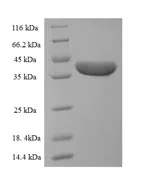
- SDS-PAGE
Supplier Data
SDS-PAGE - Recombinant Human Desmoplakin protein (His tag) (AB225667)
Tris-Glycine gel) Discontinuous SDS-PAGE (reduced) analysis of ab225667 with 5% enrichment gel and 15% separation gel.
보완 제품
Reagents, Controls & Accessories
AB325997
Prestained Protein Ladder - Extra broad molecular weight (3-250 kDa, 5-color)

- 0
- 0

Primary Antibodies
AB109445
Anti-Desmoplakin antibody [EPR4383(2)]
20ul selling size|RabMAb|Recombinant|Trial Size

- 4
- 2

Reactivity 정보
서열 정보
특성 및 보관 정보
제형
배송 시 보관 조건
적절한 단기 보관 조건
적절한 장기 보관 조건
분주 정보
보관 정보
추가 정보
This supplementary information is collated from multiple sources and compiled automatically.
Biological function summary
Desmoplakin acts to maintain cell-cell adhesion through its involvement with desmosomes and is an essential component of the desmosomal complex. This complex is important for the architectural stability of epithelial and cardiac tissues. Desmoplakin interacts directly with other desmosomal proteins like plakoglobin and plakophilin forming a bridge between the cell membrane and the cytoskeleton.
Pathways
Desmoplakin is an important player in the maintenance and function of the cytoskeletal network particularly within the intermediate filament organization. In addition desmoplakin participates in cellular adhesion signaling pathways. Its interaction with proteins such as plakoglobin mediates the organization of desmosomes influencing cellular signaling and communication processes critical for tissue morphogenesis and repair.
일반 정보
기능
A component of desmosome cell-cell junctions which are required for positive regulation of cellular adhesion (PubMed : 25733715). Critical for cell-cell adhesion in early stage blastocysts and progression through proamniotic cavity formation (By similarity). Not required for preimplantation morphogenic process in blastocysts (By similarity). Required for keratin filament anchoring at the desmosome junction and subsequent organization of the keratin intermediate filament network within the cytoplasm (By similarity). Required for anchoring of desmosomes to the microtubule architecture, via its interaction with NIN (By similarity). Plays a key role in adhesion and organization of the dermal epithelial barrier (By similarity). Critical for the maintenance of the neural tube structure following formation and organization of the neuroepithelium (By similarity). Facilitates outgrowth and repair of motor neuron fibers in regenerating axons following injury, probably by promoting recruitment of a complex containing DSP, CDH2, VIM and JUP to the outgrowth tips (By similarity). Required for the normal formation of the heart, also required for development of vascular capillary structures and intact endothelial cell barriers (By similarity). Regulates profibrotic gene expression in cardiomyocytes via activation of the MAPK14/p38 MAPK signaling cascade and increase in TGFB1 protein abundance (By similarity). Maintains cardiac rhythmicity by ensuring correct cell-cell adhesion within the sinoatrial node, via stabilization of protein components of both desmosome and Gap junctions (By similarity). Involved in maintaining the protein stability and recruitment of GJA1 to functional gap junctions, via inhibition of KRAS-mediated MAPK1/MAPK3 phosphorylation of GJA1 (By similarity). Required for the survival and maintenance of germ cells in the gonads during embryonic development (By similarity). Binds to telomere DNA (via C-terminus) and acts to prevent telomere damage and maintain telomere length via its interaction with TRF2 (PubMed : 31595153).
서열 유사성
Belongs to the plakin or cytolinker family.
Post-translational modifications
Methylation by PRMT1 promotes GSK3B-mediated phosphorylation cascade of multiple serine residues at the C-terminus resulting in trafficking to desmosome cell-cell junctions.. Phosphorylation by GSK3B occurs sequentially from Ser-2849 along multiple serine residue at the C-terminus. Hyperphosphorylation by GSK3B results in recruitment to desmosome cell-cell junction and promotion of intercellular adhesion (PubMed:25733715). Phosphorylation at Ser-2849 increases association with intermediate filament cytokeratin, potentially facilitating interaction between desmosome junctions and intermediate filament architecture (PubMed:33596089).
Subcellular localisation
Nucleus
타겟 정보
Product promise
Please note: All products are 'FOR RESEARCH USE ONLY. NOT FOR USE IN DIAGNOSTIC OR THERAPEUTIC PROCEDURES'.
For licensing inquiries, please contact partnerships@abcam.com