JavaScript is disabled in your browser. Please enable JavaScript to view this website.
AB153776

Recombinant Human Estrogen Receptor alpha protein

Be the first to review this product! 리뷰 제출

|

(1 출판물)

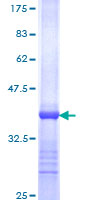
Recombinant Human Estrogen Receptor alpha protein is a Human Fragment protein, in the 1 to 116 aa range, expressed in Escherichia coli, with >95%, < 1 EU/µg endotoxin level, suitable for SDS-PAGE, HPLC.

주요 정보

Purity

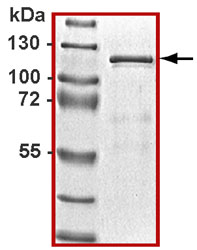
>95% SDS-PAGE

ab153776 is greater than 95% as determined by SEC-HPLC and reducing SDS-PAGE. It is lyophilized from an 0.2 µM filtered solution.

Endotoxin 레벨

< 1 EU/µg

발현 시스템

Escherichia coli

Tags

His tag N-Terminus

Applications

HPLC, SDS-PAGE

applications

Biologically active

No

Accession

P03372-1

Animal free

No

Carrier free

No

Species

Human

Reconstitution

Reconstitute in PBS

보관 버퍼

pH: 7.2 Constituents: 99% Phosphate Buffer, 0.88% Sodium chloride

storage-buffer

Reactivity 정보

{ "title": "Reactivity Data", "filters": { "stats": ["", "Reactivity", "Dilution Info", "Notes"] }, "values": { "SDS-PAGE": { "reactivity":"TESTED_AND_REACTS", "dilution-info":"", "notes":"<p></p>" }, "HPLC": { "reactivity":"TESTED_AND_REACTS", "dilution-info":"", "notes":"<p></p>" } } }

서열 정보

[{"linker":null,"sequence":"MTMTLHTKASGMALLHQIQGNELEPLNRPQLKIPLERPLGEVYLDSSKPAVYNYPEGAAYEFNAAAAANAQVYGQTGLPYGPGSEAAAFGSNGLGGFPPLNSVSPSPLMLLHPPPQ","proteinLength":"Fragment","predictedMolecularWeight":"12.2 kDa","actualMolecularWeight":null,"aminoAcidEnd":116,"aminoAcidStart":1,"nature":"Recombinant","expressionSystem":"Escherichia coli","accessionNumber":"P03372","tags":[{"tag":"His","terminus":"N-Terminus"}]}]

특성 및 보관 정보

제형
Lyophilized
배송 시 보관 조건
Blue Ice
적절한 단기 보관 기간
A few weeks
적절한 단기 보관 조건
-20°C
적절한 장기 보관 조건
-20°C
False

추가 정보

This supplementary information is collated from multiple sources and compiled automatically.

Estrogen Receptor alpha also known as ERα or ESR1 is a nuclear receptor that acts as a transcription factor when activated by its ligand estrogen. Its molecular weight is approximately 66 kDa. ERα is expressed in various tissues such as breast tissue endometrium and ovarian cells as well as some areas of the central nervous system. The ERα protein binds to specific DNA sequences called estrogen response elements to regulate the transcription of target genes. Tools like ER alpha ELISA and assays using alpha peptides help to study this receptor.
Biological function summary

ERα plays a significant role in the regulation of estrogen signaling. Estrogens binding to ERα activate the receptor which can form a homodimer or heterodimer complex with other proteins like coactivators or corepressors. This complex then modulates the transcription of genes involved in cell growth proliferation and differentiation. ERα is closely linked with processes like reproductive tissue development and maintenance.

Pathways

ERα is involved in the estrogen signaling pathway and the cell cycle regulation pathway. In the estrogen signaling pathway ERα works together with proteins such as coactivators which enhance gene transcription and corepressors which can inhibit transcription. In the context of cell cycle regulation ERα's interactions with other cell cycle proteins help control cell division and proliferation linking ERα activity to the progression through different stages of the cell cycle.

ERα's dysregulation has been implicated in breast cancer and osteoporosis. ERα overexpression or mutations can lead to oncogenic effects in breast cancer making it a prominent therapeutic target. Drugs that modulate ERα activity like selective estrogen receptor modulators (SERMs) are used in breast cancer treatment. In osteoporosis ERα is related to bone density regulation with its activity affecting bone resorption and formation. Relationships between ERα and other proteins such as those involved in hormone signaling pathways impact these disease mechanisms.

제품 프로토콜

타겟 정보

Nuclear hormone receptor. The steroid hormones and their receptors are involved in the regulation of eukaryotic gene expression and affect cellular proliferation and differentiation in target tissues. Ligand-dependent nuclear transactivation involves either direct homodimer binding to a palindromic estrogen response element (ERE) sequence or association with other DNA-binding transcription factors, such as AP-1/c-Jun, c-Fos, ATF-2, Sp1 and Sp3, to mediate ERE-independent signaling. Ligand binding induces a conformational change allowing subsequent or combinatorial association with multiprotein coactivator complexes through LXXLL motifs of their respective components. Mutual transrepression occurs between the estrogen receptor (ER) and NF-kappa-B in a cell-type specific manner. Decreases NF-kappa-B DNA-binding activity and inhibits NF-kappa-B-mediated transcription from the IL6 promoter and displace RELA/p65 and associated coregulators from the promoter. Recruited to the NF-kappa-B response element of the CCL2 and IL8 promoters and can displace CREBBP. Present with NF-kappa-B components RELA/p65 and NFKB1/p50 on ERE sequences. Can also act synergistically with NF-kappa-B to activate transcription involving respective recruitment adjacent response elements; the function involves CREBBP. Can activate the transcriptional activity of TFF1. Also mediates membrane-initiated estrogen signaling involving various kinase cascades. Essential for MTA1-mediated transcriptional regulation of BRCA1 and BCAS3 (PubMed : 17922032). Maintains neuronal survival in response to ischemic reperfusion injury when in the presence of circulating estradiol (17-beta-estradiol/E2) (By similarity).. Isoform 3. Involved in activation of NOS3 and endothelial nitric oxide production (PubMed : 21937726). Isoforms lacking one or several functional domains are thought to modulate transcriptional activity by competitive ligand or DNA binding and/or heterodimerization with the full-length receptor (PubMed : 10970861). Binds to ERE and inhibits isoform 1 (PubMed : 10970861).
See full target information ESR1

대체 명칭 보기

ESR, NR3A1, ESR1, Estrogen receptor, ER, ER-alpha, Estradiol receptor, Nuclear receptor subfamily 3 group A member 1

제품이 사용된 논문 (1)

Recent publications for all applications. Explore the 전체 목록and refine your search

International journal of nanomedicine 10:4717-30 PubMed26251594

2015

Controllable drug uptake and nongenomic response through estrogen-anchored cyclodextrin drug complex.

Applications

Unspecified application

Species

Unspecified reactive species

Juan-Juan Yin,Stepan P Shumyak,Christopher Burgess,Zhi-Wei Zhou,Zhi-Xu He,Xue-Ji Zhang,Shu-Ting Pan,Tian-Xin Yang,Wei Duan,Jia-Xuan Qiu,Shu-Feng Zhou
제품이 사용된 논문 모두 보기

Product promise

저희는 고품질 시약으로 고객님의 연구를 서포트하고자 최선을 다하고 있으며, 모든 단계에서 함께 하겠습니다. 만약 제품이 기대한 성능을 보이지 않을 경우에도 Product Promise로 보호받으실 수 있습니다.
자세한 내용은 이용 약관을 확인해 주세요.

Please note: All products are 'FOR RESEARCH USE ONLY. NOT FOR USE IN DIAGNOSTIC OR THERAPEUTIC PROCEDURES'.

For licensing inquiries, please contact partnerships@abcam.com