Recombinant Human FADD protein (His tag N-Terminus)
Be the first to review this product! 리뷰 제출
|
(0 출판물)
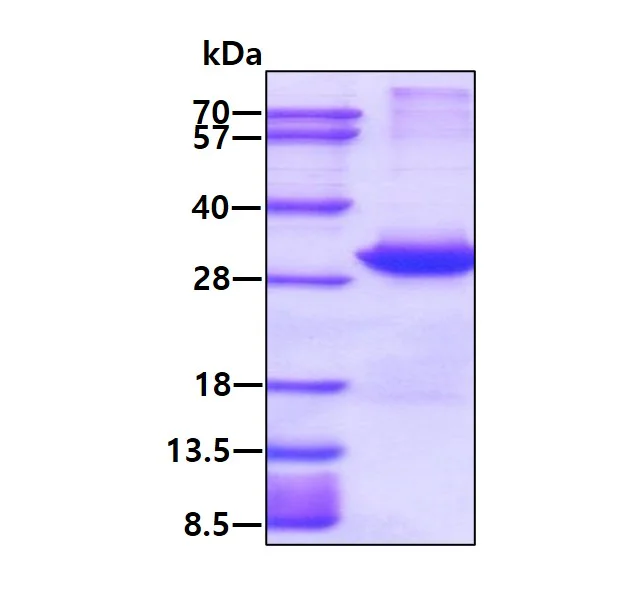
- SDS-PAGE
Supplier Data
SDS-PAGE - Recombinant Human FADD protein (His tag N-Terminus) (AB89242)
SDS-PAGE analysis of ab89242 (3 μg) under reducing conditions and visualized by coomassie blue stain.
보완 제품
Primary Antibodies
AB180673
Anti-Caspase-11 antibody [EPR18628]
20ul selling size|RabMAb|Recombinant

- 4
- 2
Reactivity 정보
서열 정보
특성 및 보관 정보
제형
배송 시 보관 조건
적절한 단기 보관 조건
적절한 장기 보관 조건
분주 정보
보관 정보
추가 정보
This supplementary information is collated from multiple sources and compiled automatically.
Biological function summary
FADD is essential in apoptosis where it assists in the assembly of the death-inducing signaling complex (DISC). Upon receptor activation FADD recruits procaspase-8 or -10 to DISC promoting their autocatalytic cleavage and activation. This leads to the subsequent cascade that results in cell apoptosis. FADD also plays a role in necroptosis and is involved in the immune response regulation highlighting its multifunctional nature in cellular processes.
Pathways
FADD integrates into the apoptotic and necroptotic pathways. In the apoptotic pathway it interacts closely with Fas a death receptor to promote caspase-8 activation. Additionally in the necroptotic pathway FADD associates with RIP1 and RIP3 contributing to an alternative form of programmed cell death. These interactions underline its significant role in controlling cell fate decisions.
일반 정보
기능
Apoptotic adapter molecule that recruits caspases CASP8 or CASP10 to the activated FAS/CD95 or TNFRSF1A/TNFR-1 receptors (PubMed : 16762833, PubMed : 19118384, PubMed : 20935634, PubMed : 23955153, PubMed : 24025841, PubMed : 7538907, PubMed : 9184224). The resulting aggregate called the death-inducing signaling complex (DISC) performs CASP8 proteolytic activation (PubMed : 16762833, PubMed : 19118384, PubMed : 20935634, PubMed : 7538907, PubMed : 9184224). Active CASP8 initiates the subsequent cascade of caspases mediating apoptosis (PubMed : 16762833). Involved in interferon-mediated antiviral immune response, playing a role in the positive regulation of interferon signaling (PubMed : 21109225, PubMed : 24204270).
Post-translational modifications
(Microbial infection) Glycosylated at Arg-117 by enteropathogenic E.coli protein NleB1, C.rodentium protein NleB and S.typhimurium protein Ssek1: arginine GlcNAcylation prevents recruitment of caspase-8 or caspase-10 to the activated Fas (CD95) or TNFR-1 receptors.
타겟 정보
대체 명칭 보기
Product promise
Please note: All products are 'FOR RESEARCH USE ONLY. NOT FOR USE IN DIAGNOSTIC OR THERAPEUTIC PROCEDURES'.
For licensing inquiries, please contact partnerships@abcam.com