JavaScript is disabled in your browser. Please enable JavaScript to view this website.
AB290106

Recombinant Human LILRB1 Protein

Be the first to review this product! 리뷰 제출

|

(0 출판물)

Recombinant Human LILRB1 Protein is a Human Fragment protein, in the 24 to 458 aa range, expressed in HEK 293 cells, with >95%, <0.005 EU/µg endotoxin level, suitable for SDS-PAGE.
1 이미지
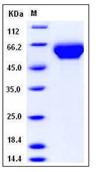
SDS-PAGE - Recombinant Human LILRB1 Protein (AB290106)
  • SDS-PAGE

Supplier Data

SDS-PAGE - Recombinant Human LILRB1 Protein (AB290106)

SDS-PAGE analysis of ab290106

주요 정보

Purity

>95% SDS-PAGE

Endotoxin 레벨

<0.005 EU/µg

발현 시스템

HEK 293 cells

Tags

Tag free

Applications

SDS-PAGE

applications

Biologically active

No

Accession

Q8NHL6-1

Animal free

Yes

Carrier free

No

Species

Human

Reconstitution

Reconstitute in PBS

보관 버퍼

pH: 7.4 Constituents: 10.26% Trehalose, 0.727% Dibasic monohydrogen potassium phosphate, 0.248% Potassium phosphate monobasic

storage-buffer

Reactivity 정보

{ "title": "Reactivity Data", "filters": { "stats": ["", "Reactivity", "Dilution Info", "Notes"] }, "values": { "SDS-PAGE": { "reactivity":"TESTED_AND_REACTS", "dilution-info":"", "notes":"<p></p>" } } }

서열 정보

[{"linker":null,"sequence":"HLPKPTLWAEPGSVITQGSPVTLRCQGGQETQEYRLYREKKTALWITRIPQELVKKGQFPIPSITWEHAGRYRCYYGSDTAGRSESSDPLELVVTGAYIKPTLSAQPSPVVNSGGNVILQCDSQVAFDGFSLCKEGEDEHPQCLNSQPHARGSSRAIFSVGPVSPSRRWWYRCYAYDSNSPYEWSLPSDLLELLVLGVSKKPSLSVQPGPIVAPEETLTLQCGSDAGYNRFVLYKDGERDFLQLAGAQPQAGLSQANFTLGPVSRSYGGQYRCYGAHNLSSEWSAPSDPLDILIAGQFYDRVSLSVQPGPTVASGENVTLLCQSQGWMQTFLLTKEGAADDPWRLRSTYQSQKYQAEFPMGPVTSAHAGTYRCYGSQSSKPYLLTHPSDPLELVVSGPSGGPSSPTTGPTSTSGPEDQPLTPTGSDPQSGLGRH","proteinLength":"Fragment","predictedMolecularWeight":"47.2 kDa","actualMolecularWeight":"47.2 kDa","aminoAcidEnd":458,"aminoAcidStart":24,"nature":"Recombinant","expressionSystem":"HEK 293 cells","accessionNumber":"Q8NHL6","tags":[]}]

특성 및 보관 정보

제형
Lyophilized
배송 시 보관 조건
Ambient - Can Ship with Ice
적절한 단기 보관 조건
Ambient
적절한 장기 보관 조건
Ambient
False

추가 정보

This supplementary information is collated from multiple sources and compiled automatically.

LILRB1 also known as leukocyte immunoglobulin-like receptor subfamily B member 1 or CD85j is a protein expressed mainly on myeloid cells including monocytes and dendritic cells as well as some subsets of lymphocytes. This transmembrane protein is approximately 110-120 kDa in mass and is recognized for its role in immune regulation. LILRB1 interacts with MHC class I molecules on target cells mediating inhibitory signals that prevent immune overactivation. These interactions allow LILRB1 to help maintain self-tolerance and regulate adaptive immune responses.
Biological function summary

LILRB1 functions as an inhibitory receptor that dampens immune system activation by recruiting SHP-1 and SHP-2 phosphatases. As part of a complex with other immune checkpoint molecules LILRB1 modulates the balance between activating and inhibitory signals in immune cells. Its inhibitory signaling prevents excessive inflammation by reducing cytokine production and limiting T cell proliferation.

Pathways

This protein plays a role in immune signaling pathways specifically through interactions with proteins involved in the regulation of immune responses such as KIRs (Killer-cell Immunoglobulin-like Receptors). It participates in pathways that control the inhibitory signals controlling immune activity like the NK cell cytotoxicity pathway and the Fc gamma R-mediated phagocytosis pathway. Through these mechanisms LILRB1 maintains immune equilibrium and preserves tissue integrity during immune responses.

The dysregulation of LILRB1 activity links to autoimmune conditions and infectious disease outcomes. Aberrant expression or function can impact diseases such as rheumatoid arthritis and HIV influencing the progression and severity of these conditions. In rheumatoid arthritis altered LILRB1 signaling may exacerbate inflammation while in the context of HIV it could affect immune cell exhaustion. Furthermore LILRB1 interactions with proteins like ILT2 highlight its potential involvement in modulating immune responses during these diseases.

제품 프로토콜

타겟 정보

Receptor for class I MHC antigens. Recognizes a broad spectrum of HLA-A, HLA-B, HLA-C, HLA-G and HLA-F alleles (PubMed : 16455647, PubMed : 28636952). Receptor for H301/UL18, a human cytomegalovirus class I MHC homolog. Ligand binding results in inhibitory signals and down-regulation of the immune response. Engagement of LILRB1 present on natural killer cells or T-cells by class I MHC molecules protects the target cells from lysis. Interaction with HLA-B or HLA-E leads to inhibition of FCER1A signaling and serotonin release. Inhibits FCGR1A-mediated phosphorylation of cellular proteins and mobilization of intracellular calcium ions (PubMed : 11907092, PubMed : 9285411, PubMed : 9842885). Recognizes HLA-G in complex with B2M/beta-2 microglobulin and a nonamer self-peptide (PubMed : 16455647). Upon interaction with peptide-bound HLA-G-B2M complex, triggers secretion of growth-promoting factors by decidual NK cells (PubMed : 19304799, PubMed : 29262349). Reprograms B cells toward an immune suppressive phenotype (PubMed : 24453251).
See full target information LILRB1

대체 명칭 보기

CD85j, ILT2, LIR1, MIR7, LILRB1, Leukocyte immunoglobulin-like receptor subfamily B member 1, LIR-1, Leukocyte immunoglobulin-like receptor 1, CD85 antigen-like family member J, Immunoglobulin-like transcript 2, Monocyte/macrophage immunoglobulin-like receptor 7, ILT-2, MIR-7

Product promise

저희는 고품질 시약으로 고객님의 연구를 서포트하고자 최선을 다하고 있으며, 모든 단계에서 함께 하겠습니다. 만약 제품이 기대한 성능을 보이지 않을 경우에도 Product Promise로 보호받으실 수 있습니다.
자세한 내용은 이용 약관을 확인해 주세요.

Please note: All products are 'FOR RESEARCH USE ONLY. NOT FOR USE IN DIAGNOSTIC OR THERAPEUTIC PROCEDURES'.

For licensing inquiries, please contact partnerships@abcam.com