JavaScript is disabled in your browser. Please enable JavaScript to view this website.
AB307191

Recombinant Human PCNA protein (His tag)

Be the first to review this product! 리뷰 제출

|

(0 출판물)

Recombinant Human PCNA protein (His tag) is a Human Full Length protein, in the 1 to 261 aa range, expressed in Escherichia coli, with >95%, <0.1 EU/mg endotoxin level, suitable for SDS-PAGE, HPLC, Mass Spec.
3 이미지
Mass Spectrometry - Recombinant Human PCNA protein (His tag) (AB307191)
  • Mass Spec

Supplier Data

Mass Spectrometry - Recombinant Human PCNA protein (His tag) (AB307191)

Mass determination by ESI-TOF. Predicted MW is 29832.96 Da (+/- 10 Da by ESI-TOF). Observed MW is 29832.64 Da.

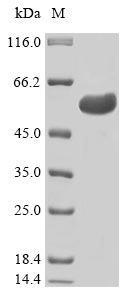
SDS-PAGE - Recombinant Human PCNA protein (His tag) (AB307191)
  • SDS-PAGE

Supplier Data

SDS-PAGE - Recombinant Human PCNA protein (His tag) (AB307191)

SDS-page analysis of ab307191

HPLC - Recombinant Human PCNA protein (His tag) (AB307191)
  • HPLC

Supplier Data

HPLC - Recombinant Human PCNA protein (His tag) (AB307191)

HPLC analysis of ab307191

주요 정보

Purity

>95% HPLC

SDS-PAGE >=95%

Endotoxin 레벨

<0.1 EU/mg

발현 시스템

Escherichia coli

Tags

His tag C-Terminus

Applications

SDS-PAGE, Mass Spec, HPLC

applications

Biologically active

No

Accession

P12004-1

Animal free

Yes

Carrier free

No

Species

Human

Reconstitution

Reconstitute in PBS

보관 버퍼

pH: 7.4 Constituents: 10.26% Trehalose, 0.727% Dibasic monohydrogen potassium phosphate, 0.248% Potassium phosphate monobasic

storage-buffer

Reactivity 정보

{ "title": "Reactivity Data", "filters": { "stats": ["", "Reactivity", "Dilution Info", "Notes"] }, "values": { "SDS-PAGE": { "reactivity":"TESTED_AND_REACTS", "dilution-info":"", "notes":"<p></p>" }, "HPLC": { "reactivity":"TESTED_AND_REACTS", "dilution-info":"", "notes":"<p></p>" }, "Mass Spec": { "reactivity":"TESTED_AND_REACTS", "dilution-info":"", "notes":"<p></p>" } } }

서열 정보

[{"linker":null,"sequence":"MFEARLVQGSILKKVLEALKDLINEACWDISSSGVNLQSMDSSHVSLVQLTLRSEGFDTYRCDRNLAMGVNLTSMSKILKCAGNEDIITLRAEDNADTLALVFEAPNQEKVSDYEMKLMDLDVEQLGIPEQEYSCVVKMPSGEFARICRDLSHIGDAVVISCAKDGVKFSASGELGNGNIKLSQTSNVDKEEEAVTIEMNEPVQLTFALRYLNFFTKATPLSSTVTLSMSADVPLVVEYKIADMGHLKYYLAPKIEDEEGS","proteinLength":"Full Length","predictedMolecularWeight":"29.83 kDa","actualMolecularWeight":"29.83 kDa","aminoAcidEnd":261,"aminoAcidStart":1,"nature":"Recombinant","expressionSystem":"Escherichia coli","accessionNumber":"P12004","tags":[{"tag":"His","terminus":"C-Terminus"}]}]

특성 및 보관 정보

제형
Lyophilized
배송 시 보관 조건
Ambient - Can Ship with Ice
적절한 단기 보관 조건
Ambient
적절한 장기 보관 조건
Ambient
False

추가 정보

This supplementary information is collated from multiple sources and compiled automatically.

PCNA or Proliferating Cell Nuclear Antigen functions as a sliding clamp for DNA polymerases during DNA replication. This important role enables it to coordinate the orderly duplication of the genome by increasing the processivity of DNA polymerase Δ. PCNA weighs approximately 29 kDa and forms a homotrimeric ring structure. It is expressed in the nucleus of cells often found abundantly in proliferating cells. Aside from its main name some people also refer to it as PC10.
Biological function summary

This protein serves a core function in cell cycle regulation and DNA repair. PCNA acts as a scaffold for the assembly of numerous proteins involved in DNA processing forming part of the replication fork complex. It interacts with cyclins and cyclin-dependent kinases (CDKs) linking DNA synthesis to cell cycle progression. Furthermore PCNA partners with proteins involved in DNA mismatch repair base excision repair and nucleotide excision repair.

Pathways

PCNA is integral in the DNA replication and repair pathways. It closely associates with the p21 protein which regulates the cell cycle by inhibiting cyclin-CDK complexes upon DNA damage. PCNA also plays a part in the ubiquitin-proteasome pathway where its modification by ubiquitin impacts how cells respond to DNA damage. This modification recruits specific proteins for DNA repair highlighting its central role in maintaining genomic stability.

PCNA is linked to cancer and autoimmune diseases. Its overexpression is common in various cancers reflecting its role in cell proliferation and the cell cycle. PCNA antibodies are sometimes found in the serum of patients with systemic lupus erythematosus (SLE) a connection also related to alterations in the p21 protein pathway. The interaction between PCNA and disease-specific proteins emphasizes its importance in both cell proliferation and immune system disorders.

제품 프로토콜

타겟 정보

Confers DNA tethering and processivity to DNA polymerases and other proteins (PubMed : 24695737, PubMed : 24939902, PubMed : 35585232). Auxiliary protein of DNA polymerase delta and epsilon, is involved in the control of DNA replication by increasing the polymerases' processivity during elongation of the leading strand (PubMed : 35585232). Induces a robust stimulatory effect on the 3'-5' exonuclease and 3'-phosphodiesterase, but not apurinic-apyrimidinic (AP) endonuclease, APEX2 activities. Has to be loaded onto DNA in order to be able to stimulate APEX2. Plays a key role in DNA damage response (DDR) by being conveniently positioned at the replication fork to coordinate DNA replication with DNA repair and DNA damage tolerance pathways (PubMed : 24939902). Acts as a loading platform to recruit DDR proteins that allow completion of DNA replication after DNA damage and promote postreplication repair : monoubiquitinated PCNA leads to recruitment of translesion (TLS) polymerases, while 'Lys-63'-linked polyubiquitination of PCNA is involved in error-free pathway and employs recombination mechanisms to synthesize across the lesion (PubMed : 24695737).
See full target information PCNA

대체 명칭 보기

DNA sliding clamp PCNA, Cyclin, Proliferating cell nuclear antigen, PCNA

Product promise

저희는 고품질 시약으로 고객님의 연구를 서포트하고자 최선을 다하고 있으며, 모든 단계에서 함께 하겠습니다. 만약 제품이 기대한 성능을 보이지 않을 경우에도 Product Promise로 보호받으실 수 있습니다.
자세한 내용은 이용 약관을 확인해 주세요.

Please note: All products are 'FOR RESEARCH USE ONLY. NOT FOR USE IN DIAGNOSTIC OR THERAPEUTIC PROCEDURES'.

For licensing inquiries, please contact partnerships@abcam.com