Recombinant Human Podoplanin protein is a Human Fragment protein, in the 23 to 131 aa range, expressed in HEK 293 cells, with >95%, < 1 EU/µg endotoxin level, suitable for SDS-PAGE, HPLC.
대체 명칭 보기
GP36, PSEC0003, PSEC0025, PDPN, Podoplanin, Aggrus, Glycoprotein 36, PA2.26 antigen, T1-alpha, Gp36, T1A
보완 제품
Reagents, Controls & Accessories
AB116028
Prestained Protein Ladder - Broad molecular weight (10 - 245 kDa)

- 5
- 3
Primary Antibodies
AB236529
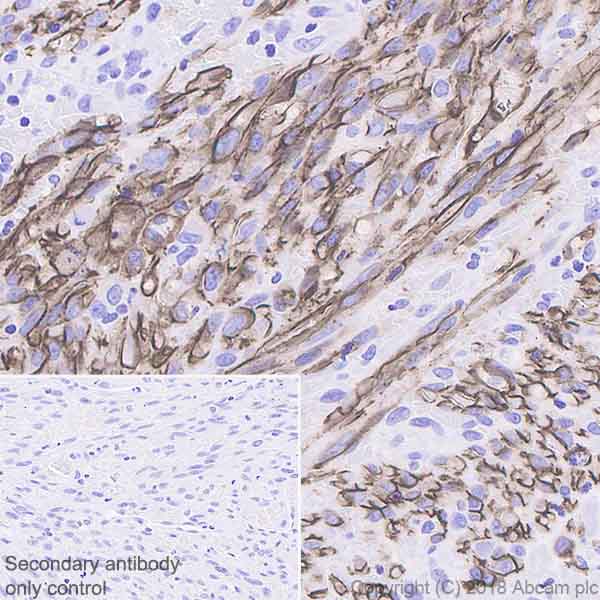
Anti-Podoplanin antibody [EPR22182]
BOND RX™ Validated|20ul selling size|RabMAb|Advanced Validation|Recombinant
- 5
- 2
Reactivity 정보
서열 정보
특성 및 보관 정보
제형
배송 시 보관 조건
적절한 단기 보관 기간
적절한 단기 보관 조건
적절한 장기 보관 조건
추가 정보
This supplementary information is collated from multiple sources and compiled automatically.
Biological function summary
The protein participates in maintaining the integrity of cell structures and lymphangiogenesis. This protein does not form part of a larger complex but actively interacts with different molecules. In lymphoid tissues podoplanin contributes to the proper formation of lymphatic channels and assists in platelet aggregation. These actions are pivotal in wound healing and protecting the epithelial cell layers in multiple organs.
Pathways
Podoplanin impacts the platelet activation pathway and the Lymphatic Vessel Development pathway. Its interaction with CLEC-2 (C-type lectin-like receptor 2) triggers downstream signaling leading to changes in platelet morphology and actin cytoskeleton reorganization. Podoplanin’s activation of these pathways links it to key processes that include cell migration and tissue homeostasis TGF-beta interaction also represents a significant relationship within these pathways.
일반 정보
기능
Mediates effects on cell migration and adhesion through its different partners. During development plays a role in blood and lymphatic vessels separation by binding CLEC1B, triggering CLEC1B activation in platelets and leading to platelet activation and/or aggregation (PubMed : 14522983, PubMed : 15231832, PubMed : 17222411, PubMed : 17616532, PubMed : 18215137). Interaction with CD9, on the contrary, attenuates platelet aggregation induced by PDPN (PubMed : 18541721). Through MSN or EZR interaction promotes epithelial-mesenchymal transition (EMT) leading to ERZ phosphorylation and triggering RHOA activation leading to cell migration increase and invasiveness (PubMed : 17046996, PubMed : 21376833). Interaction with CD44 promotes directional cell migration in epithelial and tumor cells (PubMed : 20962267). In lymph nodes (LNs), controls fibroblastic reticular cells (FRCs) adhesion to the extracellular matrix (ECM) and contraction of the actomyosin by maintaining ERM proteins (EZR; MSN and RDX) and MYL9 activation through association with unknown transmembrane proteins. Engagement of CLEC1B by PDPN promotes FRCs relaxation by blocking lateral membrane interactions leading to reduction of ERM proteins (EZR; MSN and RDX) and MYL9 activation (By similarity). Through binding with LGALS8 may participate in connection of the lymphatic endothelium to the surrounding extracellular matrix (PubMed : 19268462). In keratinocytes, induces changes in cell morphology showing an elongated shape, numerous membrane protrusions, major reorganization of the actin cytoskeleton, increased motility and decreased cell adhesion (PubMed : 15515019). Controls invadopodia stability and maturation leading to efficient degradation of the extracellular matrix (ECM) in tumor cells through modulation of RHOC activity in order to activate ROCK1/ROCK2 and LIMK1/LIMK2 and inactivation of CFL1 (PubMed : 25486435). Required for normal lung cell proliferation and alveolus formation at birth (By similarity). Does not function as a water channel or as a regulator of aquaporin-type water channels (PubMed : 9651190). Does not have any effect on folic acid or amino acid transport (By similarity).
서열 유사성
Belongs to the podoplanin family.
Post-translational modifications
Extensively O-glycosylated. Contains sialic acid residues. O-glycosylation is necessary for platelet aggregation activity. Disialylated at Thr-52; sialic acid is critical for platelet-aggregating activity and for CLEC1B interaction (PubMed:17222411, PubMed:25458834).. The N-terminus is blocked.. Cleaved by a metalloprotease within its extracellular (EC) domain, generating a membrane-bound C-terminal fragment (PCTF33) and an extracellular fragment. The resulting membrane-bound C-terminal fragment (PCTF33) is further processed between Val-150 and Val-151 by PSEN1/gamma-secretase generating the intracellular domain of podoplanin (PICD).
타겟 정보
Product promise
Please note: All products are 'FOR RESEARCH USE ONLY. NOT FOR USE IN DIAGNOSTIC OR THERAPEUTIC PROCEDURES'.
For licensing inquiries, please contact partnerships@abcam.com