JavaScript is disabled in your browser. Please enable JavaScript to view this website.
AB316399

Recombinant Mouse Clusterin Protein Standard (His tag)

Be the first to review this product! 리뷰 제출

|

(0 출판물)

Recombinant Mouse Clusterin Protein Standard (His tag) is a Mouse Full Length protein, expressed in HEK 293 cells, with >80%, suitable for SDS-PAGE, sELISA.
2 이미지
Sandwich ELISA - Recombinant Mouse Clusterin Protein Standard (His tag) (AB316399)
  • sELISA

Supplier Data

Sandwich ELISA - Recombinant Mouse Clusterin Protein Standard (His tag) (AB316399)

Sandwich ELISA with the capture antibody ab242505 dilution at 2 μg/mL and detector antibody ab242754 dilution at 0.5 μg/mL after biotin conjugation.

SDS-PAGE - Recombinant Mouse Clusterin Protein Standard (His tag) (AB316399)
  • SDS-PAGE

Supplier Data

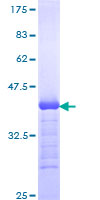
SDS-PAGE - Recombinant Mouse Clusterin Protein Standard (His tag) (AB316399)

SDS-PAGE analysis of ab316399 under reducing conditions for 2ug protein.

주요 정보

Purity

>80% SDS-PAGE

발현 시스템

HEK 293 cells

Tags

His tag C-Terminus

Applications

SDS-PAGE, sELISA

applications

Biologically active

No

Accession

Q06890-1

Animal free

Yes

Carrier free

No

Species

Mouse

보관 버퍼

pH: 7.3 - 7.5 Constituents: 2.922% Sodium chloride, 0.64107% disodium;hydrogen phosphate;dodecahydrate, 0.02858% Potassium phosphate monobasic

storage-buffer

Reactivity 정보

{ "title": "Reactivity Data", "filters": { "stats": ["", "Reactivity", "Dilution Info", "Notes"] }, "values": { "SDS-PAGE": { "reactivity":"TESTED_AND_REACTS", "dilution-info":"", "notes":"<p></p>" }, "sELISA": { "reactivity":"TESTED_AND_REACTS", "dilution-info":"", "notes":"<p></p>" } } }

제품 세부 정보

While the standard is the same as the one provided in the corresponding SimpleStep ELISA Kit, it cannot be treated as the consumable provided with our SimpleStep ELISA Kit due to differences in its concentration calibration.

Abcam guarantee that this protein standard is suitable for use in a sandwich ELISA. Individual results may vary due to differences in technique, laboratory equipment, buffers, and other experimental factors. The detection range provided for this protein standard is based on initial sandwich ELISA validation data.

The protein concentration is the concentration after validation on our sandwich ELISA platform. This Standard protein is guaranteed to work with our Capture and Detector antibodies in sELISA. Please contact our Scientific Support team to know which antibody pair is suitable for this protein.

서열 정보

[{"linker":null,"sequence":null,"proteinLength":"Full Length","predictedMolecularWeight":"51.4 kDa","actualMolecularWeight":null,"aminoAcidEnd":0,"aminoAcidStart":0,"nature":"Recombinant","expressionSystem":null,"accessionNumber":"Q06890","tags":[{"tag":"His","terminus":"C-Terminus"}]}]

특성 및 보관 정보

제형
Liquid
Purification 테크닉
Affinity purification His Tag
배송 시 보관 조건
Dry Ice
적절한 단기 보관 조건
-80°C
적절한 장기 보관 조건
-80°C
분주 정보
Upon delivery aliquot
보관 정보
Avoid freeze / thaw cycle
False

추가 정보

This supplementary information is collated from multiple sources and compiled automatically.

Clusterin also known as Apolipoprotein J (ApoJ) is a glycoprotein with a mass of approximately 75-80 kDa. Scientists find clusterin expressed widely in the human body including the brain kidney and reproductive organs. This protein exists in two isoforms a secreted form and a nuclear form each with different locations and functions within the cells.
Biological function summary

Clusterin plays multiple roles particularly in lipid transport apoptosis and cell-cell interactions. It does not form part of a larger protein complex but it acts as a molecular chaperone that helps in folding and clearance of damaged proteins. This capability allows clusterin to protect cells against stress conditions such as oxidative stress by preventing abnormal protein aggregation.

Pathways

Clusterin is involved in pathways related to cell survival and lipid metabolism. It plays a role in the insulin signaling pathway and interacts with proteins like Heat Shock Protein 70 (HSP70) to assist in protein folding and in the activation of apoptotic pathways when needed. Clusterin's function in these processes helps in maintaining cellular homeostasis.

Scientists associate clusterin with Alzheimer’s disease and cancer progression. Elevated levels of clusterin have been observed in Alzheimer's patients suggesting a role in amyloid-beta plaque formation. In cancer clusterin expression influences tumor progression and resistance to therapies. Its interaction with other proteins such as Bax modulates the apoptotic pathways impacting cancer cell survival and chemotherapy resistance.

제품 프로토콜

타겟 정보

Functions as extracellular chaperone that prevents aggregation of non native proteins. Prevents stress-induced aggregation of blood plasma proteins (By similarity). Inhibits formation of amyloid fibrils by APP, APOC2, B2M, CALCA, CSN3, SNCA and aggregation-prone LYZ variants (in vitro) (PubMed : 14741101). Does not require ATP. Maintains partially unfolded proteins in a state appropriate for subsequent refolding by other chaperones, such as HSPA8/HSC70. Does not refold proteins by itself. Binding to cell surface receptors triggers internalization of the chaperone-client complex and subsequent lysosomal or proteasomal degradation. When secreted, protects cells against apoptosis and against cytolysis by complement : inhibits assembly of the complement membrane attack complex (MAC) by preventing polymerization of C9 pore component of the MAC complex. Intracellular forms interact with ubiquitin and SCF (SKP1-CUL1-F-box protein) E3 ubiquitin-protein ligase complexes and promote the ubiquitination and subsequent proteasomal degradation of target proteins. Promotes proteasomal degradation of COMMD1 and IKBKB. Modulates NF-kappa-B transcriptional activity (By similarity). Following stress, promotes apoptosis (PubMed : 12551933). Inhibits apoptosis when associated with the mitochondrial membrane by interference with BAX-dependent release of cytochrome c into the cytoplasm. Plays a role in the regulation of cell proliferation. Following ER stress, suppresses stress-induced apoptosis by stabilizing mitochondrial membrane integrity through interaction with HSPA5. When secreted, does not affect caspase or BAX-mediated intrinsic apoptosis and TNF-induced NF-kappa-B-activity (By similarity). When secreted, acts as an important modulator during neuronal differentiation through interaction with STMN3 (By similarity). Plays a role in the clearance of immune complexes that arise during cell injury (PubMed : 11865066).
See full target information Clu

대체 명칭 보기

Apoj, Msgp-2, Clu, Clusterin, Apolipoprotein J, Clustrin, Sulfated glycoprotein 2, Apo-J, SGP-2

Product promise

저희는 고품질 시약으로 고객님의 연구를 서포트하고자 최선을 다하고 있으며, 모든 단계에서 함께 하겠습니다. 만약 제품이 기대한 성능을 보이지 않을 경우에도 Product Promise로 보호받으실 수 있습니다.
자세한 내용은 이용 약관을 확인해 주세요.

Please note: All products are 'FOR RESEARCH USE ONLY. NOT FOR USE IN DIAGNOSTIC OR THERAPEUTIC PROCEDURES'.

For licensing inquiries, please contact partnerships@abcam.com