JavaScript is disabled in your browser. Please enable JavaScript to view this website.
AB259390

Recombinant mouse SCF protein (Active)

Be the first to review this product! 리뷰 제출

|

(0 출판물)

Recombinant mouse SCF protein (Active) is a Mouse Fragment protein, in the 26 to 188 aa range, expressed in HEK 293 cells, with >95%, <0.005 EU/µg endotoxin level, suitable for SDS-PAGE, FuncS, Mass Spec, Cell Culture, HPLC.
4 이미지
Functional Studies - Recombinant mouse SCF protein (Active) (AB259390)
  • FuncS

Supplier Data

Functional Studies - Recombinant mouse SCF protein (Active) (AB259390)

Fully biologically active when compared to standard. Determined by dose-dependant stimulation of human TF-1 cells. ED50 is ≤ 2.223 ng /ml, corresponding to a specific activity of 4.50 x 10⁵ units/mg.
SDS-PAGE - Recombinant mouse SCF protein (Active) (AB259390)
  • SDS-PAGE

Lab

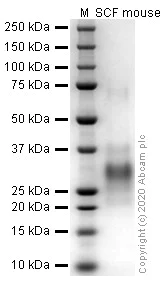
SDS-PAGE - Recombinant mouse SCF protein (Active) (AB259390)

SDS-PAGE analysis of ab259390.
OI-RD Scanning - Recombinant mouse SCF protein (Active) (AB259390)
  • OI-RD Scanning

Supplier Data

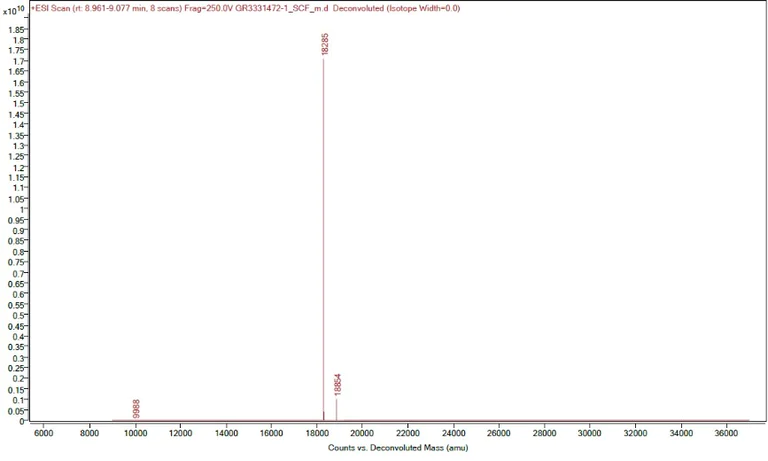
OI-RD Scanning - Recombinant mouse SCF protein (Active) (AB259390)

M + 0.49 Da (calc mass 18284.51) (+569 Da : Hex(1)HexNAc(2))

The spectrum was recorded with a 6545XT AdvanceBio LC/Q-TOF (Agilent Technologies) and a MabPac RP column (42.1x50 mm, 4 μm, Thermo Scientific). 5 μL of purified protein was injected and the gradient run from 85 % water : FA (99.9 : 0.1 v/v) and 15 % acetonitrile : FA (90 : 9.9 : 0.1 v/v/v) to 55 % water : FA (99.9 : 0.1 v/v) and 45 % acetonitrile : FA (90 : 9.9 : 0.1 v/v/v) within 3 minutes followed by an isocratic step for another 2.5 min. Flow rate was 0.4 mL/min and the column compartment temperature was 60 °C. Data was analysed and deconvoluted using the Bioconfirm software (Agilent Technologies).
HPLC - Recombinant mouse SCF protein (Active) (AB259390)
  • HPLC

Supplier Data

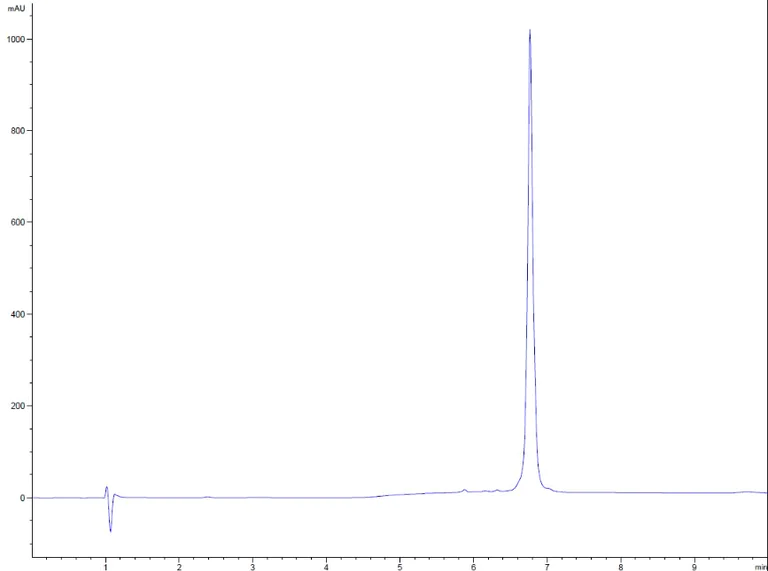
HPLC - Recombinant mouse SCF protein (Active) (AB259390)

Purity : 95%

The spectrum was recorded using a 1260 Infinity II HPLC system with DAD and a MabPac RP column (3.0x100 mm, 4 μm). 5 μL of purified protein was injected and the gradient run from 80 % water : TFA (99.9 : 0.1 v/v) and 20 % acetonitrile : water : TFA (90 : 9.9 : 0.1 v/v/v) to 20 % water : TFA (99.9 : 0.1 v/v) and 80 % acetonitrile : water : TFA (90 : 9.9 : 0.1 v/v/v) within 3 minutes followed by an isocratic step for another 3 min. Flow rate was 0.5 mL/min and the column compartment temperature was 50 °C.

주요 정보

Purity

>95% SDS-PAGE

Purity by HPLC >= 95%.

Endotoxin 레벨

<0.005 EU/µg

발현 시스템

HEK 293 cells

Tags

Tag free

Applications

Cell Culture, SDS-PAGE, FuncS, HPLC, Mass Spec

applications

Biologically active

Yes

Biological activity

Fully biologically active when compared to standard. ED<sub>50</sub> is &le; 2.223 ng /ml, corresponding to a specific activity of 4.50 x 10<sup>5</sup> units/mg.

Accession

P20826-1

Animal free

Yes

Carrier free

No

Species

Mouse

Reconstitution

Reconstitute in PBS

보관 버퍼

pH: 6 - 8 Constituents: 10.26% Trehalose, 0.727% Dibasic monohydrogen potassium phosphate, 0.248% Potassium phosphate monobasic

storage-buffer

Reactivity 정보

{ "title": "Reactivity Data", "filters": { "stats": ["", "Reactivity", "Dilution Info", "Notes"] }, "values": { "SDS-PAGE": { "reactivity":"TESTED_AND_REACTS", "dilution-info":"", "notes":"<p></p>" }, "FuncS": { "reactivity":"TESTED_AND_REACTS", "dilution-info":"", "notes":"<p></p>" }, "Mass Spec": { "reactivity":"TESTED_AND_REACTS", "dilution-info":"", "notes":"<p></p>" }, "Cell Culture": { "reactivity":"TESTED_AND_REACTS", "dilution-info":"", "notes":"<p></p>" }, "HPLC": { "reactivity":"TESTED_AND_REACTS", "dilution-info":"", "notes":"<p></p>" } } }

제품 세부 정보

This protein is filter sterilised prior to aliquoting and lyophilisation. All aliquoting and lyophilisation steps are performed in a sterile environment

서열 정보

[{"linker":null,"sequence":"KEICGNPVTDNVKDITKLVANLPNDYMITLNYVAGMDVLPSHCWLRDMVIQLSLSLTTLLDKFSNISEGLSNYSIIDKLGKIVDDLVLCMEENAPKNIKESPKRPETRSFTPEEFFSIFNRSIDAFKDFMVASDTSDCVLSSTLGPEKDSRVSVTKPFMLPPV","proteinLength":"Fragment","predictedMolecularWeight":"18.29 kDa","actualMolecularWeight":null,"aminoAcidEnd":188,"aminoAcidStart":26,"nature":"Recombinant","expressionSystem":"HEK 293 cells","accessionNumber":"P20826","tags":[]}]

특성 및 보관 정보

제형
Lyophilized
배송 시 보관 조건
Ambient - Can Ship with Ice
적절한 단기 보관 조건
Ambient
적절한 장기 보관 조건
Ambient
True

추가 정보

This supplementary information is collated from multiple sources and compiled automatically.

Stem Cell Factor (SCF) also known as kit ligand c-kit ligand or KITLG is a critical protein involved in cell signaling. It usually appears as a 30 kDa glycoprotein. SCF is widely expressed in various tissues including the bone marrow brain and fetal liver. Its major mechanical function is to bind to the c-KIT receptor triggering various intracellular pathways that influence cell proliferation survival and differentiation. Aside from its other names SCF in mouse plasma is often monitored including in assays like c-kit ligand ELISA.
Biological function summary

SCF acts as an indispensable growth factor promoting hematopoiesis and melanogenesis. It plays a significant role in the regulation of hematopoietic stem cells and mast cells. SCF and its receptor c-KIT form a complex that activates signaling pathways essential for these processes. This protein is also involved in gametogenesis by aiding the proliferation and survival of primordial germ cells. SCF's action is not limited to mammals as studies demonstrate its activity in other species like mouse SCF.

Pathways

SCF impacts multiple important biological systems by engaging with c-KIT. The SCF/c-KIT interaction contributes to the MAPK/ERK pathway influencing cell division and growth. It also plays a role in the PI3K/AKT pathway that governs cell survival. Beyond its direct association with c-KIT SCF's involvement in these pathways connects it to several other proteins like RAS and PI3K which are important for signal transduction.

SCF has associations with several pathological conditions. Dysregulation of the SCF/c-KIT pathway can lead to disorders like mastocytosis and certain leukemias. The overactivation or mutations in c-KIT are often implicated in these diseases due to its cooperative action with SCF. Additionally aberrant SCF signaling can contribute to the progression of gastrointestinal stromal tumors (GIST) where c-KIT has known relevance. Understanding SCF's role can therefore provide insights into diagnostic and therapeutic strategies for these conditions.

제품 프로토콜

타겟 정보

Ligand for the receptor-type protein-tyrosine kinase KIT. Plays an essential role in the regulation of cell survival and proliferation, hematopoiesis, stem cell maintenance, gametogenesis, mast cell development, migration and function, and in melanogenesis. KITLG/SCF binding can activate several signaling pathways. Promotes phosphorylation of PIK3R1, the regulatory subunit of phosphatidylinositol 3-kinase, and subsequent activation of the kinase AKT1. KITLG/SCF and KIT also transmit signals via GRB2 and activation of RAS, RAF1 and the MAP kinases MAPK1/ERK2 and/or MAPK3/ERK1. KITLG/SCF and KIT promote activation of STAT family members STAT1, STAT3 and STAT5. KITLG/SCF and KIT promote activation of PLCG1, leading to the production of the cellular signaling molecules diacylglycerol and inositol 1,4,5-trisphosphate. KITLG/SCF acts synergistically with other cytokines, probably interleukins.
See full target information Kitlg

대체 명칭 보기

Kitl, Mgf, Sl, Slf, Kitlg, Kit ligand, Hematopoietic growth factor KL, Mast cell growth factor, Steel factor, Stem cell factor, c-Kit ligand, MGF, SCF

Product promise

저희는 고품질 시약으로 고객님의 연구를 서포트하고자 최선을 다하고 있으며, 모든 단계에서 함께 하겠습니다. 만약 제품이 기대한 성능을 보이지 않을 경우에도 Product Promise로 보호받으실 수 있습니다.
자세한 내용은 이용 약관을 확인해 주세요.

Please note: All products are 'FOR RESEARCH USE ONLY. NOT FOR USE IN DIAGNOSTIC OR THERAPEUTIC PROCEDURES'.

For licensing inquiries, please contact partnerships@abcam.com